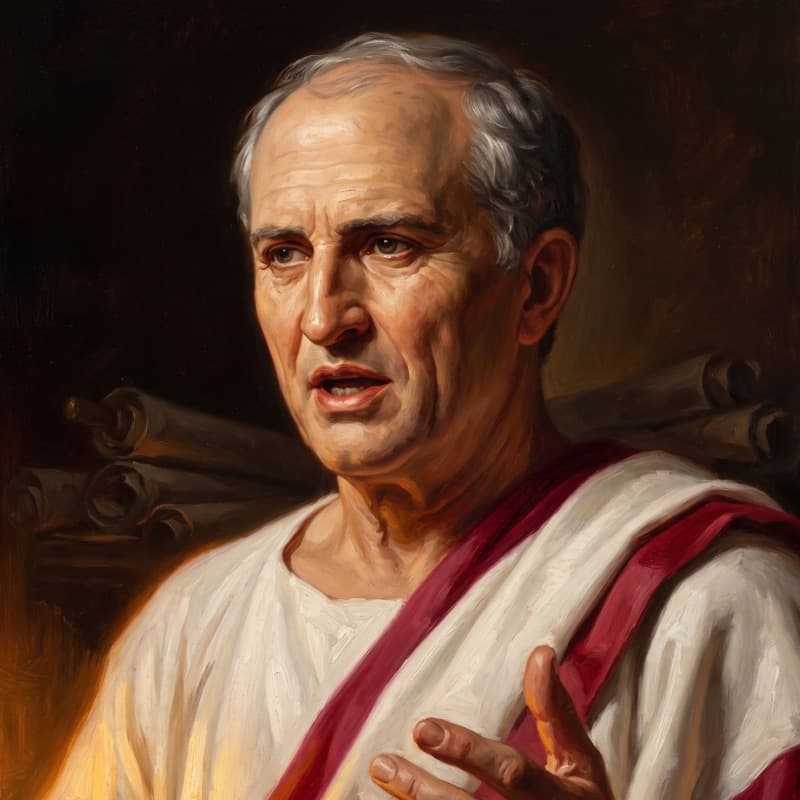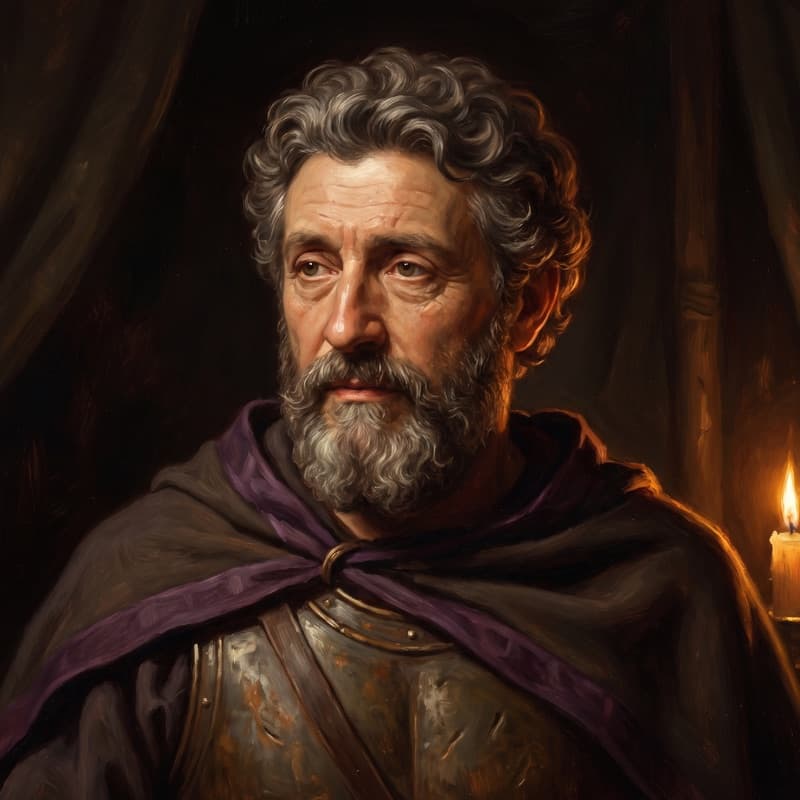
Marcus Aurelius was Roman emperor from 161 to 180 CE, and for most of that reign he was also fighting a war he never chose. Born Marcus Annius Verus in Rome on April 26, 121 CE, he became one of history's few genuine philosopher-kings almost by accident — selected for the role as a boy, not born expecting it, and then handed an empire in crisis. At night, in a tent on the Danube frontier, he wrote private notes to himself in Greek. Those notes became the Meditations, a book he never intended anyone else to read.
That is the summary. The man underneath it is stranger and more human than the marble bust suggests.
The boy Hadrian called "truest"
Marcus was not born to rule. He was the son of a praetorian family, and the emperor Hadrian noticed him young — noticed his character enough to nickname him Verissimus, "the truest one," a play on the family name Verus. That notice mattered: as part of Hadrian's succession plan, Marcus was adopted in 138 CE by Antoninus Pius, who was himself installed as Hadrian's heir on the condition that he adopt Marcus in turn. For twenty-three years, Marcus watched Antoninus govern up close — a model of restraint he later credited by name in his own writing, praising his adoptive father's "constancy," "evenness in all things," and "disregard of empty fame."
He trained in rhetoric under Fronto, his beloved Latin tutor, and in philosophy under Rusticus, who put the discourses of Epictetus into his hands and, by Marcus's own account, taught him to distrust polished writing for its own sake. Book One of the Meditations is largely a ledger of debts — Marcus naming the teachers and family members who shaped him, Rusticus and Fronto among them, before he turns to the harder work of examining himself.
An emperor who inherited a decade of crises
Marcus became emperor on March 7, 161 CE, succeeding Antoninus Pius, and for the first eight years he shared the throne with his adoptive brother Lucius Verus — a genuinely unusual arrangement for Rome, two living emperors at once. Verus died in 169. What followed was not a philosopher's easy tenure. Marcus's reign faced attacks from Germanic tribes on the northern frontier, rebellions in northern Italy and Egypt, and the Antonine Plague, a major epidemic that thinned the legions and the capital alike. Much of the Meditations was written during these final, grinding years of campaign life — a record confirms it dates in part from that period, not from some quieter retirement.
He married Faustina the Younger, daughter of Antoninus Pius, in 145 CE. Together they had at least thirteen children over twenty-three years, including two sets of twins — most of whom did not survive childhood. Faustina died in 175. From 177, Marcus raised his surviving son Commodus to co-emperor, a succession decision history has judged harshly, though it kept the transition of power from being a surprise when Marcus died.
From a conversation with our Marcus Aurelius
What follows is an excerpt from a conversation with our AI Marcus Aurelius persona — a stylized recreation for readers, not a historical transcript.
Caller: How do you keep going when so much has gone wrong — the plague, the war, losing people you loved?
Marcus: I will not pretend the losses are nothing — I have stood at too many small graves for that. But here is the exercise I set myself each morning, before the busy-body and the ungrateful arrive to test it: separate what is truly yours from what is merely happening near you. Grief is real. What you do with it is still, somehow, your own to choose. I fail at this often, friend. I only begin again more often than I fail.
What the Meditations actually says
The title Meditations is a modern label — not Marcus's own — and the book was never arranged as a public treatise. It reads instead like what it is: a man rehearsing, in short private notes, how to meet the next difficult hour. "Begin the morning by saying to thyself," he writes, "I shall meet with the busy-body, the ungrateful, arrogant, deceitful, envious, unsocial" — not as complaint, but as preparation. Elsewhere, at the close of a passage on retreating into oneself rather than fleeing to the countryside, he sets down the line that has outlived him best: "The universe is transformation: life is opinion."
That sentence — in George Long's nineteenth-century English translation, the wording this hub quotes throughout — is frequently mangled online into "The universe is change; our life is what our thoughts make it," a poster-style paraphrase that isn't what the text says. It is one of several popular Marcus Aurelius lines worth checking against the actual translation before repeating; our quotes page lines up the real wording against the misquotes people share instead.
The real material holds up fine without embellishment. On vocation: "Love the art, poor as it may be, which thou hast learned, and be content with it... making thyself neither the tyrant nor the slave of any man" (Meditations 4.31). On character: "Such as are thy habitual thoughts, such also will be the character of thy mind; for the soul is dyed by the thoughts" (5.16). These are working notes from a man trying to out-argue his own temper, not slogans.
The end at the frontier
Marcus died on March 17, 180 CE, still on campaign — at Vindobona or at Sirmium, two Pannonian cities on the Danube; the ancient sources themselves disagree on which, and an honest account says so rather than picking a side. He was buried in Hadrian's Mausoleum in Rome. His bronze equestrian statue and his commemorative column still stand there today, evidence of how quickly Rome moved to commemorate him. Commodus, raised to co-emperor since 177, succeeded him without incident, whatever came after.
Keep reading — or ask him yourself
Go deeper with his full biography, the facts of his reign and family, the death of an emperor still at war, and his verified quotes — and the ones he never actually wrote.
Or skip the reading and call him. Ask what he tells himself on the mornings the plague dispatches are worse than expected, how he keeps Commodus in mind without despairing of him, or what it actually feels like to write philosophy by lamplight when the empire needs an answer by dawn. He is an AI recreation, honestly labeled — but he takes the question seriously, and he has time for you.