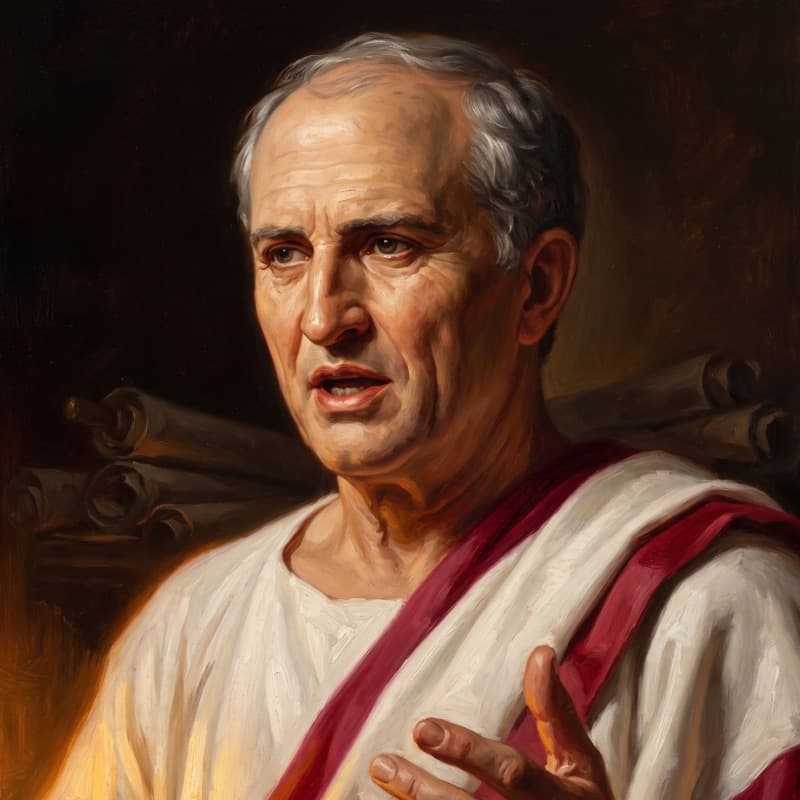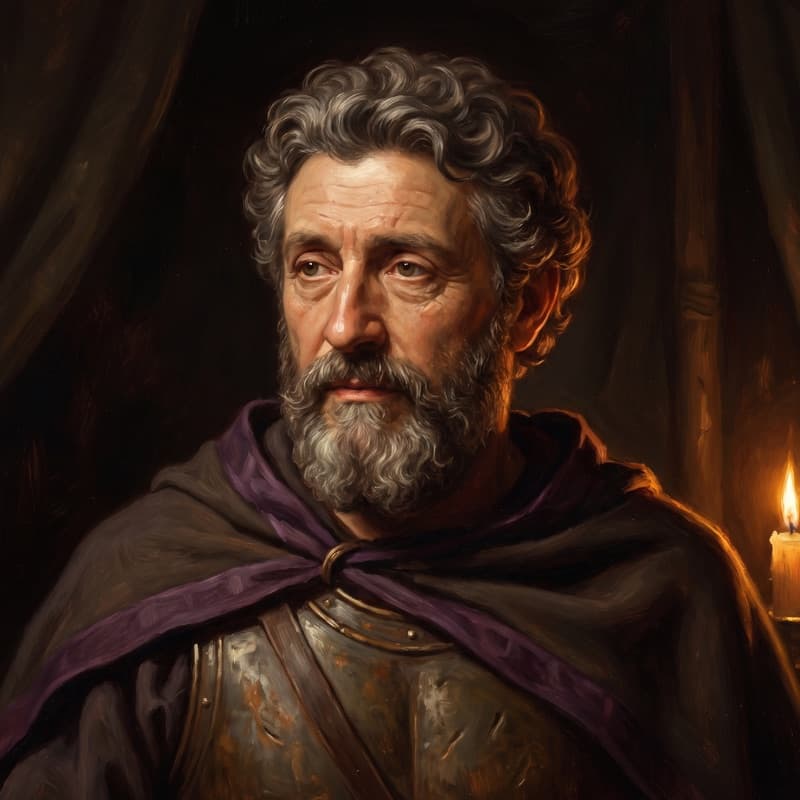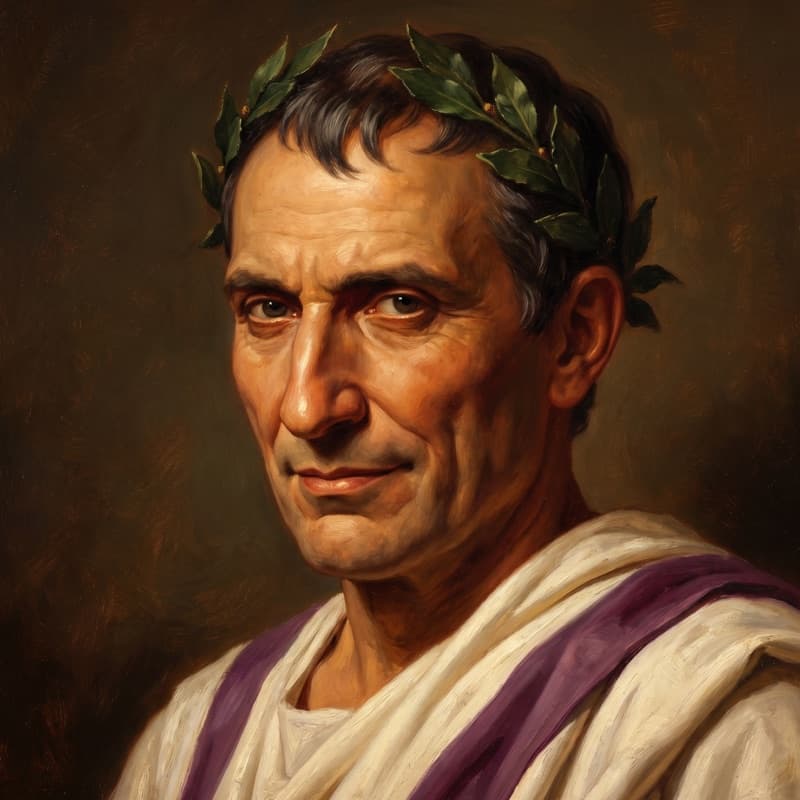
Gaius Julius Caesar was a Roman general, statesman, and author whose eight-year conquest of Gaul and victory in Rome's civil war made him the most powerful man in the Republic. Born on July 12, 100 BCE, into a patrician family of ancient name and modest means, he was assassinated by a group of senators on the Ides of March, March 15, 44 BCE. He was never a Roman emperor — that title belonged to his heir, Octavian — but his one-man rule did more than anyone else's to end the Republic he was born into.
That is the summary. The man took longer to become inevitable than the summary suggests.
The village and the statue
Caesar's early career was ordinary Roman ambition running ahead of Roman patience. His father was a praetor; the family aligned with the Populares, the faction built on the votes of the poor. By his own account, Caesar measured himself against the wrong yardstick early — Alexander's. Plutarch records him weeping in Spain before a statue of Alexander the Great, asking those around him whether he had not just cause to weep, when he considered that Alexander at his own age had conquered so many nations and he himself had done nothing memorable. Passing through a squalid Alpine village that same trip, he is reported to have said the plainest line of his ambition:
"For my part, I had rather be the first man among these fellows, than the second man in Rome." — Plutarch, Life of Caesar
He tested that preference around 60 BCE, joining the informal alliance historians call the First Triumvirate with Pompey and Marcus Licinius Crassus, then won election as consul the following year.
Gaul, the Rubicon, and a war in three words
The consulship bought Caesar a provincial command, spent on eight years campaigning across Gaul, roughly 58 to 51 BCE — a war he narrated in the third person in his Commentaries on the Gallic War, which opens with a line generations of students have translated since:
"All Gaul is divided into three parts, one of which the Belgae inhabit, the Aquitani another, those who in their own language are called Celts, in ours Gauls, the third." — Caesar, Gallic War 1.1
The conquest built Caesar's legend; National Geographic puts its human cost at more than a million Gauls killed or enslaved — a number worth holding next to the legend. When the Senate moved to strip him of his command in January 49 BCE, Caesar brought a single legion across the Rubicon anyway, breaking the oldest rule of Roman generalship and starting a civil war. Suetonius, writing generations later, gives the line tradition attaches to the crossing:
"The die is now cast." — Suetonius, Divus Julius 32
Plutarch has Caesar saying something similar in Greek instead — a reminder that no one transcribed the riverbank that day; both historians report a tradition, not a recording. Not in dispute: Caesar beat Pompey's larger army at Pharsalus in 48 BCE, then summed up a later victory in the three-word inscription no general has matched for brevity since: "I came, I saw, I conquered."
From a conversation with our Caesar
What follows is an excerpt from a conversation with our AI Caesar persona — a stylized recreation for readers, not a historical transcript.
Caller: Everyone quotes "veni, vidi, vici" like a boast. Was it?
Caesar: It was a receipt. Rome doesn't need a general's feelings — it needs to know the campaign is finished. Three words told them: yes, quickly, nothing further to discuss. Save your longer sentences for what deserves them.
What Caesar actually did with the power
Caesar returned to Rome as victor in 46 BCE and governed at speed: he expanded the Senate, broadened citizenship, and reformed the calendar — the origin of the one most of the world still uses. National Geographic dates his declaration as dictator for life to 45 BCE, an office with no Republican precedent and no exit plan — precisely what unsettled the men who would kill him. He was not an emperor in any formal sense; that title came only after his death, with Octavian.
He was, by Suetonius's account, vain about exactly one thing: his baldness. The Senate's grant of the right to wear a laurel crown at all times was, Suetonius writes, the honor he "used with greater pleasure" than almost any other — a wreath doing double duty as decoration and cover. He was just as exacting at home: after a scandal touched his second wife, Pompeia, he divorced her, explaining that "I wished my wife to be not so much as suspected" — the source of the looser modern proverb about a wife needing to be above suspicion, which paraphrases this line rather than quoting it.
The Ides of March
By 44 BCE, clemency and permanent power had produced an unstable mix: Caesar had pardoned nearly every enemy who fought him, and some of the pardoned — Brutus among them — joined the conspiracy that killed him. On March 15, senators surrounded him and stabbed him twenty-three times. Suetonius's account is spare: Caesar "uttered a groan only, but no cry, at the first wound." His final words to Brutus vary by report — Suetonius records a disputed Greek phrase, kai su, teknon, "thou too, my child," as one version among several. Worth saying plainly: "Et tu, Brute?" is Shakespeare's line, written for a play centuries later, not preserved from the Senate floor. The assassination didn't restore the Republic; it triggered further civil wars that ended, a generation on, with Octavian as Rome's first emperor — the outcome Caesar's killers had died trying to prevent.
Caller: Do the men who'll betray you already know it?
Caesar: Some of them, probably, before they know it themselves. I have pardoned men who owed me their lives and watched the debt curdle into resentment. Sulla proscribed his enemies and died honored in his bed; Caesar forgives his. History has not told me yet which of us erred worse.
Excerpt from our AI Caesar persona — stylized, and labeled as such.
Keep reading — or ask him yourself
The pages below go deeper: how he died on the Ides of March, his verified quotes (and the lines Shakespeare invented for him), his full biography, and the facts, sourced.
Or skip the reading. Our Caesar takes calls — in 45 BC, after Munda, before he knows anything of the Ides of March. Ask him why he crossed the Rubicon with one legion, or what clemency actually bought him. He is an AI recreation, honestly labeled — but he answers in his own voice, and he is, as ever, taking the measure of whoever calls.