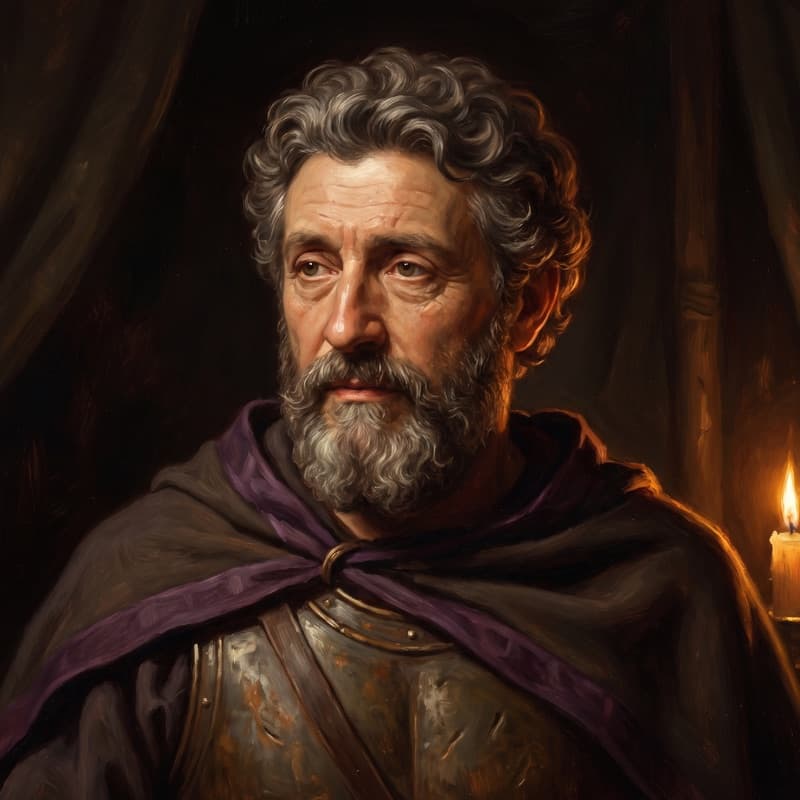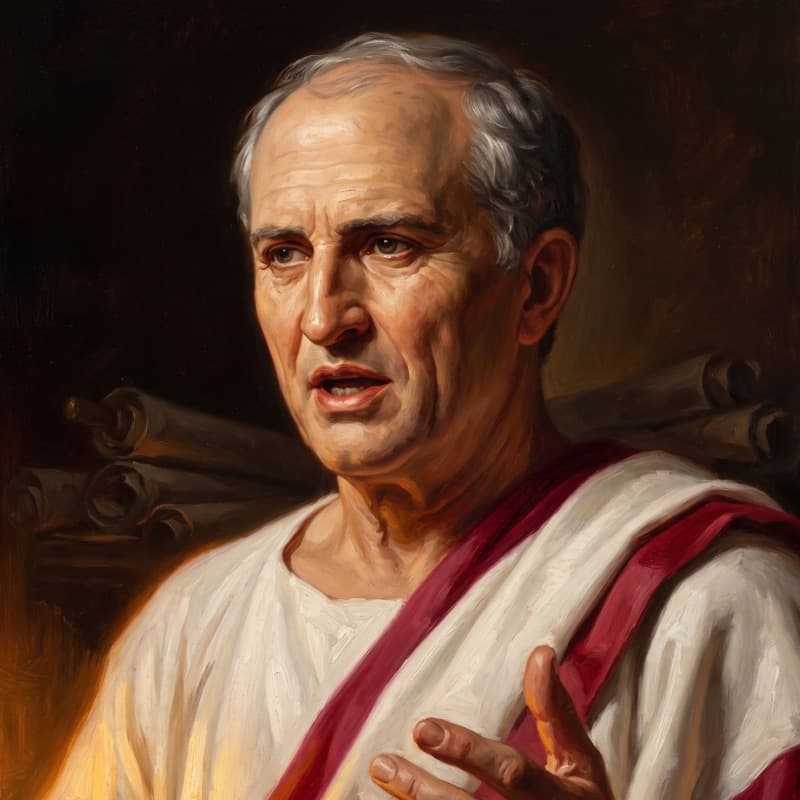
Marcus Tullius Cicero was born on January 3, 106 BC, in the hill town of Arpinum, into a wealthy equestrian family with no senatorial ancestry at all. He talked his way into the consulship anyway — the Republic's highest office — exposed the Catiline conspiracy in 63 BC, was exiled for it, came back to a hero's welcome, buried a daughter, wrote some of the most influential philosophy in the Latin language, and picked a public fight with Mark Antony that got him killed on December 7, 43 BC, at 63 years old.
That is the summary. The man is more interesting than the summary.
The new man who out-talked the nobility
Cicero had no family name to trade on. He was a "new man" — novus homo — trained in law, rhetoric, and Greek philosophy, who built his reputation the only way available to someone without a consul among his ancestors: in court. A defense of Sextus Roscius in 80 BC made people notice him; prosecuting the corrupt governor Gaius Verres in 70 BC made him famous — Verres reportedly fled before Cicero finished the case. The offices followed in order: quaestor in Sicily in 75 BC, praetor in 66 BC, consul in 63 BC — a rung men of his birth weren't supposed to reach.
Consul in 63 BC: the conspiracy he talked to death
Cicero's consular year is the hour he never stopped mentioning, and for good reason. He uncovered Lucius Sergius Catilina's plot to overthrow the government, denounced it to the Senate in the Catilinarian orations, and backed the execution of the captured conspirators without a trial. In the first of those speeches, with Catiline reportedly sitting in the chamber, he let fly one of the most quoted lines to survive from Roman politics:
"O tempora, o mores!" — In Catilinam 1.2, Latin text
Loosely, "Oh, the times! Oh, the customs!" — Cicero's exasperation that the Senate can see the plot and still the man sits there, unchecked. The executions saved the Republic from the conspiracy. They also handed Cicero's enemies the charge that would eventually break him: a citizen died without trial, on his order.
From a conversation with our Cicero
What follows is a stylized excerpt from a conversation with our AI Cicero persona — a recreation for readers, not a historical transcript.
Caller: Do you ever get tired of bringing up your consulship?
Cicero: Tired of it? My friend, I built a career on knowing when to stop talking, and I have chosen never to apply that skill to the subject of 63 BC. I saved the Republic with a speech and a vote — no legion, no blood on my own hands, only the facts arranged in their proper order. A man who did that is entitled to mention it. Once or twice a conversation, perhaps twice.
Exile, return, and a grief philosophy couldn't fix
The Catiline executions came back for him. In 58 BC, the tribune Publius Clodius Pulcher passed a law aimed squarely at Cicero for putting citizens to death without trial; his house on the Palatine was demolished, and Cicero went into exile, reaching Thessalonica by late May. He returned the following year, landing at Brundisium on August 5, 57 BC, to a welcome loud enough to erase some of the shame of having left — though not, by his own account, the wound of it.
The deeper grief came later. His daughter Tullia died in February 45 BC, weeks after childbirth, and it broke something in him that public triumph never had. Out of that grief — and out of watching the Republic collapse around Caesar's rise and murder — came a burst of philosophical writing in 45 and 44 BC: the Tusculan Disputations, De Officiis, Laelius de Amicitia (On Friendship), and De Senectute (On Old Age), works that rendered Greek philosophy into Latin prose so influential it shaped Western ethics for two thousand years.
Those books are also where Cicero sounds most like himself in English. On friendship: "In the face of a true friend a man sees as it were a second self" (On Friendship §7, trans. Shuckburgh). On the value of learning: "These studies are the food of youth, the delight of old age; the ornament of prosperity, the refuge and comfort of adversity" (Pro Archia §16). On mortality, from the Tusculan Disputations: "the whole life of a philosopher is... a meditation on death" (Book 1, §74, trans. Yonge) — the real line behind the looser modern paraphrase "to philosophize is to learn how to die," which owes more to Montaigne's riff on Cicero than to Cicero himself.
Two cautions worth stating plainly: "A nation can survive its fools, and even the ambitious — but it cannot survive treason from within" has no ancient source; PolitiFact traced it to a modern fabrication. And "the budget should be balanced, the treasury refilled" comes from a 1965 novel, Taylor Caldwell's A Pillar of Iron — the University of Texas's Cicero project traced it. Neither belongs to him.
The last fight, and the price of it
After Caesar's assassination in 44 BC, Cicero threw the last of his authority against Mark Antony, delivering fourteen speeches — the Philippics — modeled on Demosthenes's orations against tyranny. He knew the risk. The Second Triumvirate of Octavian, Antony, and Lepidus placed him on its proscription list, and on December 7, 43 BC, he was caught leaving his villa at Formiae by litter, trying to reach the coast, and was killed there. His hands and head — the hands that wrote the Philippics, the head that spoke them — were displayed on the Rostra in the Forum, on Antony's order.
He never claimed a soldier's physical courage. His battlefield, from the defense of Roscius to the last Philippic, was always the Forum — and he was never once routed there while he lived.
Caller: Weren't you afraid, at the end?
Cicero: Afraid is a small word for it, and I am too old a lawyer to insult you with one. I was afraid, and I wrote anyway — a Republic is only as brave as the citizens willing to speak for it. I defended her as a young man. I did not intend to desert her as an old one.
Excerpt from our AI Cicero persona — stylized, and labeled as such.
Keep reading — or ask him yourself
Go deeper on his death and the proscriptions, his verified quotes — and the ones he never said, his full biography, and the facts, sourced.
Or skip the reading and call him. Ask our Cicero how he'd build an argument from your facts, what cui bono means when someone wrongs you, or whether the advantageous can ever truly be separated from the honorable. He is an AI recreation, honestly labeled — but he has never once, in two thousand years, run out of things to say.