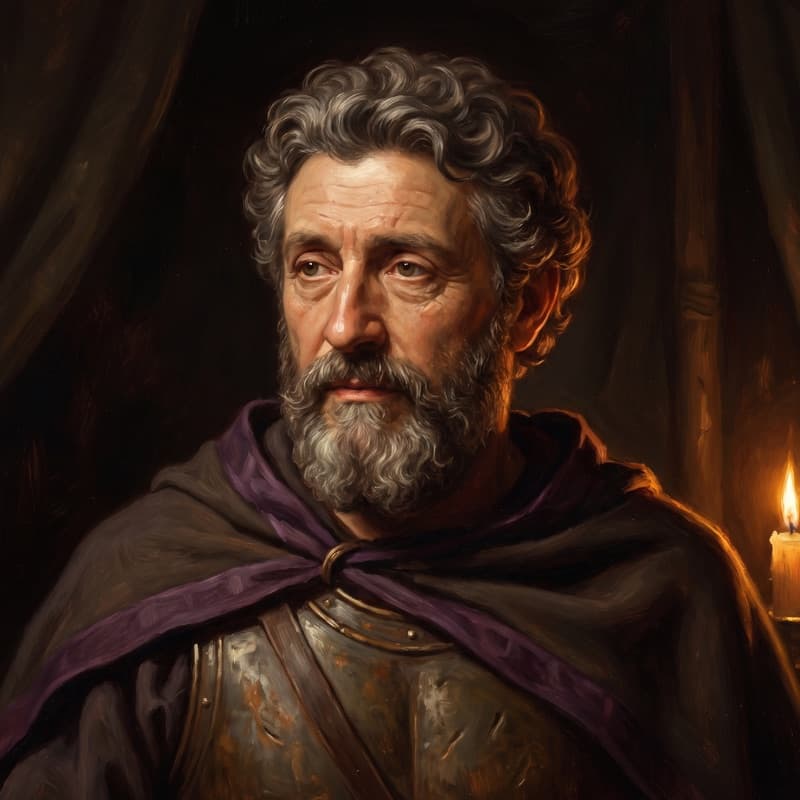
Marcus Aurelius never meant for any of this to be read. The Meditations were private Greek notes an emperor wrote to himself, mostly during military campaigns on the northern frontier — not a book, not a speech, not advice for anyone else. That makes the wording fragile: every English sentence below passes through a translator, and the version most people repeat online has often drifted from what the translator actually wrote. Here are the verified lines, in George Long's nineteenth-century translation, by book and section — and the popular "Marcus quotes" that don't match any of them.
The morning discipline
Marcus opens Book Two by rehearsing, before the day starts, exactly the kind of people he is about to deal with:
"Begin the morning by saying to thyself, I shall meet with the busy-body, the ungrateful, arrogant, deceitful, envious, unsocial." — Meditations 2.1
A few sections later, he gives himself the reason any of it matters at all:
"Since it is possible that thou mayest depart from life this very moment, regulate every act and thought accordingly." — Meditations 2.11
Judgment is the whole game
Marcus returns constantly to one idea: the world doesn't harm you, your opinion of the world does. Book Four states it as bluntly as he ever does:
"The universe is transformation: life is opinion." — Meditations 4.3
And he works the same claim into a piece of practical advice a few sections later:
"Take away thy opinion, and then there is taken away the complaint, 'I have been harmed.' Take away the complaint, 'I have been harmed,' and the harm is taken away." — Meditations 4.7
Book Eight restates it as a small dialogue with himself:
"If thou takest away thy opinion about that which appears to give thee pain, thou thyself standest in perfect security.—Who is this self?—The reason." — Meditations 8.40
Character, obstacles, and vocation
On what habitual thinking does to a person:
"Such as are thy habitual thoughts, such also will be the character of thy mind; for the soul is dyed by the thoughts." — Meditations 5.16
A few sections on, the line that modern "obstacle is the way" framings borrow from without citing:
"...the mind converts and changes every hindrance to its activity into an aid; and so that which is a hindrance is made a furtherance to an act; and that which is an obstacle on the road helps us on this road." — Meditations 5.20
And on doing modest work without either lording it over people or groveling to them:
"Love the art, poor as it may be, which thou hast learned, and be content with it; and pass through the rest of life like one who has intrusted to the gods with his whole soul all that he has, making thyself neither the tyrant nor the slave of any man." — Meditations 4.31
On his teacher, not just to himself
Most of the Meditations is Marcus addressing his own conduct. Book Six's tribute to his adoptive father, Antoninus Pius, is the rarer thing — Marcus describing a specific person he admired, in specific terms:
"Remember his constancy in every act which was conformable to reason, and his evenness in all things, and his piety, and the serenity of his countenance, and his sweetness, and his disregard of empty fame..." — Meditations 6.30
It reads like a private definition of the kind of ruler he was trying to become.
Stop talking about it
Book Ten collapses years of Stoic argument into one sentence:
"No longer talk at all about the kind of man that a good man ought to be, but be such." — Meditations 10.16
Forward, not resigned
The closer, from the opening of Book Twelve, is the least fatalistic-sounding line in the set — worth ending on precisely because Marcus is so often read as pure resignation:
"All those things at which thou wishest to arrive by a circuitous road thou canst have now, if thou dost not refuse them to thyself." — Meditations 12.1
Quotes Marcus never wrote this way
All of the lines above are George Long's translation, checked against two independent digitized editions — the MIT Internet Classics Archive and Wikisource — so the book and section numbers can be trusted. The popular versions below are not that:
- "The universe is change; our life is what our thoughts make it." A poster-style combination and rewording of the real 4.3 sentence above ("The universe is transformation: life is opinion."). Put the two side by side and the difference is obvious — but only if you have the real one to compare against.
- "The happiness of your life depends upon the quality of your thoughts." A smoothed-out modern paraphrase of the 5.16 idea, not Long's sentence.
- "You have power over your mind — not outside events. Realize this, and you will find strength." A popular modern-English rendering with no single Long sentence behind it. Don't quote it as a translation of anything specific.
- "Waste no more time arguing what a good man should be. Be one." A condensed modern rewrite of Meditations 10.16. If you want the line in its verbatim, sourced form, use the real one above: "No longer talk at all about the kind of man that a good man ought to be, but be such."
Notice what the real quotes share that the fakes don't: they're arguments Marcus was making to himself, mid-thought, usually followed by a "why" — not free-standing maxims built for a poster.
From a conversation with our Marcus
An excerpt from our AI Marcus persona — a stylized recreation, clearly labeled; not a historical quotation.
Caller: Did you actually believe the things you wrote to yourself, or were you just trying to?
Marcus: Both, friend, most mornings. I wrote "meet the ungrateful and the deceitful" not because I had mastered meeting them but because by evening I generally had not. The page doesn't record a settled man. It records a man arguing with the same complaint every few months, in slightly different words, hoping one phrasing would finally take. Some of them did last a week. That was a good week.
Hear him argue it out
Our Marcus — an AI recreation of the man, honestly labeled — works through the same material out loud: why judgment, not circumstance, is where he insists the real fight happens, what he actually meant by treating an obstacle as fuel, and what he owed the man whose habits he tried to inherit. Ask him about any line above and he'll tell you which campaign or which bad morning it came from.
More in this cluster: Marcus Aurelius hub · his death · biography · facts.