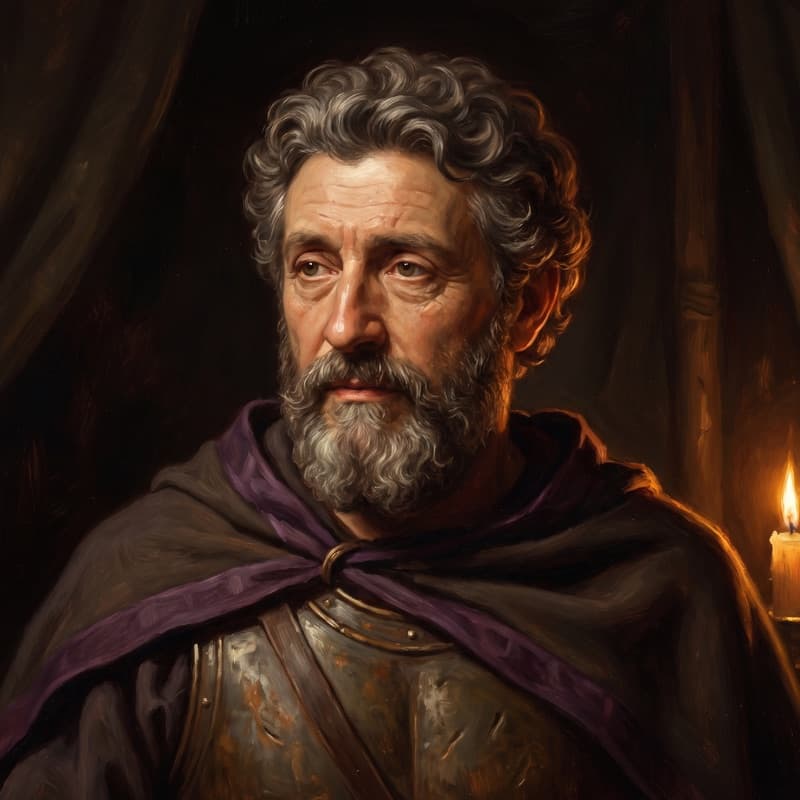
The essential Marcus Aurelius facts: he was born in Rome on April 26, 121 CE, and died on March 17, 180 CE, still on campaign at the Danube frontier; his birth name was Marcus Annius Verus, and the emperor Hadrian nicknamed him Verissimus ("the truest") for his character; he had at least thirteen children with his wife Faustina the Younger, including two sets of twins; he was one of two Roman emperors sharing the throne, not once but twice — first with Lucius Verus, later with his own son Commodus; and the book we call the Meditations was private notes he never meant to publish. All verified. This page gives you the facts worth keeping — and flags the popular "facts" that don't survive checking, because a facts page that can't tell you what's false is only doing half the job.
The core facts, with why they matter
Born in Rome on April 26, 121 CE; died March 17, 180 CE. Not born in Spain, despite a claim you'll still find repeated online — that confusion likely traces to his father's family, who were of Baetican (Spanish) origin, not to Marcus's own birthplace.
His birth name was Marcus Annius Verus, and Hadrian gave him the nickname Verissimus. "The truest one" was a play on the family name Verus, and Hadrian meant it as a genuine compliment to the boy's character, years before anyone knew he'd rule an empire.
He had at least thirteen children with Faustina the Younger, including two sets of twins. Most people picture a solitary Stoic scribbling by lamplight; the record shows a large, crowded household spanning twenty-three years of marriage, with more grief in it than the marble bust suggests.
Rome briefly had two living emperors — twice in his lifetime. Marcus co-ruled first with his adoptive brother Lucius Verus (161–169), then with his own son Commodus (177–180). The arrangement was unusual even by Roman standards and matters for reading his reign correctly: he was rarely the sole decision-maker people assume.
The Meditations was never meant for publication. Marcus wrote it to and for himself, mostly in the field during his final military campaigns. The familiar title is a modern editorial choice — not his own — and the book reads like private rehearsal, not a treatise written for an audience.
Book One is essentially a gratitude list. Before turning to self-examination, Marcus names the teachers and family members who shaped him — including his rhetoric tutor Fronto and the Stoic teacher Rusticus, who put Epictetus's discourses in his hands.
His bronze equestrian statue and commemorative column still stand in Rome. Both were erected to celebrate his military victories and remain visible today — a fact worth handing to anyone who thinks ancient history is only in books.
From a conversation with our Marcus Aurelius
What follows is an excerpt from a conversation with our AI Marcus Aurelius persona — a stylized recreation for readers, not a historical transcript.
Caller: What's the one fact about you people get wrong most often?
Marcus: That I sat apart from my own life to write those notes — some quiet philosopher above the mess. I wrote them in a tent, between dispatches about the plague and the frontier, with a household of children behind me and half of them already in the ground. The notes were not composed at a distance from the trouble. They were how I stayed inside it.
Popular "facts" that need correcting
"He died peacefully in Rome, the retired philosopher-emperor." Not so. Marcus died mid-campaign on the Danube frontier, at either Vindobona or Sirmium — the ancient sources themselves disagree on which city, so any confident single answer overstates the evidence.
"Waste no more time arguing what a good man should be. Be one." A popular condensed paraphrase, not Marcus's actual wording. The real translated line, from Meditations 10.16: "No longer talk at all about the kind of man that a good man ought to be, but be such."
"The universe is change; our life is what our thoughts make it." Another poster-style alteration. The verified translated sentence, from Meditations 4.3, is: "The universe is transformation: life is opinion." A handful of other popular Marcus Aurelius lines don't hold up either — the full comparison lives on our quotes page.
Five things Marcus Aurelius did (the honest short list)
- Became Roman emperor in 161 CE, succeeding his adoptive father Antoninus Pius.
- Co-ruled with Lucius Verus in an unusual two-emperor arrangement (161–169).
- Led Rome through Germanic frontier wars, rebellions, and the Antonine Plague.
- Wrote the private Stoic notes now published as the Meditations.
- Raised his son Commodus to co-emperor in 177, before his death in 180.
The fact pages can't hold him
Facts are the skeleton; the voice is the man. Our Marcus Aurelius — an AI recreation, built from the sourced record and labeled as what it is — can tell you about the boy Hadrian singled out, the model of restraint he watched in Antoninus Pius for twenty-three years, and what it actually took to keep governing through plague, war, and a house full of grief. Ask him how he tells the difference, most mornings, between what is his to control and what isn't. He's ready when you are.
More in this cluster: Marcus Aurelius hub · his death at the frontier · verified quotes · full biography.