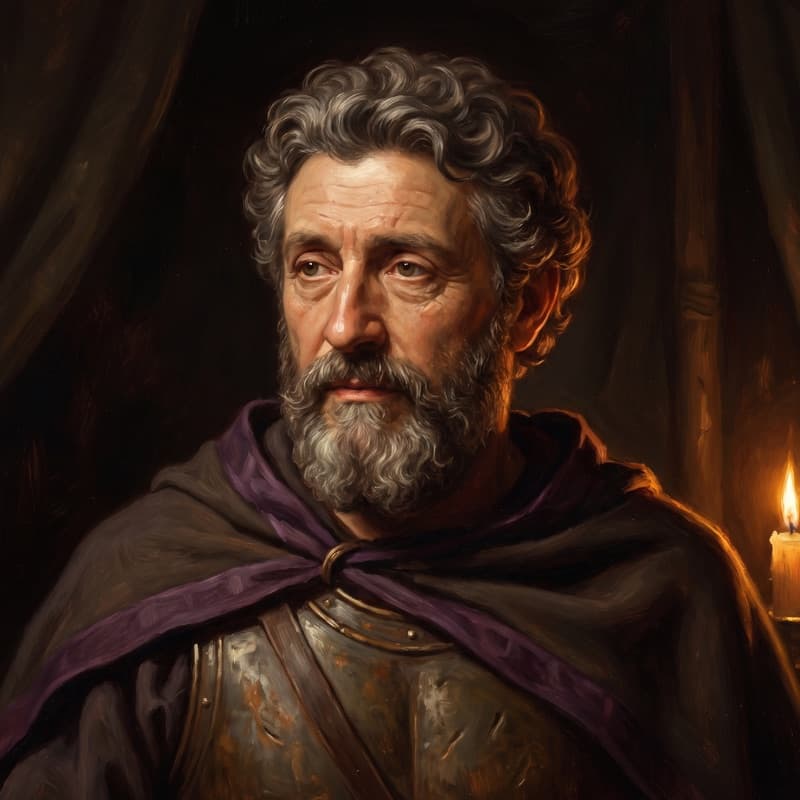
Marcus Aurelius was born in Rome on 26 April 121 CE under the name Marcus Annius Verus. He died on 17 March 180 CE, after nineteen years as Roman emperor — a reign spent almost entirely managing frontier war, rebellion, and plague, while privately drafting the Greek notebook later published as the Meditations. He was not the serene philosopher who happened to rule an empire; he was a man governing through crisis, rehearsing on paper how to bear it.
Verissimus
Hadrian took an interest in the boy's character rather than his birth, and nicknamed him "Verissimus" — "the truest," playing on the family name Verus. Marcus was not born into the succession; he was noticed and selected into it. He trained extensively in rhetoric and philosophy, and Stoicism became the chief influence on how he thought a life should be run. In 138 CE, under Hadrian's succession arrangement, he was adopted by Antoninus Pius and became his heir, spending the next twenty-three years watching Antoninus govern at close range — restrained, unspectacular rule Marcus later credited directly, naming his adoptive father's constancy, evenness, and disregard of empty fame among the qualities he tried to absorb.
Marriage and a house full of grief
In 145 CE Marcus married Faustina the Younger, daughter of Antoninus Pius. Over the following twenty-three years Faustina bore at least thirteen children, including two sets of twins, beginning with a daughter, Domitia Faustina, in November 147. Most of those children did not survive. That fact sits directly behind the notebook he kept: a man rehearsing how to meet loss without being undone by it was not solving an abstract problem — he was describing his own household.
Emperor amid crisis
Marcus became emperor on 7 March 161 CE, succeeding Antoninus Pius, and initially shared rule with Lucius Verus until Verus's death in 169 — an unusual arrangement of two emperors governing jointly. What followed was not the calm reign later imagination assigns him: attacks from Germanic tribes on the northern frontier, rebellions in northern Italy and Egypt, and a major outbreak of plague ran through his years in power. Faustina died in 175, in the middle of this run of crises. From 177, Marcus raised his surviving son Commodus to co-emperor — a decision history has judged harshly given what followed, though within his own reign it was simply the next act of an emperor trying to secure an uncertain future.
Notes to himself
Against the campaigns and the funerals sits the other half of the man: private Greek notes, written to and for himself, never intended for publication and never carrying a title of his own choosing — Meditations is a modern label, not his. At least part of it was composed during the final years of his campaigns, in an army camp rather than a philosopher's study. Book 1 opens as a plain accounting of debts owed — named teachers and family, including Rusticus and his rhetoric tutor Fronto, credited for shaping his character.
From a conversation with our Marcus Aurelius
An excerpt from a conversation with our AI Marcus Aurelius persona — a stylized recreation, honestly labeled; not a historical quotation.
Caller: Did the philosophy actually help, in the middle of a war?
Marcus: Help is a strange word for it. It did not stop the frontier from needing men, or the plague from taking them anyway. What it gave me was somewhere to put the fear each morning before the reports arrived — a page instead of a person.
Continue the conversation
You have just read the recorded life. Our Marcus Aurelius — an AI recreation, built on the sourced record and labeled as what it is — speaks from inside it. Ask him about watching Antoninus Pius govern before he held the office himself, what it meant to write in Greek at night in an army camp, about Faustina, or about raising a son toward a throne he could not guarantee the boy was ready for.
More in this cluster: Marcus Aurelius hub · his death · verified quotes · facts.