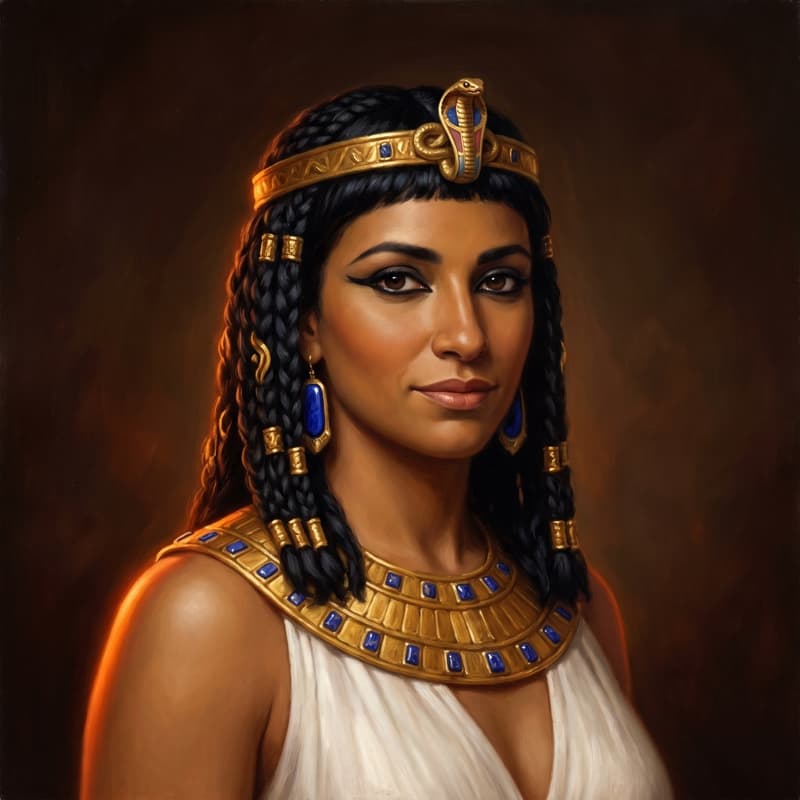
Cleopatra VII was queen of the Ptolemaic Kingdom of Egypt from 51 to 30 BC — the last person to rule an independent Egypt for the next two thousand years. Born in late 70 or early 69 BC in Alexandria to Ptolemy XII Auletes, she inherited a Macedonian Greek dynasty three centuries old, survived a civil war against her own brother, and kept the richest kingdom in the Mediterranean out of Rome's hands through alliances with Julius Caesar and Mark Antony. She died in Alexandria on 10 or 12 August 30 BC, after Octavian's forces took the city, and Rome annexed Egypt at once.
That is the summary. The sources are where it gets interesting — because almost everything vivid you have heard about Cleopatra was written by Greek and Roman men, decades to centuries after she died.
The queen the sources actually describe
Start with what Plutarch — writing around AD 100, roughly a century and a half after her death — says about her in the Life of Antony. It is not the femme fatale of the movies. Her beauty, he reports, "was in itself not altogether incomparable." What made her dangerous was conversation:
"her tongue, like an instrument of many strings, she could readily turn to whatever language she pleased" — Plutarch, Life of Antony, ch. 27
Plutarch adds that she rarely needed an interpreter with foreign envoys — remarkable in a dynasty whose kings, for three hundred years, had not troubled to learn Egyptian. Treat this as what it is: an ancient historian's report, not a contemporary record, and treat the popular "nine languages" count as tradition rather than documented fact. But it is the report of a hostile tradition conceding that her real weapon was her mind.
Statecraft, not seduction
Her career reads like a survival manual. She acceded jointly with her younger brother Ptolemy XIII in 51 BC, in the nominal sibling marriage the Ptolemies used for succession; his faction drove her out of Alexandria within three years. She came back in 48 BC by recruiting the most powerful man alive — Julius Caesar — to her side of the civil war. After Ptolemy XIII died in the fighting in 47 BC, she ruled again, bore Caesar a son, Caesarion, and spent time in Rome while Caesar lived.
After his assassination in 44 BC she took the measure of his successors and chose Mark Antony. Their meeting at Tarsus in 41 BC produced the most famous entrance in ancient history — Plutarch describes her sailing "up the river Cydnus in a barge with gilded poop, its sails spread purple, its rowers urging it on with silver oars" (Life of Antony, ch. 26). The spectacle worked. The alliance restored former Ptolemaic territory to her rule, gave her three more children, and in 34 BC — after Antony's Armenian campaign — she was proclaimed "queen of kings" in Alexandria and presented herself as the goddess Isis.
From a conversation with our Cleopatra
What follows is an excerpt from a conversation with our AI Cleopatra persona — a stylized recreation for readers, not a historical quotation. She speaks from 41 BC, at the height of her power.
Caller: The barge at Tarsus — purple sails, silver oars. Wasn't that a bit much?
Cleopatra: A bit much is precisely the correct amount, when a Roman summons a queen as though she were a defendant. Antony expected a suppliant; I sent him a goddess arriving at her leisure, and by evening he was accepting invitations to my table. Understand this and you understand statecraft: the barge cost less than one legion, and accomplished more. Rome respects only two things — force and spectacle — and spectacle is cheaper.
Did she really say that? Mostly, we can't know
Here is the honest problem with every Cleopatra quote page on the internet: no verbatim words of Cleopatra survive in her own voice. Everything she "said" comes to us as reported speech in later historians — chiefly Plutarch, and Cassius Dio writing two full centuries after her death. The liveliest of these is her teasing of Antony, who had a diver secretly hang a catch on his fishing hook to impress her:
"Imperator, hand over thy fishing-rod to the fishermen of Pharos and Canopus; thy sport is the hunting of cities, realms, and continents." — reported by Plutarch, Life of Antony, ch. 29
And the single most famous "Cleopatra quote" — "Age cannot wither her, nor custom stale her infinite variety" — is not hers at all. It is spoken about her by the character Enobarbus in Shakespeare's Antony and Cleopatra, written around 1607 (Folger Shakespeare Library, Act 2, Scene 2). Wrong speaker, wrong millennium.
The death nobody actually witnessed
You know the ending: the asp. But Plutarch, our best ancient source for her final days, refuses to certify it. After the defeat at Actium in 31 BC and the fall of Alexandria, after her attempts to negotiate her children's future with Octavian failed, she died — and even in Plutarch's own time the method was disputed:
"But the truth of the matter no one knows; for it was also said that she carried about poison in a hollow comb and kept the comb hidden in her hair" — Plutarch, Life of Antony, ch. 86
Cassius Dio tells the surrender scene differently from Plutarch, too — his Cleopatra greets Octavian with "Hail, master — for Heaven has granted you the mastery and taken it from me" (Roman History, Book 51.12.2, Cary translation, ToposText), a line Plutarch never records. Two ancient sources, one meeting, two stories. Her tomb, meanwhile, has never been found.
Caller: People will still be arguing about you in two thousand years. Does that worry you?
Cleopatra: Worry me? It flatters me — though I note you say arguing, not remembering correctly, which tells me Rome gets to hold the pen. Very well. Let them argue. I was driven from my throne at twenty-one and took it back at twenty-two; whatever they write, the grain fleets sailed and Egypt stayed Egypt while I ruled it. Ask the scribes of any kingdom which epitaph they would prefer.
Excerpt from our AI Cleopatra persona — stylized, and labeled as such.
Keep reading — or ask her yourself
The pages below go deeper: her full biography, how she died — and what Plutarch actually says, her reported quotes, and the famous one she never said, and the facts, sourced.
Or skip the reading. Our Cleopatra takes calls. She speaks from Alexandria in 41 BC — fresh from Tarsus, at the height of her power, with no idea how the story ends. Ask her how she won Caesar to her cause, why she was the first of her dynasty to learn Egyptian, or what a queen looks for before choosing an ally. She is an AI recreation, honestly labeled — but she answers like a sovereign, and she has time for you.