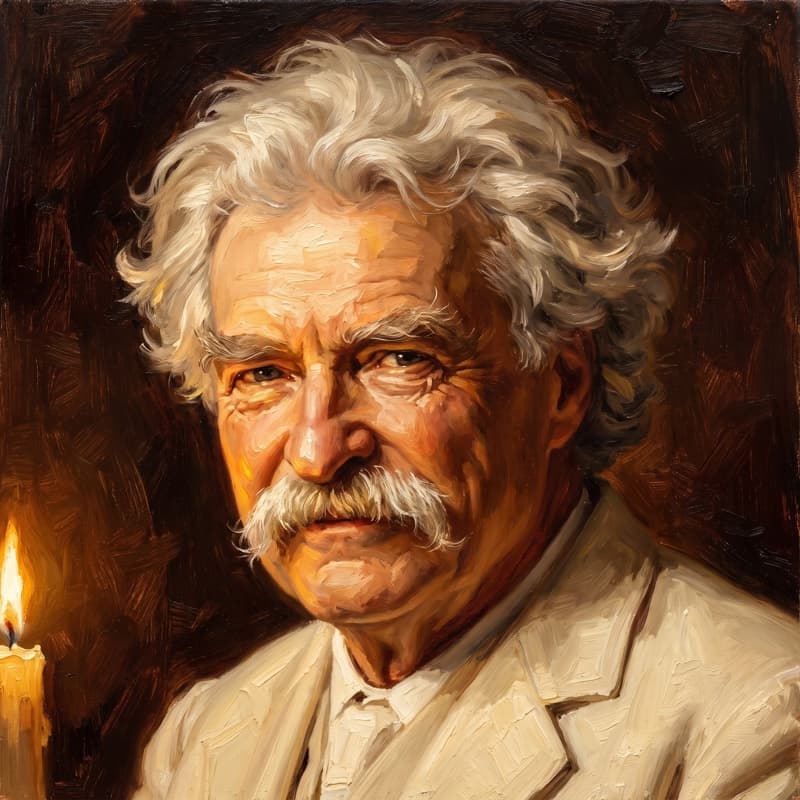
Mark Twain was the pen name of Samuel Langhorne Clemens, born in Florida, Missouri, on November 30, 1835, and dead at Stormfield, his home in Redding, Connecticut, on April 21, 1910 — the day after Halley's Comet, which had also been visible around his birth, returned to the skies. In between he was a printer's apprentice, a licensed Mississippi steamboat pilot, a failed Nevada silver miner, a newspaper man, the most famous humorist in the world, a Hartford family man, and a spectacularly bad investor who went broke and paid every dollar back. The books came out of all of it: The Innocents Abroad (1869), The Adventures of Tom Sawyer (1876), Life on the Mississippi (1883), and Adventures of Huckleberry Finn (1884 in London, 1885 in New York).
That is the summary. The trouble with summaries is that Twain spent a whole career making fun of them.
The river that named him
Before there was a Mark Twain there was a boy in Hannibal, Missouri, whose father died in March 1847, sending him out to work at eleven. In February 1857 he boarded the steamboat Paul Jones out of Cincinnati and talked his way into an apprenticeship under the pilot Horace E. Bixby; by April 9, 1859, he held a full license to pilot steamboats between St. Louis and New Orleans. He never got over it — in Life on the Mississippi he looked back on piloting as the trade he loved best of any he ever followed.
The pen name itself is river language: "mark twain" is the leadsman's call for two fathoms — twelve feet, safe water. He first signed it on February 3, 1863, writing for the Virginia City Territorial Enterprise, after the Civil War had closed the river and sent him west to fail at silver mining first. Two years later, on November 18, 1865, "Jim Smiley and His Jumping Frog" ran in the New York Saturday Press, and the byline was suddenly national property.
The pilot's habit of taking his own soundings never left him — not even when the subject was science:
"There is something fascinating about science. One gets such wholesale returns of conjecture out of such a trifling investment of fact." — Life on the Mississippi, Chapter 17
Hartford, the great books, and a machine eating his fortune
Twain married Olivia Langdon on February 2, 1870, and the couple settled first in Buffalo; the family later made its home at 351 Farmington Avenue in Hartford, Connecticut, where the biggest books got written. His comedy always carried a payload. Tom Sawyer conning the neighborhood boys into whitewashing his fence produces an actual economic theorem:
"Work consists of whatever a body is obliged to do, and that Play consists of whatever a body is not obliged to do." — The Adventures of Tom Sawyer, Chapter II
Then the money went. In 1894 his publishing firm, Webster and Co., declared bankruptcy, and Twain abandoned the Paige typesetting machine — an ingenious invention, perpetually one improvement from perfection, that had swallowed his books' earnings. He rebuilt with a round-the-world lecture tour, and the bill came due in harder currency: his daughter Susy died of meningitis on August 18, 1896, while he and Olivia were still abroad. Olivia died in Florence on June 5, 1904. His daughter Jean died on December 24, 1909, four months before her father. The late humor ran black, and he meant every word of it.
From a conversation with our Mark Twain
What follows is an excerpt from a conversation with our AI Twain persona — a stylized recreation for readers, not a historical quotation.
Caller: Be honest — was the typesetter really worth losing a fortune over?
Twain: Worth it? That machine was the future itself, friend — it merely declined to arrive on schedule. I have a genius for spotting the future and betting on the other thing. But I'll say this at full price: I went around the whole circumference of the earth on a lecture platform and paid every man back, every dollar. A man's jokes may be exaggerated. His debts shouldn't be.
Did Mark Twain really say that?
Probably not — and that's one of the most interesting things about him. Twain is the most misquoted man in American letters, so much so that the Center for Mark Twain Studies runs an entire Apocryphal Twain archive debunking lines he never wrote. Even his most famous quip is usually rendered wrong: reacting to a premature death report in 1897, he wrote "The report of my death was an exaggeration" — not the "greatly exaggerated" plural on all the coffee mugs.
The genuine article holds up fine without help:
"Man is the only animal that blushes. Or needs to." — Following the Equator, Chapter 27
"It is by the goodness of God that in our country we have those three unspeakably precious things: freedom of speech, freedom of conscience, and the prudence never to practice either of them." — Following the Equator, Chapter 20
Caller: How do you feel about taking a phone call more than a century after your funeral?
Twain: Well, I did state my position on the record. Huck said it for me: I don't take no stock in dead people. So you may imagine my relief at discovering, when the bell rang, that the description didn't apply. I came in with Halley's Comet and I went out with it, which was showmanship — and now here I am doing an encore, which is vanity. But you called, friend, and I never yet turned down an audience of one.
Excerpt from our AI Twain persona — stylized, and labeled as such.
Keep reading — or ask him yourself
The pages below go deeper: his death and the comet that kept its appointment, his verified quotes — and the famous ones he never said, his full biography, and the facts, sourced.
Or skip the reading. Our Twain takes calls. Ask him how Bixby taught him to read twelve hundred miles of river in the dark, what the Concord library's ban did for Huckleberry Finn's sales, or why he still defends the Paige typesetter — and watch him do it. He is an AI recreation, honestly labeled — but he answers slow, in his own drawl, and the pause before the punchline comes free of charge.