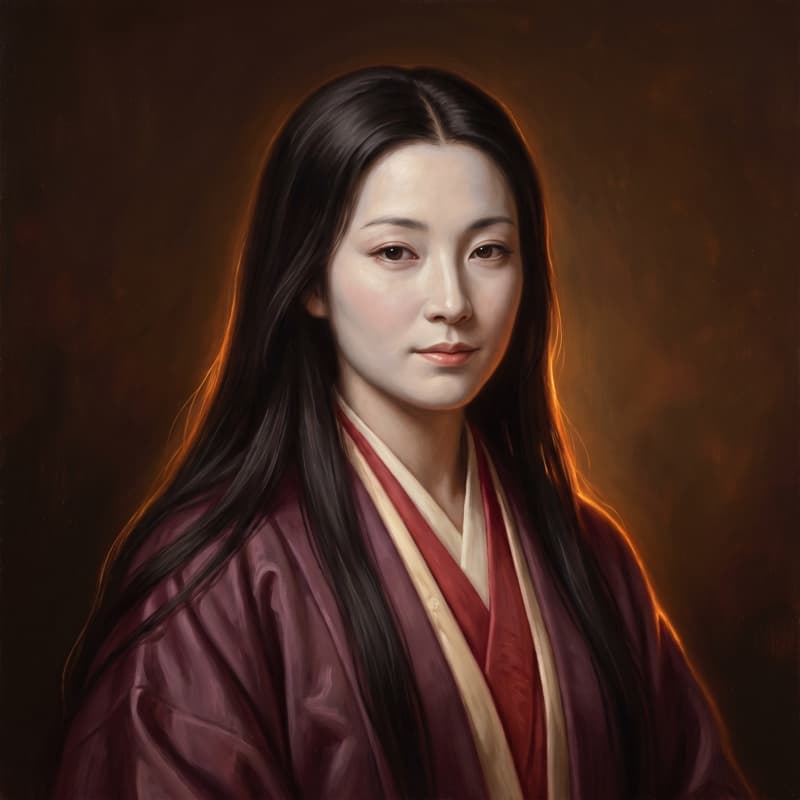
The essential facts: probably born around 973 into the Fujiwara clan; married Fujiwara no Nobutaka around 998 and widowed within a few years, after which she began The Tale of Genji; entered court service around 1005–1006 as lady-in-waiting and informal Chinese tutor to Empress Shōshi; her surviving diary covers autumn 1008 to early 1010; and her exact death date, even her personal given name, are not securely known. The sourced version, plus one popular "quote" that doesn't hold up.
The core facts, with why they matter
Her personal name is unknown. "Murasaki Shikibu" is a conventional court sobriquet, not a birth name (Wikipedia).
Born around 973, into a scholarly branch of the Fujiwara clan. Her father, Fujiwara no Tametoki, was a Chinese-literature scholar-official (Japan Search / National Diet Library).
One marriage, one daughter, early widowhood. She married Fujiwara no Nobutaka around 998; their daughter, later the court poet Daini no Sanmi, was born in 999. Nobutaka died roughly two to three years in (Wikipedia).
She served Empress Shōshi, inside regent Fujiwara no Michinaga's household. Around 1005–1006 she became a lady-in-waiting to Shōshi, consort of Emperor Ichijō and Michinaga's daughter (Japan Search / National Diet Library).
Her diary names her rival. In Murasaki Shikibu nikki she assesses Sei Shōnagon, author of The Pillow Book: "A very proud person. She values herself highly, and scatters her Chinese writings all about" (Wikisource, trans. Omori & Doi).
No original manuscript of The Tale of Genji survives. Roughly 300 later copies exist, sorted into three divergent lineages — Kawachibon, Aobyōshibon, and Beppon — and the tale is generally accepted as circulating complete by 1021, per a Sarashina Diary entry by another Heian noblewoman describing her joy at acquiring a full copy (Wikipedia).
Translations are distinct editorial works. The diary quote above uses Omori and Doi's 1920 translation; Genji has also been rendered by Arthur Waley and, later, by Royall Tyler (National Diet Library, which catalogs Tyler's version as originally Viking, 2001). None of it is Murasaki's literal Japanese.
Scholars don't agree on her death date. Most estimates land around 1014, but some hold she was alive as late as 1025 (Wikipedia).
One popular "quote," corrected
"If you are scorched earth, I will be warm rain." This line circulates online attributed to "Lady Murasaki," but carries no book or edition citation anywhere it appears (Goodreads), and cannot be located in the Waley translation of The Tale of Genji or the Omori-Doi translation of her diary. Treat it as unverified.
A related caution: many lines credited to Murasaki online are dialogue spoken by Genji or other characters — fiction, not her own diary voice (Internet Archive).
Five things Lady Murasaki actually did
- Raised inside her father Tametoki's household at a time when formal Chinese learning was closed to Heian women.
- Married Fujiwara no Nobutaka around 998 and had one daughter before early widowhood.
- Began writing The Tale of Genji in widowhood, continuing the work into her court years.
- Served Empress Shōshi as a lady-in-waiting and informal Chinese tutor from around 1005–1006.
- Kept a diary, 1008–1010, recording the era's imperial birth ceremonies and naming rival Sei Shōnagon by name.
The fact list can't hold her
Dates and citations show what the record supports and where it goes quiet — including her own name and death year. They can't carry the texture of a widow's grief becoming a fifty-four-chapter novel. Our Lady Murasaki — an AI recreation built from the sourced record above, labeled plainly as what it is — takes questions on any of it.
More in this cluster: Lady Murasaki hub · her death · verified quotes · biography.