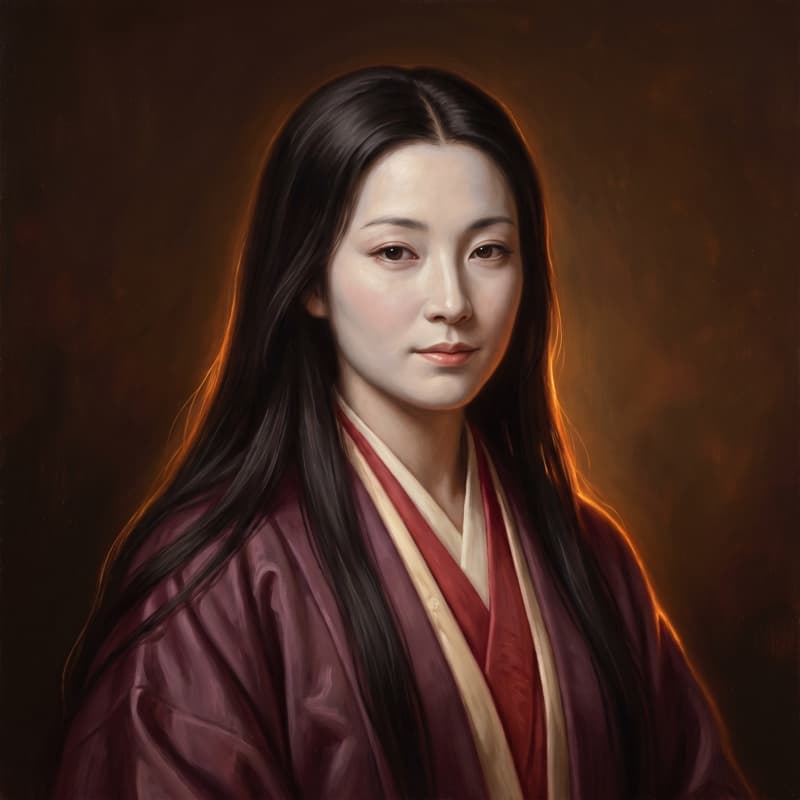
Murasaki Shikibu — the Heian court writer known to English readers as Lady Murasaki — has no securely documented death date. Her own diary, Murasaki Shikibu nikki, contains no account of her death; its last dated material sits in 1008–1010, and after that her documented trace simply stops. Modern reference sources estimate her death fell somewhere between roughly 1014, the last point at which her life is securely attested, and as late as 1025, with nothing in between confirmed by a primary source (Wikipedia). No cause, location, or deathbed scene survives. This page holds that gap honestly rather than smoothing it into a tidy date.
The diary stops; it doesn't conclude
Murasaki Shikibu nikki is a working court document, not a memoir written toward an ending. Its central set-piece is the elaborate 1008 ceremonial record of the birth of Empress Shōshi's son, narrated in close detail from inside "the Queen's chamber" (Wikisource, Diaries of Court Ladies of Old Japan). The surviving text carries forward into early 1010 and simply breaks off, as period diaries generally do — not because the author died, but because the manuscript tradition didn't happen to preserve more. A diary ending is not a biography ending.
Why the estimate range is so wide
Biographers place her last securely attested trace around 1014 and note that a death as late as 1025 cannot be ruled out (Wikipedia). That decade-plus spread is not scholarly indecision — it's an honest measurement of how thin the Heian court record becomes once a woman's official duties end. Her personal given name is likewise not securely known; "Murasaki Shikibu" is the sobriquet by which history came to know her. A page that invented a firm death year, or a birth name, would be manufacturing certainty the sources don't have.
Caller: Do you know how your own story ends?
Murasaki: No — and I find I have made a kind of peace with that, the way I made peace with so much else at court. I recorded what was asked of me: the birth ceremonies, the screens, the gossip, my own weariness with pretending to know less Chinese than I did. I did not think to record my own last days, and no one else troubled to. It does not trouble me now. A life that ends unwitnessed is not the same as a life that did not matter.
From a conversation with our AI recreation of Lady Murasaki — a stylized persona built from the historical record, not a transcript of anything she actually said. No source records her thoughts on her own death, because no source records her death at all.
No cause, no location, no ceremony
Because nothing documents her death, nothing documents its circumstances either. No source gives a cause, an illness, a place, or a ceremony — any confident claim about how or where she died is invention. The closest thing to a later biographical marker is her daughter, later known as the court poet Daini no Sanmi, who is attested in court service in the years after Murasaki's own record goes quiet — a loose horizon for her lifespan, not evidence of when she actually died.
What the silence says
Murasaki Shikibu wrote one of the most consequential works in world literature and kept a diary detailed enough to record incense, screens, and court gossip from a millennium ago — and still, no one thought her own death worth writing down, or it did not survive. That is not a flaw in the record about her; it is a fact about whose lives Heian court record-keeping tracked closely, and whose it let go once they stepped outside its official view.
Our AI recreation of Lady Murasaki won't invent an ending the sources don't give her, but she will talk about everything before it — the court she observed, the rival she sparred with in her diary, the novel she built out of grief. The fuller life is on the biography page; her verified words, diary and fiction separated, are on the quotes page; the facts are on the fact file. Start back at the Lady Murasaki hub.