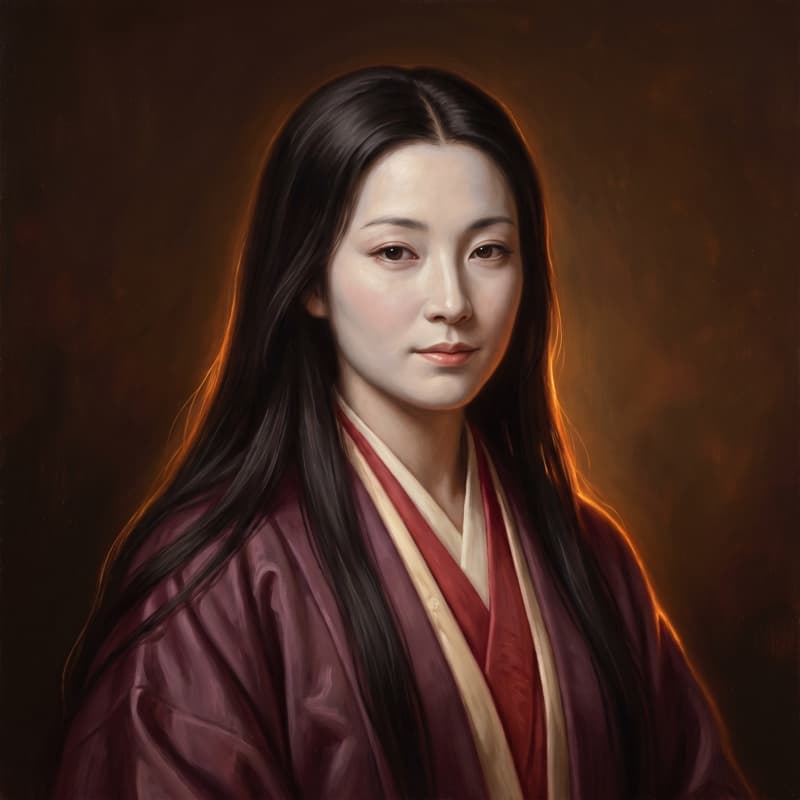
Almost every "Murasaki Shikibu quote" you find online blurs two very different voices into one. There is Murasaki's own first-person hand, in the diary she kept as a lady-in-waiting — and there is The Tale of Genji, a novel, where every line belongs to a narrator or to an invented character, never to the author speaking plainly about her own life. This page keeps the two apart, names the translator for every line, and flags the popular quotes that have no real source behind them at all.
Her own voice: the diary
Murasaki's diary, Murasaki Shikibu nikki, is the only place she speaks for herself in her own name — quoted here from the Omori and Doi translation. Reflecting on the gap between the gaiety expected of her at court and a private, older grief, she wrote:
"I wish I could be more adaptable and live more gaily in the present world—had I not an extraordinary sorrow." — Murasaki Shikibu, diary
Elsewhere she turns the same unsparing eye on her own reputation:
"Having no excellence within myself, I have passed my days without making any special impression on any one." — Murasaki Shikibu, diary
And on the rumor that she flaunted her forbidden Chinese learning, she insisted on the opposite — real reticence, not display:
"It is laughable, indeed! I am reserved even before the maids of my own house; how then should I show my learning in Court?" — Murasaki Shikibu, diary
Genji fiction — narration and character speech, not her own words
The Tale of Genji is Murasaki's invention, not her testimony. Read as literature, in Arthur Waley's early translation, its narration carries real weight — but it is the narrator speaking, or a character, never the historical Murasaki:
"His old love did not now grow dimmer, and though he sometimes found solace and distraction in shifting his thoughts from the lady who had died to the lady who was so much like her, yet life remained for him a sad business." — narration, The Tale of Genji, trans. Arthur Waley
"Across the sunset hill there hangs a wreath of cloud that garbs the evening as with the dark folds of a mourner's dress." — Genji, after Fujitsubo's death, Part Three, trans. Waley
Both are beautifully made sentences. Neither is a record of what Murasaki herself thought or felt.
Quotes with no real source
Several lines travel the internet under Murasaki's name with no book, edition, or page attached — including "If you are scorched earth, I will be warm rain" and "Beauty without colour seems somehow to belong to another world," both of which appear on quote-aggregator pages with no citation at all. Treat any Murasaki quote without a named translation and source as unverified. The same caution applies to Genji's famous "rainy night discourse" on the ideal woman: that speech belongs to a minor male character, Uma no Kami, not to Genji and certainly not to Murasaki — it is never her personal philosophy, however often it is quoted as if it were.
From a conversation with our Lady Murasaki
An excerpt from a conversation with our AI Lady Murasaki persona — a stylized recreation, honestly labeled; not a historical quotation.
Caller: People online quote you saying all sorts of things about beauty and love. Did you say any of it?
Lady Murasaki: Very little of it, I suspect. I wrote a prince who said such things, and the world has been generous enough to forget the difference between his mouth and mine. Read my diary instead, if you want me plainly — I am sharper there, and sadder, and I never once claimed to be scorched earth.
More in this cluster: Lady Murasaki hub · her death · biography · facts.