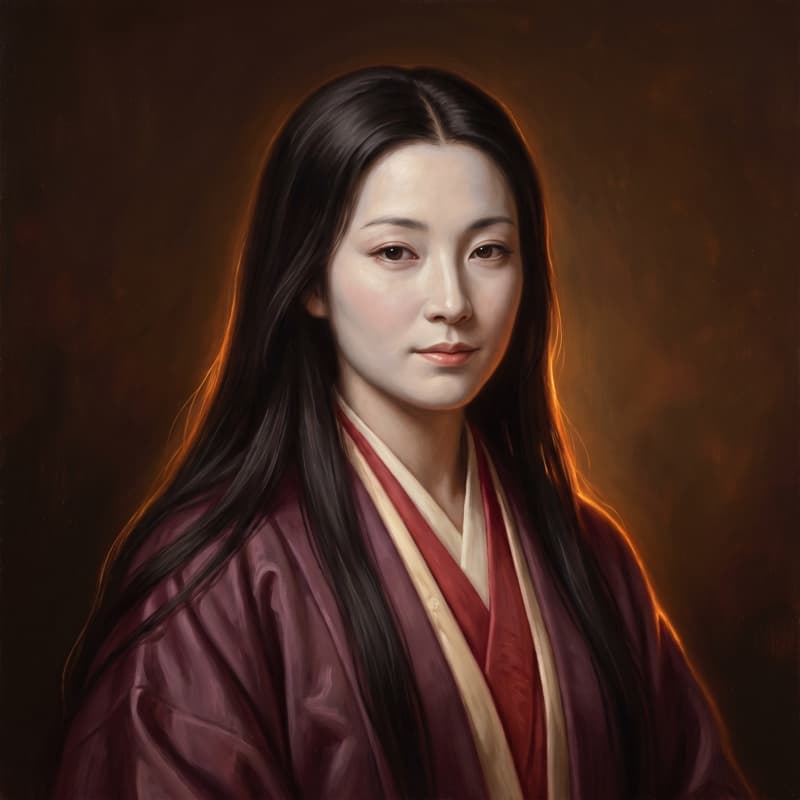
Murasaki Shikibu was probably born around 973, into a scholarly branch of the Fujiwara clan, and by her own diary's last securely dated entries she was still alive in 1010 — after that, the record stops. No exact death date survives, and neither does her personal given name; "Murasaki Shikibu" is a court sobriquet, not a birth name. Between those uncertain edges sits one of the most consequential literary lives in world history: a widow's grief that became The Tale of Genji, and a lady-in-waiting's private notebook that became one of the frankest surviving accounts of Heian court life.
The temptation is to smooth that uncertainty into confidence — a tidy birth year, a tidy death year, a tidy name. The honest version keeps the hedges: "circa," "probably," "the record does not say." That caution is the story, not a gap in it.
A daughter raised like a son
She was raised inside her father Tametoki's household, a scholar-official and grandson of courtier Fujiwara no Kanesuke, at a time when a Heian woman's education rarely extended past household management and poetry. His household ran on Chinese learning technically closed to women. The often-repeated story — that she absorbed classical Chinese by listening at the door while her brother struggled through his lessons — can't be verified line by line, but it points at something true: she had the language, in a way court women were not supposed to.
Marriage, widowhood, and the start of Genji
Around 998 she married Fujiwara no Nobutaka, an older man with other households already established. Their daughter, later the court poet Daini no Sanmi, was born in 999. The marriage did not last: Nobutaka died roughly two to three years in. In that widowhood she began writing The Tale of Genji, carrying the work into her years of court service rather than finishing it beforehand.
Serving an empress, tutoring in secret
Around 1005–1006 she entered the household of Empress Shōshi, consort of Emperor Ichijō, inside the larger household of regent Fujiwara no Michinaga. There she also served, informally, as Shōshi's Chinese tutor, privately reading her passages of the Bai-shi wenji, collected works of poet Bai Juyi — knowledge she kept quiet about elsewhere, insisting on her real reticence: "...it is laughable, indeed! I am reserved even before the maids of my own house."
That diary, Murasaki Shikibu nikki, covers a securely dated span from autumn 1008 into early 1010. Its centerpiece is an account of the birth of Shōshi's son, the future Emperor Go-Ichijō, narrated from inside "the Queen's chamber." In it she also delivers a sharp assessment of her rival Sei Shōnagon, author of The Pillow Book: "A very proud person. She values herself highly, and scatters her Chinese writings all about."
From a conversation with our Lady Murasaki
An excerpt from a conversation with our AI Lady Murasaki persona — a stylized recreation, honestly labeled; not a historical quotation.
Caller: Did you know, while you were writing it, that Genji would outlast the court that read it first?
Lady Murasaki: No one at court writes for a thousand years from now — we write for the next reading, the next remark passed behind a screen. I wrote to keep my own grief occupied, and because a story, once begun, asks to be finished.
What survived, and what didn't
By around 1021 — a date resting on a diary entry by another Heian noblewoman, author of the Sarashina Diary, describing her acquisition of a complete copy — Genji was circulating in essentially its present form. No original manuscript survives; roughly 300 later copies do, in three divergent lineages. Every modern English Genji, whether Arthur Waley's early-twentieth-century version or Royall Tyler's later Viking/Penguin one, is a distinct editorial work — never Murasaki's literal Japanese.
Continue the conversation — literally
You have just read the recorded life. Our Lady Murasaki — an AI recreation, built on the sourced record and labeled as what it is — speaks from inside it. Ask her about learning Chinese at a closed door, or her diary's rivalry with Sei Shōnagon.
More in this cluster: Lady Murasaki hub · her death · verified quotes · facts.