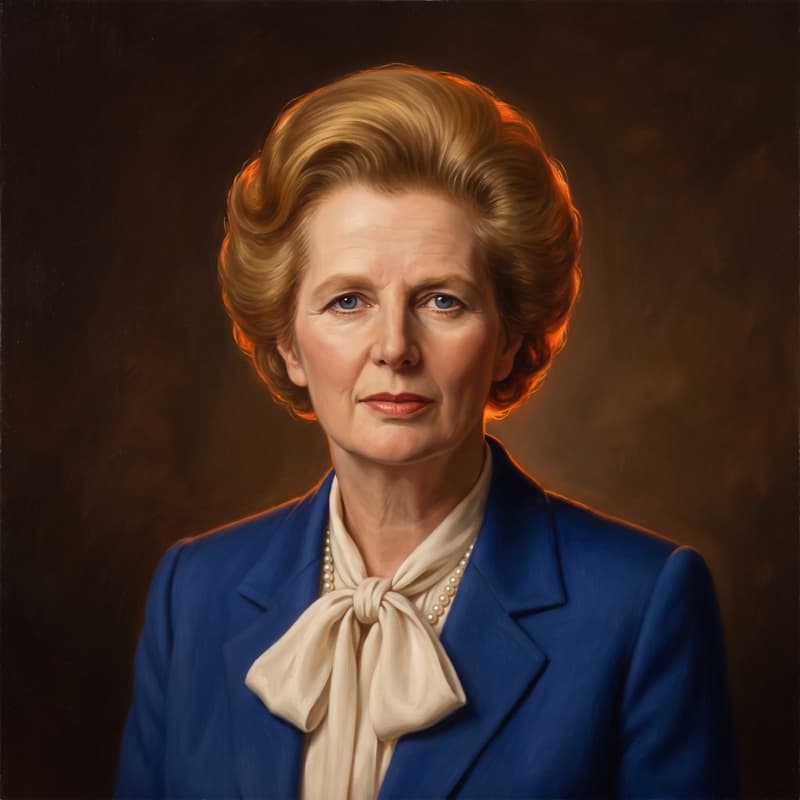
Margaret Thatcher was Britain's first woman prime minister, serving from May 4, 1979, until November 28, 1990 — just under eleven and a half years, won across three consecutive general elections. Born Margaret Hilda Roberts on October 13, 1925, above her father's grocer's shop in Grantham, Lincolnshire, she read chemistry at Oxford, entered Parliament at 34, and by 1975 had taken the Conservative leadership from the men who assumed the job was theirs by right. She died on April 8, 2013, at the Ritz Hotel in London, after a stroke, aged 87.
That is the summary. The record underneath it is sharper, and more contested, than the summary suggests.
From the grocer's till to the Commons
Thatcher's own account of her politics starts in the shop, not in Parliament. Her father, Alfred Roberts, was a grocer, a Methodist lay preacher, and eventually mayor of Grantham — a man whose household rule was that the books had to balance, full stop. She read chemistry at Somerville College, Oxford, from 1943 to 1947 under the crystallographer Dorothy Hodgkin, worked briefly as a research chemist, then trained for the Bar while raising twins, Carol and Mark, born in 1953. She was elected Conservative MP for Finchley in October 1959, served as Secretary of State for Education and Science under Edward Heath from 1970, and in February 1975 beat Heath for the Conservative leadership outright — the first woman to lead a major British political party.
The nickname came from an unlikely source. After a January 1976 speech at Kensington Town Hall warning that "the Russians are bent on world dominance," the Soviet defence ministry newspaper Krasnaya Zvezda branded her the Iron Lady as an insult. She kept the name and wore it as a compliment for the rest of her life.
What she actually did as prime minister
Elected in 1979 to a country gripped by strikes, inflation, and a sense of managed decline, Thatcher governed on the conviction that the state had to do less and citizens had to do more for themselves. Her governments privatised state-run industries — telecoms, gas, airlines, steel — and the Housing Act 1980 gave council tenants the right to buy their homes, which over a million families did. Trade union law was rewritten after a decade in which strikes could shut down the country with little legal check.
The confrontation that defined her second term was the miners' strike of 1984–85: the National Union of Mineworkers, under Arthur Scargill, struck against pit closures without a national ballot, and the strike ran a full year before collapsing without a settlement. Coalfield communities never fully recovered, and whether that was a necessary reckoning or a needless wound is still argued in Britain today — this page states what happened and leaves the verdict to the reader.
Abroad, the defining test came in April 1982, when Argentina invaded the Falkland Islands. Thatcher sent a naval task force eight thousand miles south; South Georgia was recaptured on April 25, and Argentine forces surrendered on June 14 — a 74-day war. Two years later, in the early hours of October 12, 1984, the Provisional IRA bombed the Grand Hotel in Brighton during the Conservative Party conference. Thatcher, who was in the hotel, was unhurt, and delivered her conference speech roughly six hours later, on schedule.
From a conversation with our Thatcher
What follows is an excerpt from a conversation with our AI Thatcher persona — a stylized recreation for readers, not a historical quotation.
Caller: Weren't you afraid, that night in Brighton?
Thatcher: Afraid is a private word, and I keep private words private. What I will tell you is that the conference opened at nine-thirty the next morning precisely as printed on the agenda, because the alternative — one comma of the schedule surrendered to a bomb — was not an alternative at all. You do not negotiate your resolve with people who plant devices in bathroom walls. You bury your friends, you write to the families who need writing to, and you go on. That is not courage, particularly. It is simply the only sensible thing to do.
"There is no such thing as society" — what she actually said
No line attributed to Thatcher is more mangled than this one, so here it is in full. In a 1987 interview for Woman's Own, she said: "There is no such thing as society. There are individual men and women, and there are families. And no government can do anything except through people, and people must look to themselves first," continuing that it was "our duty to look after ourselves and then, also to look after our neighbour." Quoted alone, the first sentence sounds like a denial that people owe each other anything. Read in full, her point was closer to the opposite: that society is not an abstraction that can be billed for obligations individuals should meet themselves. Whether that argument was right is a matter of politics; what she actually said is a matter of record, and the two should not be confused.
The soundbites, and the two best-sourced ones
Thatcher's most quoted line — "You turn if you want to. The lady's not for turning" — came from her October 10, 1980, party conference speech, a direct answer to critics inside her own party urging a reversal. A decade later, the line that arguably ended her premiership came in the House of Commons on October 30, 1990, rejecting a more centralised European Commission proposed by Jacques Delors: "he wanted the Commission to be the Executive and he wanted the Council of Ministers to be the Senate. No. No. No." It is recorded verbatim in Hansard, and it prompted Geoffrey Howe's resignation — the opening move in the challenge that unseated her three weeks later. A frequently repeated line about socialism running out of "other people's money" is a popular compression of a longer 1976 television answer; the sentiment is hers, but the tidy one-line version is a paraphrase, not a transcript.
The fall, and the long afterward
On November 28, 1990, after her own Cabinet told her privately she could not win a second leadership ballot, Thatcher resigned. John Major succeeded her. She left the Commons for the House of Lords in 1992 and spent her later years writing memoirs before her death in 2013. Her funeral at St Paul's Cathedral was given ceremonial honours on a scale not seen for a British political figure since Winston Churchill — and drew both official mourners and street protesters, a split that would not have surprised her in the least.
Keep reading — or ask her yourself
The pages below go deeper: her death and the divided reaction to it, her verified quotes — and the ones she never quite said, her full biography, and the facts, sourced.
Or skip the reading. Our AI recreation of Margaret Thatcher takes calls. Ask her why she wouldn't reverse course on the economy, what she actually meant about society, or how she'd have handled your argument with your own Cabinet of doubters. She is an AI recreation, honestly labeled — but she answers in her own voice, certain of it, and entirely willing to be disliked for being right.