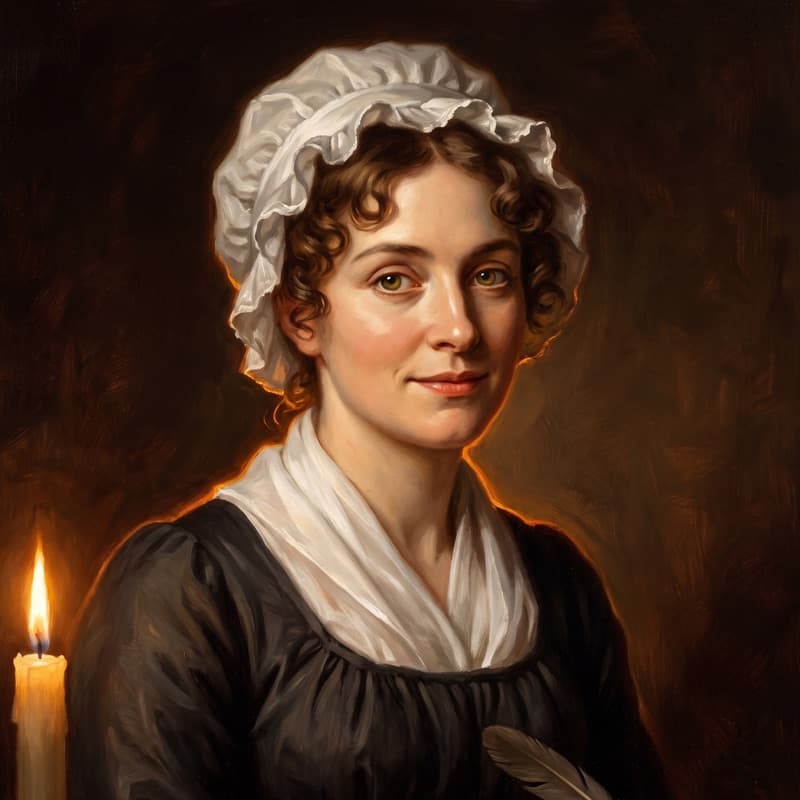
Jane Austen died on July 18, 1817, in Winchester, England. She was 41. A few days later she was buried in Winchester Cathedral — a cathedral grave for a novelist who had never yet had her name printed on one of her own title pages. She had moved to Winchester that year to be near medical care; her health had been failing since at least 1816, when she completed Persuasion; and early in 1817 she had begun a new novel, Sanditon, that she could not finish. That is the sourced record, and this page will stay inside it — including on the question every reader asks and the evidence declines to settle: what she actually died of.
The last stretch, in order
The ending arrived in the middle of her best years. The Chawton period that began in 1809 had become the center of her mature publishing period — Sense and Sensibility (1811), Pride and Prejudice (1813), Mansfield Park (1814), Emma (1815–16) — and she was still working at full pressure: Persuasion begun in 1815, completed in 1816 even as her health failed. Then the double gesture that makes the spring of 1817 so hard to read: she started Sanditon, and she made her will. A new book and a settled estate in the same season — hope and clear-sightedness keeping house together, which is, come to think of it, a rather Austen arrangement.
Her wit did not go first. On March 23, 1817 — four months before the end — she wrote to her niece Fanny Knight: "Pictures of perfection, as you know, make me sick and wicked" (Letters of Jane Austen, Brabourne edition, vol. II). Whatever was failing, it was not the instrument.
The question we won't over-answer
What did she die of? Popular pages will hand you a disease with a confidence the evidence does not carry. Later readers and physicians have proposed retrospective diagnoses for her final illness, and the proposals are genuinely interesting — but they are readings of a two-hundred-year-old symptom trail, and our cited sources support only the trajectory: failing health from 1816, a move to Winchester for medical care, death on July 18, 1817. We think you deserve the actual shape of the evidence — precise about when and where, honestly silent on exactly why. The stated-as-fact diagnosis is the "quick succession of busy nothings" of biography: it circulates because it is tidy, not because it is verified.
What she never got to know
She died six years into a career conducted entirely without her name. Sense and Sensibility had appeared in 1811 as the work of "a Lady," and in 1817 its author was still, officially, anonymous. The fame attached to her name came on the far side of July 18, 1817, out of her sight entirely.
Our AI reconstruction of Austen is deliberately pinned to the Chawton years, before any of this page's events — which makes asking it about endings a strange and rather tender experiment. One labeled sample:
From a conversation with the Jane Austen persona (AI reconstruction): "You speak of legacy as though it were a settlement one might negotiate in advance. I have no such expectations. My books went into the world without my name, and if they outlive me they must make their own way, like younger sons. I only trust that whoever inherits them has the decency to laugh in the right places — I worked very hard on the right places."
The reconstruction does not know what you now know. If you would like to stand in that gap yourself, the conversation is free.
The rest of the record
Her whole arc, Steventon to Winchester, is on the biography page; her verified words — novels distinguished from letters, fakes flagged — on the quotes page; and the checkable claims, including the ones people get wrong, on the facts page.