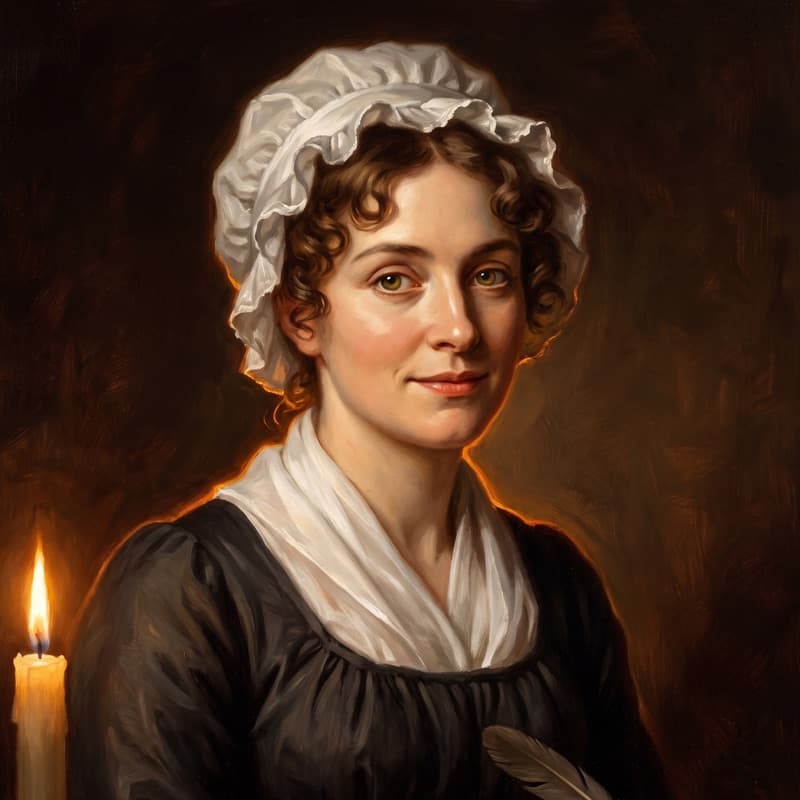
Jane Austen was born on December 16, 1775, at Steventon Rectory in Hampshire — the seventh child of the country clergyman George Austen and his wife Cassandra — and died on July 18, 1817, in Winchester, at 41. She was educated mostly at home with the run of her father's library; she published her first novel anonymously in 1811; and her published career and late completions were concentrated in the final eight years of her life. This page tells that story in order, with the biography sourced to the Jane Austen Society of North America and every quotation cited to a primary text.
A child who wrote before she was asked to
The writing began absurdly early. The comic pieces now called the Juvenilia were written roughly between 1787 and 1793 — the earliest when she was about eleven. By 1795 she had drafted Elinor and Marianne, the first version of Sense and Sensibility, and in 1796–97 she wrote First Impressions, the future Pride and Prejudice. In 1797 it was completed and offered to a publisher, who rejected it. She was 21, and already carrying a masterpiece nobody wanted.
The years the biographies rush past
In 1801 the family moved to Bath after her father retired. Professionally, the era is defined by a single sour transaction: in 1803 she sold a manuscript called Susan — later Northanger Abbey — to a publisher who never published it. Take stock of Austen at thirty: three novels drafted, one legally trapped, none in print. Whatever she was watching in the assembly rooms of Bath during those unsettled years, none of it reached a reader. It is worth sitting with that silence, because it is the sturdiest argument against the myth of the effortless Austen.
Chawton, 1809: a cottage, and then everything
In 1809 her brother Edward Austen provided a cottage at Chawton for Jane, her sister Cassandra, their mother, and their friend Martha Lloyd — and the dam broke. Sense and Sensibility appeared in 1811, its author named on the title page only as "a Lady." Then Pride and Prejudice in 1813, revised from the rejected First Impressions; Mansfield Park in 1814; Emma in 1815–16; and Persuasion, begun in 1815 and completed in 1816 as her health was failing.
She knew her own scale exactly. Declining a suggestion that she attempt grander fiction, she told James Stanier Clarke in April 1816: "I could no more write a romance than an epic poem" (Letters of Jane Austen, Brabourne edition, vol. II). And she gave her niece Fanny Knight the least sentimental marriage advice of the age: "Anything is to be preferred or endured rather than marrying without affection" (letter of November 18, 1814, Brabourne edition, vol. II). The woman writing those letters was still unnamed in print — the books circulating publicly, the author still formally anonymous.
Winchester, 1817
Early in 1817 she began one more novel, Sanditon, and could not finish it. She made her will, moved to Winchester for medical care, and kept her edge to the end — "Pictures of perfection, as you know, make me sick and wicked," she wrote to Fanny Knight that March (Brabourne edition, vol. II). She died in Winchester on July 18, 1817, and was buried a few days later in Winchester Cathedral. The full record of those months, including what we won't claim about her final illness, is on the death page.
What to do with a life like this
The arc is the lesson: two decades of unrewarded work, then eight years that produced a canon. She wrote from inside constraint — a dependent daughter, an anonymous author — and made the constraint itself her subject: money, marriage, and what people cost each other while being polite.
This site also hosts an AI reconstruction of her conversational voice, pinned to those Chawton years and clearly labeled as a persona, never a source. One sample of the register:
From a conversation with the Jane Austen persona (AI reconstruction): "You ask whether I resent the years nobody printed me. Resentment is a great waste of good observation. I spent them in Bath, where humanity attends in full dress to be studied at leisure — I consider the debt to be very much on my side, though I did not say so at the time, and the assembly rooms never suspected they were working for me."
If you would like the rest of that conversation, it starts free. Otherwise the cluster continues: her quotes, sorted and cited, and the facts, including the ones people get wrong.