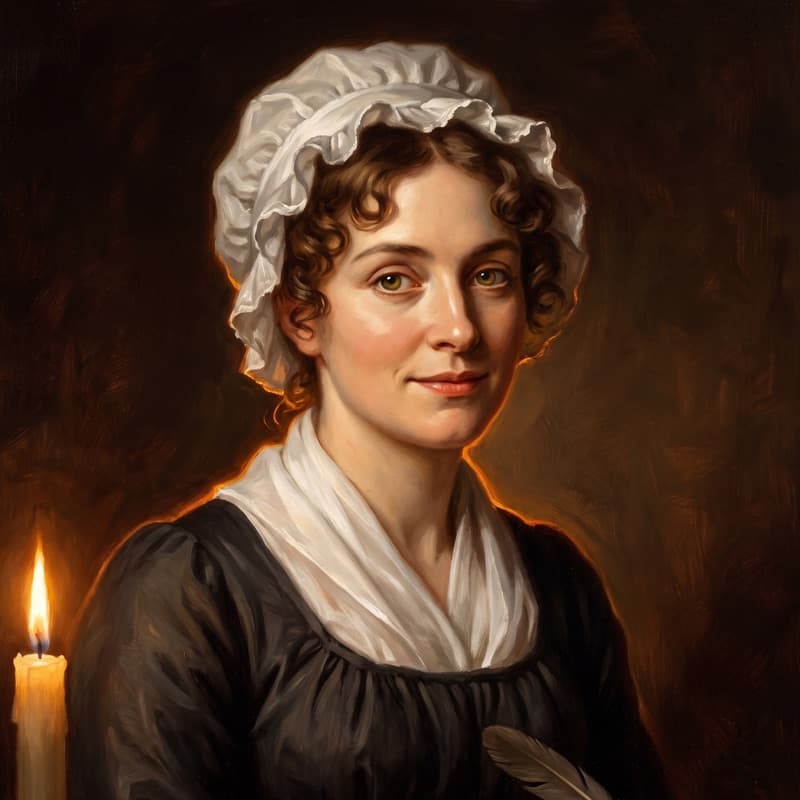
The verified Jane Austen facts fit in a paragraph: born December 16, 1775, at Steventon Rectory in Hampshire, the seventh child of the clergyman George Austen and his wife Cassandra; educated at home in her father's library; First Impressions, later revised as Pride and Prejudice, rejected in 1797; publishing career begun anonymously in 1811 and conducted entirely from the Chawton cottage her brother Edward provided in 1809; six completed novels; dead in Winchester on July 18, 1817, at 41, and buried in Winchester Cathedral. Everything below expands that record with citations — JASNA's biography and works chronology, plus primary texts — and then names the popular claims that don't survive checking.
The facts, with their teeth left in
- Born December 16, 1775, at Steventon Rectory, Hampshire — seventh child of a country clergyman and his wife (JASNA biography). The novels' pitch-perfect parsonages were reporting.
- Educated primarily at home, with access to her father's library and the household schoolroom (JASNA).
- The Juvenilia — her comic early pieces — date from roughly 1787 to 1793 (JASNA works chronology). She was writing parody at about eleven.
- First Impressions, later revised as Pride and Prejudice, was completed and offered to a publisher in 1797 — and rejected (JASNA works chronology). Sixteen years separate that rejection from the 1813 publication of Austen's most famous book.
- In 1803 she sold Susan — later Northanger Abbey — to a publisher who never published it (JASNA). By her early thirties: three novels written, none in print.
- In 1809 Edward Austen provided the Chawton cottage for Jane, her sister Cassandra, their mother, and Martha Lloyd — and her most productive period began (JASNA biography). The mature publishing period postdates this address.
- Sense and Sensibility was published in 1811 identifying its author only as "a Lady" (JASNA). Then Pride and Prejudice (1813), Mansfield Park (1814), Emma (1815–16).
- The six completed novels are Sense and Sensibility, Pride and Prejudice, Mansfield Park, Emma, Northanger Abbey, and Persuasion (JASNA works chronology).
- Persuasion was begun in 1815 and completed in 1816 as her health was failing (JASNA biography).
- In early 1817 she began Sanditon, made her will, and moved to Winchester for medical care; she died there on July 18, 1817, and was buried a few days later in Winchester Cathedral (JASNA biography).
The myths, named
"She was famous while she lived." Her documented career ran anonymously — "a Lady" on the 1811 title page. Public acknowledgment of her as the writer came later; during her life, the sourced record keeps the emphasis on anonymity.
"We know her cause of death." We know the trajectory — failing health from 1816, medical care in Winchester, death on July 18, 1817. A confident diagnosis outruns the sourced record; the death page explains why we leave it open.
"Those quotes are hers." The two most shared "Austen" lines fail primary-text checks: "It isn't what we say or think that defines us, but what we do" is absent from Sense and Sensibility's full text, and "Life seems but a quick succession of busy nothings" is an altered form of a Mansfield Park phrase, listed by Wikiquote as misattributed. The verified lines — novels sorted from letters — are on the quotes page.
What the facts add up to
A late, compressed, anonymous career built on a long unrewarded apprenticeship — and a temperament the letters preserve directly: "Pictures of perfection, as you know, make me sick and wicked," she told her niece Fanny Knight in March 1817 (Letters of Jane Austen, Brabourne edition, vol. II). Keep that sentence next to fact 10 and you have the whole character: four months from death, allergic to flattery, still funny.
That temperament is what our AI Jane Austen persona reconstructs — clearly labeled as a modern performance, never a source. One sample:
From a conversation with the Jane Austen persona (AI reconstruction): "Facts about me are like calling cards — true, orderly, and wholly uninformative as to whether the visit was agreeable. If you wish to know what I am actually like, you must risk the conversation, as one does with any new acquaintance. I promise to be at least as curious about you — people who read lists of facts to the very end are precisely my sort of material."
She means it about the material. Start the free conversation — or continue with the biography and the record of 1817.