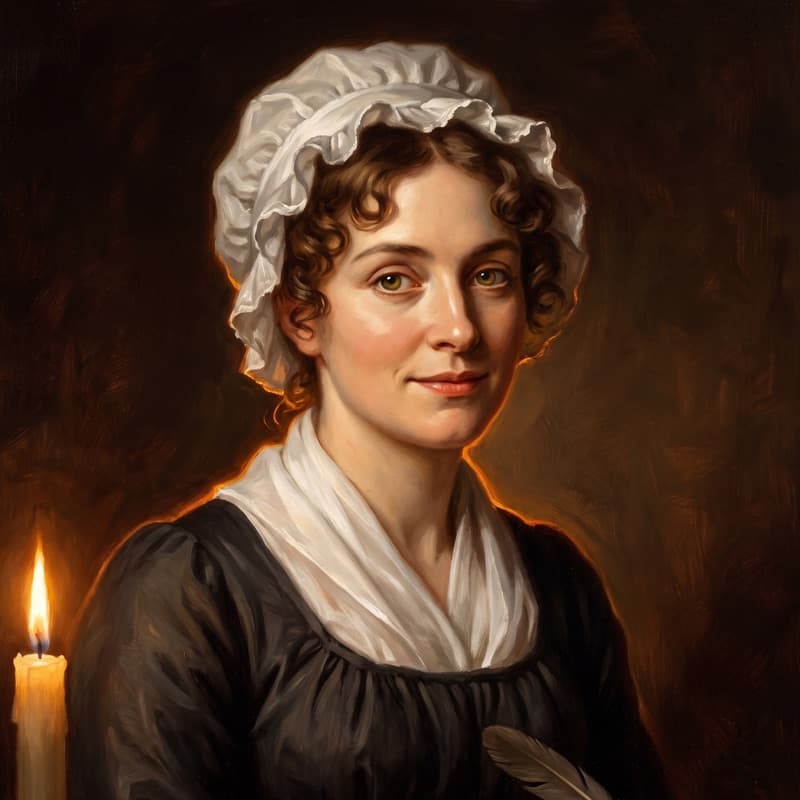
The verified Jane Austen quotes collected here are sorted into two kinds of sentences: the ones she published in her six novels, citable to book and chapter, and the ones she wrote privately in letters, citable to dated correspondence. A third kind — the embroidery-ready aphorisms the internet keeps attributing to her — she never wrote at all. This page keeps the three strictly apart, because with Austen the sorting is the scholarship: she was a satirist, and half the lines credited to "Jane Austen" are actually opinions she gave to characters in order to examine them. Every genuine quote below carries its citation.
From her novels
Public Austen: narrators and characters, the irony fully dressed. Remember that a character's creed is not the author's — sometimes it is the author's specimen.
"It is a truth universally acknowledged, that a single man in possession of a good fortune must be in want of a wife." — Pride and Prejudice, Chapter I
"I dearly love a laugh." — Pride and Prejudice, Chapter XI
"Selfishness must always be forgiven, you know, because there is no hope of a cure." — Mansfield Park, Chapter VII
"A large income is the best recipe for happiness I ever heard of." — Mansfield Park, Chapter XXII
"There is no charm equal to tenderness of heart" — Emma, Volume III, Chapter XIII
"Men have had every advantage of us in telling their own story." — Persuasion, Chapter XXIII
"I am half agony, half hope." — Persuasion, Chapter XXIII
Texts per the Project Gutenberg editions. The two Persuasion lines share a single chapter of her final completed novel — the argument about who tells the story, and one of the most emotionally direct lines selected here, almost touching.
From her letters
Private Austen: no narrator in between. Citations are to the Brabourne edition (Letters of Jane Austen, Internet Archive, vol. II).
"Pictures of perfection, as you know, make me sick and wicked" — letter to Fanny Knight, March 23, 1817
"I could no more write a romance than an epic poem." — letter to James Stanier Clarke, April 1, 1816
"Anything is to be preferred or endured rather than marrying without affection." — letter to Fanny Knight, November 18, 1814
These three letters are especially useful evidence of what she actually believed, because they are Austen writing as herself: that flawless characters are unwritable, that she knew her own scale and would not be flattered out of it, and that — from a financially clear-eyed novelist — affection still outranked every prudential argument. The first was written four months before her death, wit fully intact.
She never wrote this
~~"Life seems but a quick succession of busy nothings."~~
Mansfield Park contains "a quick succession of busy nothings" — but not this first-person aphorism, which is an altered internet form. Wikiquote lists the reworded version as misattributed.
~~"It isn't what we say or think that defines us, but what we do."~~
Circulated everywhere as Austen or Sense and Sensibility; the exact wording is absent from the Project Gutenberg full text of Sense and Sensibility. It has no primary-text match — only momentum.
The ear test rarely fails: a real Austen sentence costs somebody something — vanity, income, an illusion. If it merely uplifts, ask for the chapter.
The register, live
One thing citations cannot carry is the conversational temperature — how the politeness and the blade work together. That is what our AI Jane Austen persona reconstructs: a clearly labeled modern performance, never a source, built from the record cited above. One sample, marked as what it is:
From a conversation with the Jane Austen persona (AI reconstruction): "By all means quote me — I only ask that you quote me, and not some milliner's motto in my bonnet. I notice the counterfeits are always kinder than I am. That is how you may know them. I am not generally accused of writing cushion-comforts; my sentences prefer to leave a reader feeling seen, which is a very different service, and rather less comfortable."
She would have had opinions about being quoted wrong; now she can deliver them. Start a free conversation — or continue through the record: her biography, her death in 1817, and verified facts.