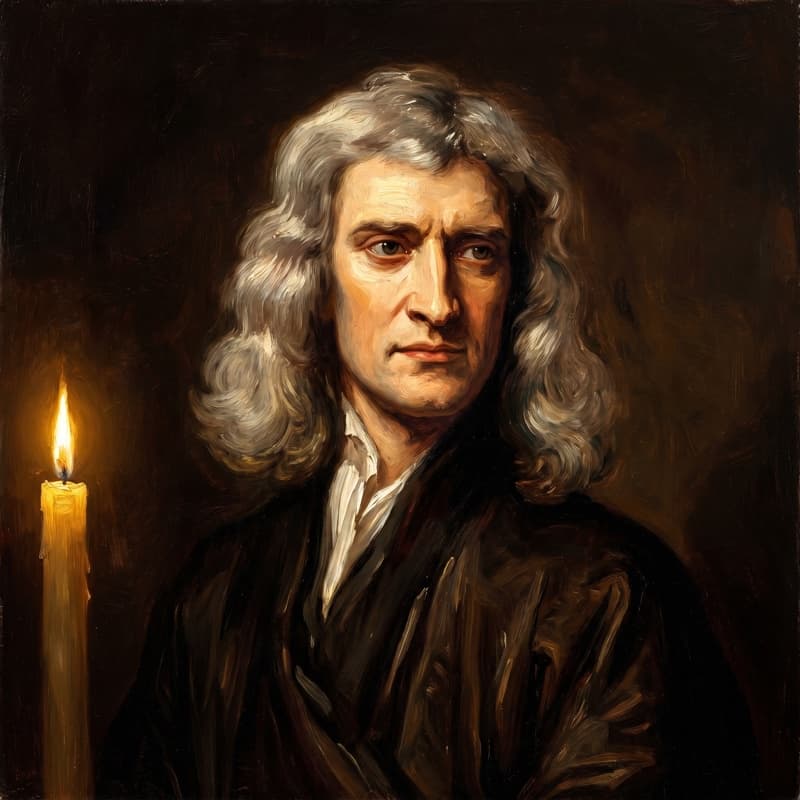
Isaac Newton was an English natural philosopher and mathematician who set out the laws of motion and universal gravitation in Philosophiæ Naturalis Principia Mathematica (1687), and showed, in Opticks (1704), that ordinary white light is a mixture of colors. Born on Christmas Day 1642 (Old Style) at Woolsthorpe Manor in Lincolnshire, he became Lucasian Professor of Mathematics at Cambridge, President of the Royal Society, and Master of the Royal Mint, and died in London in March 1727, buried in Westminster Abbey with an honor no natural philosopher had received before him.
That is the summary. The man built it in near-total silence, and told almost no one.
The plague years: a farmhouse, and eighteen months that remade physics
Newton was born posthumous and premature — his father had died before his birth — at the family manor in Woolsthorpe. He entered Trinity College, Cambridge, in 1661, studying under Isaac Barrow. When the Great Plague closed the university in 1665, he went home to Woolsthorpe, staying on and off until 1667, and described the period plainly:
"For in those days I was in the prime of my age for invention and minded Mathematics and Philosophy more than at any time since." — quoted at Woolsthorpe Manor, National Trust
Alone, in his early twenties, he worked out the method of fluxions — the calculus — began resolving white light into its component colors, and started asking whether the force that pulls an apple to the ground might also govern the Moon. The apple story is real, though narrower than the legend: Newton's friend William Stukeley heard the account from Newton himself and set it down in his own third-person memoir — not as a direct quotation in Newton's voice — recording that "why should that apple always descend perpendicularly to the ground, thought he to him self." A question turned over in the mind, not a blow to the skull. Stukeley's memoir, Newton Project He told almost no one about any of it for years — back at Cambridge, he succeeded Barrow as Lucasian Professor of Mathematics in 1669, at 26, while the fluxions, the optics, and the gravitation question all sat unpublished.
The Principia: one law, from the apple to the comets
The trigger was a visit. In 1684 the astronomer Edmond Halley asked Newton what curve a planet would trace under an inverse-square force. Newton answered instantly: an ellipse — he had already worked it out. Halley pushed him to write it up properly, and roughly eighteen months of relentless labor became the Principia (1687): three laws of motion and universal gravitation, demonstrated in geometry, beginning with inertia itself:
"Every body perseveres in its state of rest, or of uniform motion in a right line, unless it is compelled to change that state by forces impress'd thereon." — Law I, Motte translation, Wikisource
Newton was exact about the limits of his own claim: he could show that gravity acts by an inverse-square law across the whole system — the falling stone, the orbiting Moon, the returning comet — without claiming to know what gravity is: "Whatever is not deduced from the phenomena, is to be called an hypothesis... I frame no hypotheses." General Scholium, Wikisource
Where the demonstration ended, something closer to reverence began: "This most beautiful System of the Sun, Planets, and Comets, could only proceed from the counsel and dominion of an intelligent and powerful being" — the one subject on which the guarded Newton drops his guard entirely. And the famous line about giants is earlier still, from an 1675/6 letter to Robert Hooke, with whom Newton would later feud bitterly over optics: "If I have seen further [than the ancients] it is by standing on the sholders of Giants" — the manuscript's own spelling, not the modernized "shoulders" usually printed. Letter to Hooke, Newton Project
From a conversation with our Newton
A stylized excerpt from our AI Newton persona — a recreation for readers, not a historical transcript.
Caller: Did the apple really hit you on the head?
Newton: It struck nothing. I watched it fall and asked why it fell down, not sideways or up. A question held before the mind without ceasing is worth more than any blow to the skull. Eighteen months later I had the calculation.
Warden and Master of the Mint, President of the Royal Society
After the Principia, Newton left Cambridge for London: Warden of the Royal Mint around 1696, Master in 1699 — and took the job seriously, personally investigating counterfeiters and gathering depositions in disguise. He was elected President of the Royal Society in 1703, a post he held for life, and in 1704 published Opticks, laying out the prism experiments that had shown white light to be a mixture of colors. Queen Anne knighted him in 1705. Fitzwilliam Museum, Cambridge
Behind the offices sat a private man few saw: decades of alchemical experiment at his own furnaces, and unorthodox, legally risky theological convictions kept carefully guarded — both well documented in his surviving papers, neither for public consumption in his lifetime.
The line you should not trust
The single most quoted "Newton" line may not be Newton's at all. "I do not know what I may appear to the world, but to myself I seem to have been only like a boy playing on the sea-shore... whilst the great ocean of truth lay all undiscovered before me" appears nowhere in his own writing. It surfaces first in 1820, nearly a century after his death, sourced to a man who claimed to have heard it from Newton "a little before he died" — yet was living in France at the time, not returning to England until three years after Newton's death. Today in Science History, provenance discussion It may capture something true about the man, but it is a legend, not a documented quotation — Newton lore, like the apple striking his head, rather than Newton's own words.
The end, and the honor that followed
Newton's final illness was a stone in the bladder; his last weeks brought "violent fits of pain with very brief intermissions." He died at Kensington in the early hours of 20 March 1727 (Old Style; 31 March New Style), aged 84, and was buried in Westminster Abbey on 28 March. Westminster Abbey, official commemoration His monument there — Michael Rysbrack's sculpture to William Kent's design, finished 1730, showing Newton reclining beside putti bearing a telescope, a prism, and a steelyard weighing the Sun and planets — was an honor no natural philosopher had been given in the Abbey before.
Keep reading — or ask him yourself
The pages below go deeper: his full biography, his final illness and death, his verified quotes — and the famous one he probably never said, and the facts, sourced.
Or skip the reading. Our Newton takes calls. Ask him what the apple actually taught him, why he refuses to guess at what gravity is, or what happened between him and Mr. Leibniz over the calculus. He is an AI recreation, honestly labeled — guarded at first, exacting always, and something close to awed the moment the System of the World comes up.