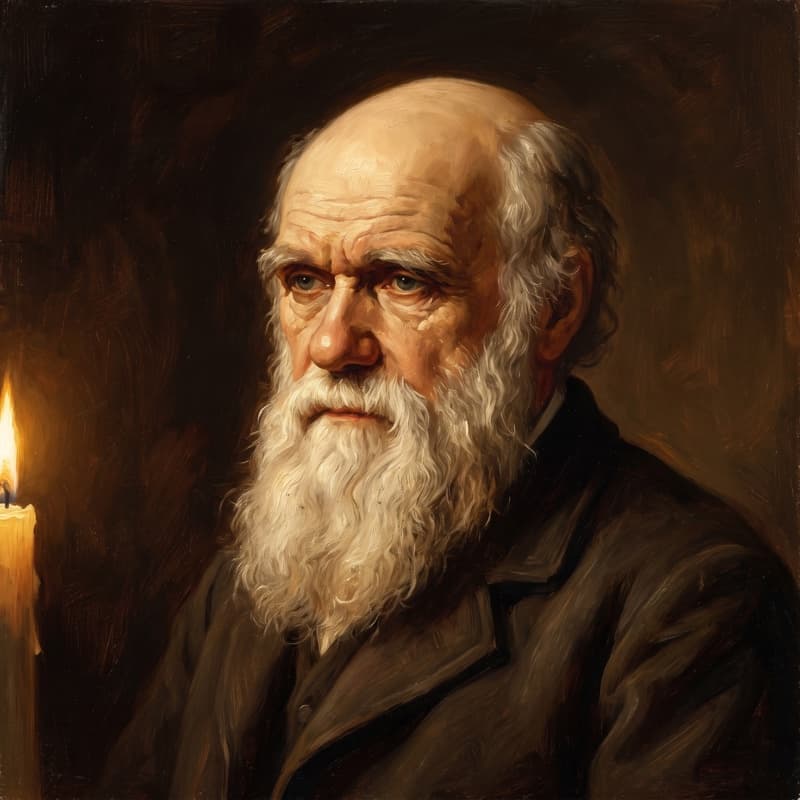
Charles Robert Darwin was born on February 12, 1809, in Shrewsbury, England, and died on April 19, 1882, at Down House, his home in Kent. Between those dates he sailed around the world as a young naturalist, spent two decades quietly gathering evidence before he dared publish, and then set out an argument — natural selection — that changed how people understand the history of life. He is buried in Westminster Abbey, not far from Isaac Newton, a national honor he never sought for himself.
That is the summary. The delay is most of the story.
The five years that rearranged everything
Darwin was not an obviously promising young man. Medicine at Edinburgh defeated him — the operating theater was more than he could stomach — and he drifted toward Cambridge and a country parsonage instead. Then, in August 1831, came an offer: an unpaid post as naturalist aboard HMS Beagle, bound for South America and around the world. The Beagle sailed from Plymouth on December 27, 1831, and did not return until October 2, 1836 — nearly five years at sea filled with fossils, geology, and specimens from Patagonia to the Galápagos.
Twenty years in a drawer
Back in England, Darwin opened his first notebook on the transmutation of species in 1837. By January 11, 1844, in a letter to the botanist Joseph Hooker, he had arrived at something he could barely say aloud:
"At last gleams of light have come, & I am almost convinced (quite contrary to opinion I started with) that species are not (it is like confessing a murder) immutable." — Darwin to J. D. Hooker, 11 January 1844
Then he did something almost nobody expects of a man who has just had the idea of his life: he sat on it. He married his cousin Emma Wedgwood on January 29, 1839, settled at Down House, and spent roughly eight years, from the mid-1840s to 1854, producing an exhaustive monograph on barnacles before he felt entitled to speak about species at all. The theory waited while the evidence accumulated.
It stopped waiting in 1858, when a letter arrived from Alfred Russel Wallace, working independently in the Malay Archipelago, sketching a strikingly similar idea. Rather than compete for priority, Darwin let his friends Charles Lyell and Joseph Hooker arrange a joint reading of both men's work at the Linnean Society of London — an honorable arrangement both men accepted. On the Origin of Species followed the next year, published in London by John Murray on November 24, 1859.
What follows is an excerpt from a conversation with our AI Darwin persona — a stylized recreation for readers, not a historical quotation.
Caller: Twenty years is a long time to keep an idea in a drawer. Weren't you afraid someone would beat you to it?
Darwin: I confess I was — and someone very nearly did, with more grace than I'd have managed in his place. I told myself the evidence had to be overwhelming first. The plainer truth is I feared the outcry, and what it might cost Emma. Mr. Wallace's letter settled the matter rather better than my own courage ever did.
What natural selection actually says
The mechanism itself needs no mystery: more individuals are born in each generation than can possibly survive.
"Hence, as more individuals are produced than can possibly survive, there must in every case be a struggle for existence." — On the Origin of Species, 1859, Chapter III
Inherited variations that help an organism survive and reproduce tend to be passed on; those that hurt its chances tend not to be.
"This preservation of favourable variations and the rejection of injurious variations, I call Natural Selection." — On the Origin of Species, 1859, Chapter IV
Two corrections worth making, since both get repeated as Darwin's own words. "Survival of the fittest" is not his coinage — it belongs to Herbert Spencer, and Darwin did not adopt the phrase until Origin's fifth edition, in 1869, crediting Spencer explicitly. And the popular line "it is not the strongest of the species that survives... but the one most responsive to change" is not Darwin at all — it traces to a 1963 speech by management writer Leon C. Megginson, decades after Darwin died.
The book's closing image is Darwin's own, and it is worth reading in full:
"There is grandeur in this view of life, with its several powers, having been originally breathed into a few forms or into one." — On the Origin of Species, 1859, Chapter XIV
Faith, suffering, and Emma
Darwin never wrote a tidy statement of belief. In a May 22, 1860, letter to the American botanist Asa Gray, he laid out the trouble as plainly as he ever would, pointing to a parasitic wasp family that lays its eggs inside living caterpillars:
"I cannot persuade myself that a beneficent & omnipotent God would have designedly created the Ichneumonidæ with the express intention of their feeding within the living bodies of caterpillars, or that a cat should play with mice." — Darwin to Asa Gray, 22 May 1860
In the same letter he confessed the limits of his own certainty — "I feel most deeply that the whole subject is too profound for the human intellect. A dog might as well speculate on the mind of Newton" — before landing on something closer to rest: "Let each man hope & believe what he can." Nine years earlier, his ten-year-old daughter Annie had died at Malvern during a course of hydrotherapy, a loss widely discussed as a turning point in Darwin's relationship to orthodox faith. Emma remained a steady believer throughout; Darwin's own position stayed unresolved.
Death, Westminster Abbey, and one persistent myth
Darwin died at Down House after decades of unexplained chronic illness. He had wanted a quiet burial in the churchyard at Downe; instead, fellow scientists campaigned for a state funeral, and he was buried in the north aisle of Westminster Abbey's nave, near Isaac Newton. One story about his death is worth retiring on sight: the claim that Darwin recanted evolution and converted to Christianity on his deathbed, the "Lady Hope" story, has no contemporary evidence behind it and was denied by his own children, who were present.
Keep reading — or ask him yourself
The pages below go deeper: his full biography, his death and what came after, his verified quotes — and the ones he never said, and the facts, sourced.
Or skip the reading. Our Darwin takes calls. Ask him about the twenty years he kept the theory in a drawer, what he actually thought about God and suffering, or what he made of a letter from the far side of the world with his own idea in another man's hand. He is an AI recreation, honestly labeled — but he answers gently, in his own voice, and he has never yet turned away a fresh question.