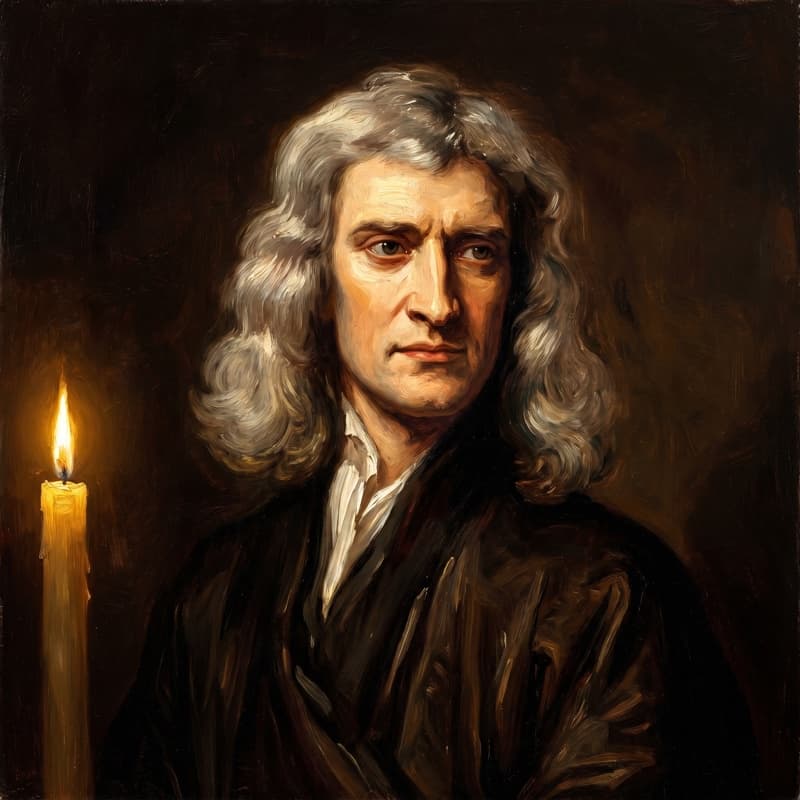
Isaac Newton's most reliable quotes come from two places: the Principia (1687), and his private letters. "I frame no hypotheses," "Nature is pleas'd with simplicity," and "standing on the sholders of Giants" are all real, dated, and traceable to a specific page. The line most people think is Newton's best — the one about a boy on the sea-shore — almost certainly isn't his. Both lists are below.
The three Laws of Motion (1687)
In the Andrew Motte translation, in order:
"Every body perseveres in its state of rest, or of uniform motion in a right line, unless it is compelled to change that state by forces impress'd thereon." — Law I
"The alteration of motion is ever proportional to the motive force impress'd; and is made in the direction of the right line in which that force is impress'd." — Law II
"To every Action there is always opposed an equal Reaction: or the mutual actions of two bodies upon each other are always equal, and directed to contrary parts." — Law III
Axioms, or Laws of Motion, Motte translation, Wikisource
"I frame no hypotheses"
In the General Scholium, Newton drew a hard line between what he had proven and what he was willing to merely guess at — a methodological statement, not a refusal to reason:
"Whatever is not deduced from the phenomena, is to be called an hypothesis... I frame no hypotheses." — General Scholium, Wikisource
In the same passage, on the order he had found, he allowed one unguarded line:
"This most beautiful System of the Sun, Planets, and Comets, could only proceed from the counsel and dominion of an intelligent and powerful being." — General Scholium, Wikisource
On method: "Nature is pleas'd with simplicity"
Rule I of the Principia's "Rules of Reasoning in Philosophy" states the principle behind all three laws:
"We are to admit no more causes of natural things, than such as are both true and sufficient to explain their appearances... Nature is pleas'd with simplicity, and affects not the pomp of superfluous causes." — Rules of Reasoning in Philosophy, Wikisource
Two letters, two disputes
To Robert Hooke, 5 February 1675/6 — a man he'd later feud with bitterly — Newton allowed a rare gesture of debt, in the manuscript's own spelling:
"If I have seen further [than the ancients] it is by standing on the sholders of Giants." — Letter to Hooke, Newton Project
To the clergyman Richard Bentley, 1692–93, ahead of Bentley's Boyle Lectures, Newton flatly rejected gravity acting on its own, without any mediating cause:
"That gravity should be innate, inherent, and essential to matter, so that one body may act upon another at a distance through a vacuum, without the mediation of any thing else... is to me so great an absurdity, that I believe no man who has in philosophical matters any competent faculty of thinking can ever fall into it." — Letter to Bentley, Newton Project
The apple — Stukeley's words, not Newton's
Newton left no first-person quote about the apple. What survives is William Stukeley's account of Newton telling him the story decades later, in the third person: watching an apple fall, Newton "thought he to him self: why should that apple always descend perpendicularly to the ground." Stukeley's memoir, Newton Project Treat this as a paraphrase of a reported thought, not a direct quotation — and note it says nothing about a blow to the head.
The quote he almost certainly never said
"I do not know what I may appear to the world, but to myself I seem to have been only like a boy playing on the sea-shore... whilst the great ocean of truth lay all undiscovered before me" does not appear anywhere in Newton's own writing. It surfaces first in 1820, nearly a century after his death, in Joseph Spence's Anecdotes, sourced to a man who claimed Newton told him this shortly before dying — but who was living in France at the time and didn't return to England until three years after Newton was already dead. Provenance discussion, Today in Science History It may be a beautiful summary of the man. It is not a documented quotation.
From a conversation with our Newton
A stylized excerpt from our AI Newton persona — a recreation, clearly labeled; not a historical transcript.
Caller: Did you really say you were just a boy playing on the sea-shore, with the ocean of truth undiscovered before you?
Newton: I have heard that line attributed to me more often than any sentence I actually wrote, and I have never found it in my own hand. Whoever composed it composed it well. But I did not deduce it from any phenomena of mine, and by my own rule, whatever is not deduced I decline to call my own. What I will own is Law I, Law II, Law III, and the demonstration that binds the falling stone to the orbiting Moon. Attribute those to me freely. The rest is another man's ocean.
More in this cluster: Newton hub · his biography · his death · facts.