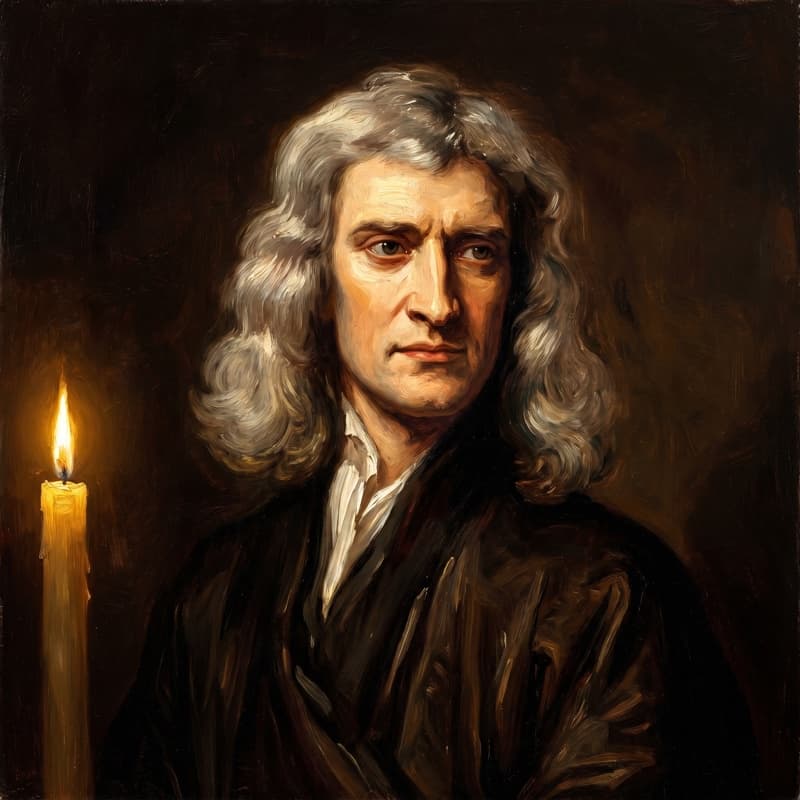
Isaac Newton died at Kensington between one and two in the morning on 20 March 1727, in the Old Style calendar England still used — he was in his eighty-fifth year. He had been failing for months with a stone in the bladder, and in his final weeks suffered what the record calls "violent fits of pain with very brief intermissions." He was buried in Westminster Abbey on 28 March 1727, with a ceremony no English natural philosopher had received before him.
That answers the immediate question. The fuller account — and a calendar trap hiding inside the date — is worth five minutes.
A long decline, not a sudden death
Newton's end had none of the drama that clings to some famous deaths. There was no accident, no single dramatic scene. He simply grew old in office — still Master of the Mint, still President of the Royal Society, still overseeing a third edition of the Principia — while a bladder stone wore him down across his final year. The pain worsened through early 1727 until those brief intermissions were all the relief he got.
Which March 20 — Old Style or New?
Here is the trap for anyone checking this against a modern calendar: England in 1727 still used the Julian ("Old Style") calendar, while most of the European continent had already switched to the Gregorian ("New Style") one. Newton died on 20 March 1727 Old Style — 31 March 1727 New Style. Both dates are correct; they describe the same night in two different calendars, eleven days apart on paper.
Westminster Abbey, an honor without precedent
Newton was buried in Westminster Abbey on 28 March 1727. For a man born to a Lincolnshire farming family, with no title until his 1705 knighthood, that burial was an extraordinary honor — the Abbey's own record describes it as commemorating him as no natural philosopher had been commemorated there before.
The monument: three years in the making
The monument took time to get right. Sculpted by Michael Rysbrack to a design by William Kent, it was finished in August 1730 and unveiled the following year, more than three years after Newton's death. It shows a reclining Newton beneath a relief of putti at work with the tools of his career — a telescope, a prism, a steelyard weighing the sun and its planets — under a Latin epitaph.
Myth-check: this one is actually documented
Compare that to the apple story, and the contrast is the point. Newton's death and burial are unusually well-recorded — a diagnosed illness, dated accounts of his final weeks, an official Abbey record of the funeral and monument. Not every Newton story gets that treatment; this is a good example of what solidly sourced history looks like next to the legends that grew up around him.
From a conversation with our Newton
An excerpt from a conversation with our AI Newton persona — a stylized recreation, honestly labeled, fixed at the year 1705. He has no knowledge of his own death in 1727, more than two decades later.
Caller: Do you ever worry about being forgotten?
Newton: Forgotten as a man, very likely — men are forgotten constantly, and I have made myself difficult enough that I expect no shortage of forgetting on my account. But I did not set down the laws of motion so that Isaac Newton should be remembered. I set them down so that the motion itself should be known, correctly, by whoever cares to look. A law rightly stated outlives the one who stated it. That seems to me a fair trade.
Ask him about the years he did live through
Our Newton — an AI recreation, built from the historical record and labeled as what it is — can't tell you about his final illness or the Abbey; his knowledge stops decades before either. But he can walk you through the plague years at Woolsthorpe, the writing of the Principia, or what he meant by "I frame no hypotheses." Start the conversation whenever you're ready.
More in this cluster: Newton's verified quotes · his biography · fact file · back to the Newton hub.