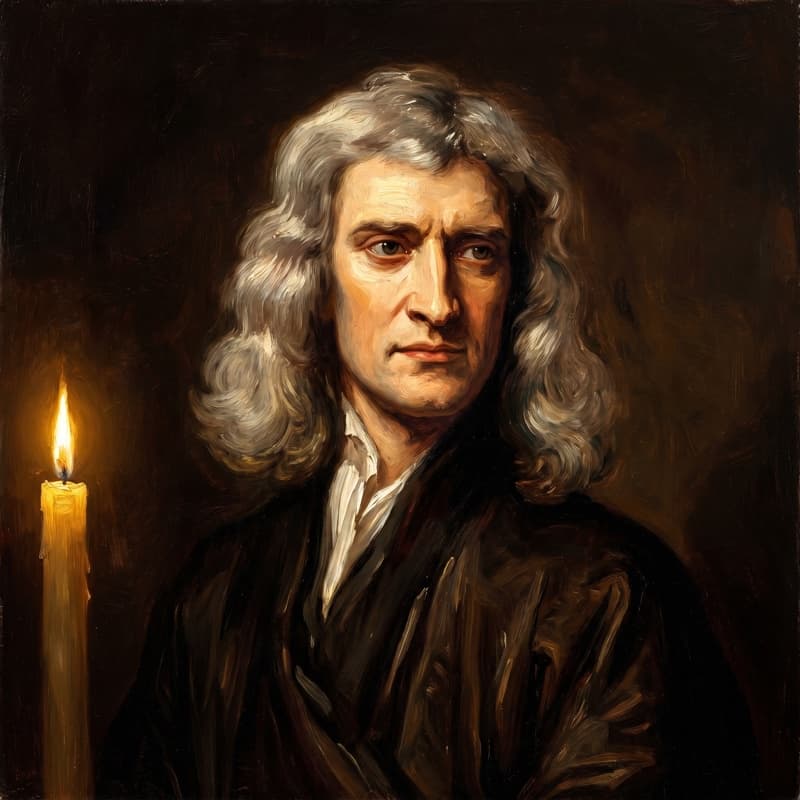
The essential Isaac Newton facts: he was born December 25, 1642 (Old Style calendar), at Woolsthorpe Manor in Lincolnshire, a premature and posthumous child; he entered Trinity College, Cambridge, in 1661 and became Lucasian Professor of Mathematics at just 26; his Principia Mathematica (1687) set out the three laws of motion and universal gravitation; his Opticks (1704) showed that white light is a mixture of colors; he ran the Royal Mint, presided over the Royal Society for over two decades, and was knighted by Queen Anne in 1705. All verified. This page gives you the facts worth keeping — and flags the popular "facts" that don't survive checking, because a facts page that can't tell you what's false is only doing half the job.
The core facts, with why they matter
Born at Woolsthorpe Manor on Christmas Day, 1642, fatherless and premature. His father had died before his birth, leaving a farm childhood with his widowed mother and, after she remarried, his grandmother's household. The distance between that uncertain start and the Lucasian chair is worth sitting with.
Lucasian Professor of Mathematics at 26. Newton entered Trinity College in 1661 and, by 1669, succeeded his own teacher, Isaac Barrow, in Cambridge's most prestigious mathematics chair — before he had published almost any of the work he's now famous for.
The Principia (1687) set out three laws of motion and universal gravitation. This is the single achievement most people mean when they say "Newton" — inertia, force proportional to acceleration, and action-reaction, unified with a mathematical account of gravity that explained both a falling apple and an orbiting planet.
Opticks (1704) is a separate achievement, not a footnote to the Principia. Newton's prism experiments demonstrated that white light is a mixture of differently refrangible colored rays — a finding about light, not motion, arrived at through decades of his own optical work.
He ran the Royal Mint and hunted counterfeiters personally. Warden of the Mint around 1696, then Master in 1699, Newton treated coin-clipping and counterfeiting as prosecutable crimes and pursued cases himself — most notably against the counterfeiter William Chaloner, hanged in 1699.
President of the Royal Society from 1703 until his death. He held England's leading scientific office for the rest of his life, alongside his Mint duties.
Knighted by Queen Anne in 1705.
From a conversation with our Newton
An excerpt from our AI Newton persona — a stylized recreation, honestly labeled; not a historical quotation.
Caller: Did the apple really hit you on the head?
Newton: It did not strike me, sir — it only fell, as apples do, and I was fool enough to ask why it fell straight down rather than sideways or up. That is the whole of the story: a question, not a blow. I have written that hypotheses have no place in experimental philosophy, and I hold to it here — I will not pretend a bruise gave me a theory that in truth cost years of grinding work.
Popular "facts" that need correcting
"An apple fell and hit Newton on the head, and he instantly had the theory of gravity." The documented account — recorded by William Stukeley from conversations with Newton himself — has Newton watching an apple fall and wondering why it always falls straight to the ground. No blow to the head, and no instant finished theory: gravitation, calculus, and his optical work all took years of private effort, much of it during his 1665–1667 plague retreat to Woolsthorpe.
"I do not know what I may appear to the world... a boy playing on the sea-shore... the great ocean of truth." This famous line does not appear anywhere in Newton's own writings. It surfaces first in 1820, in Joseph Spence's posthumously published Anecdotes, sourced to a man who claimed to have heard it from Newton shortly before his 1727 death — despite reportedly being out of the country at the time. Treat it as a well-known legend, not a documented quotation.
Five things Isaac Newton did
- Set out the three laws of motion and the law of universal gravitation in the Principia (1687).
- Proved that white light is composed of a spectrum of colors, published in Opticks (1704).
- Served as Warden, then Master, of the Royal Mint, prosecuting counterfeiters himself.
- Presided over the Royal Society from 1703 until his death.
- Was knighted by Queen Anne in 1705.
The fact pages can't hold him
Facts are the skeleton; the voice is the man. Our Newton — an AI recreation, built from the sourced record and labeled as what it is — can tell you about the Woolsthorpe years before he was famous, about grinding his own telescope mirror, about the guarded years of alchemy and unorthodox theology he kept out of print, and about what "I frame no hypotheses" actually meant to him. Ask him yourself.
More in this cluster: Newton hub · his death · verified quotes · biography.