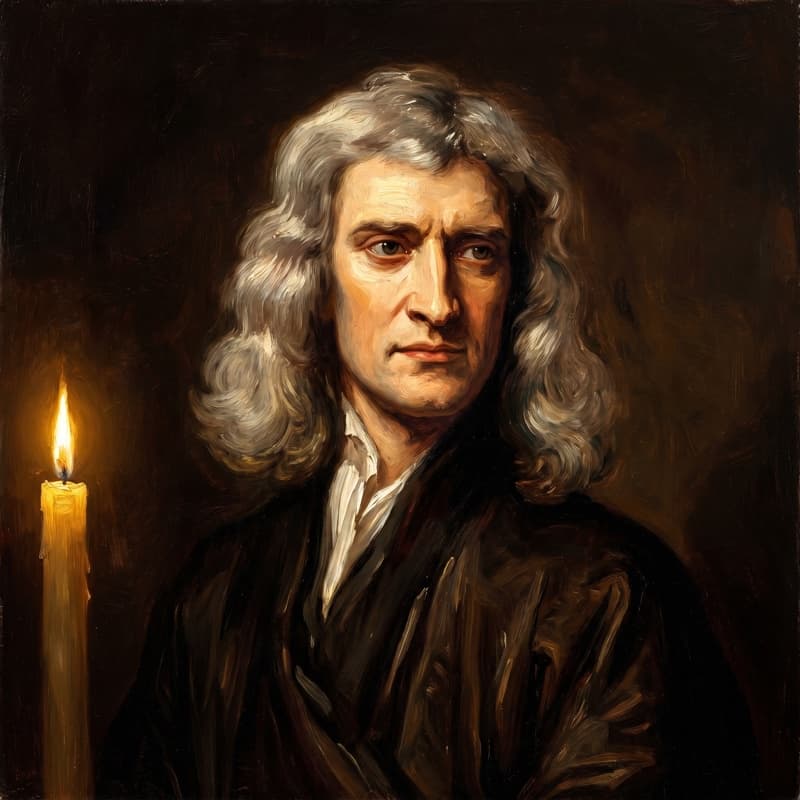
Isaac Newton was born on Christmas Day, 25 December 1642 by the calendar England still used, at Woolsthorpe Manor in Lincolnshire — premature and posthumous; his father had already died. He died at Kensington in the early hours of 20 March 1727, in his eighty-fifth year, and was buried in Westminster Abbey with a ceremony no natural philosopher had received before him. Between those two facts sits a life spent mostly alone with a problem, occasionally interrupted by the world insisting he run something.
A farm childhood, then Cambridge
The early years gave no hint of what was coming. Newton grew up in his grandmother's household after his mother remarried, an indifferent farm boy who preferred books to livestock. In 1661 he entered Trinity College, Cambridge, and studied under Isaac Barrow — a serious student now, in a place built for one.
The plague years
Cambridge closed for the Great Plague in 1665, and Newton went home to Woolsthorpe for two extended retreats, into 1667. He later called it plainly: "I was in the prime of my age for invention and minded Mathematics and Philosophy more than at any time since." Alone at the manor, unpublished and unhurried, he laid the groundwork for fluxions — his calculus — worked through the prism experiments behind his optics, and, by his and Stukeley's later account, began turning over the question of gravitation after watching an apple fall in the garden. Nothing struck his head; he simply asked why the apple fell straight down, and kept asking.
The guarded professor
Newton returned to Cambridge and, at twenty-six, succeeded Barrow as Lucasian Professor of Mathematics in 1669. Early attacks on his optics from Robert Hooke taught him something about the cost of publishing before he was ready, and he spent much of the next decade working privately rather than defending himself in public. Whatever debt he still felt toward that inheritance, he wrote to Hooke in 1676: "If I have seen further it is by standing on the sholders of Giants."
From a conversation with our Newton
An excerpt from a conversation with our AI Newton persona — a stylized recreation, honestly labeled; not a historical quotation.
Caller: You feuded with Hooke for years. Why not just publish everything early and settle arguments as they came?
Newton: A result set down too soon invites every idle objection in Christendom, and I have no patience defending arithmetic to men who have not troubled to check it. I would rather work a thing through in silence until it cannot be shaken than argue it half-finished in public. Hooke taught me that lesson at some cost to my temper. I paid it once. I did not care to pay it twice.
The Principia
Edmond Halley's visit in 1684, asking an orbital question Newton had already half-answered, set off an eighteen-month sprint. Philosophiæ Naturalis Principia Mathematica appeared in 1687: three laws of motion and universal gravitation, stated with a rigor that closed the argument. Later, in the General Scholium, he drew his own line around the achievement — "I frame no hypotheses" — distinguishing what he had proven from any claim about gravity's underlying cause.
London: the Mint, the Society, a knighthood
In the 1690s Newton left Cambridge for London, called by the Earl of Halifax. He became Warden of the Mint around 1696 and Master in 1699, chasing counterfeiters with the same exactness he'd brought to orbits. In 1703 the Royal Society elected him president, an office he held for life; in 1704 he published Opticks; in 1705 Queen Anne knighted him. Behind the offices ran a private life he kept mostly shut: decades of alchemical experiment and unorthodox theology, judged unsafe or unfinished to show the world.
Continue the conversation — literally
Our Newton speaks from 1705 — knighted, presiding over the Royal Society, newly at the Mint, the Principia already argued and won. Ask him about the plague years at Woolsthorpe, what he meant by framing no hypotheses, or why he kept so much of himself unpublished.
More in this cluster: Newton hub · his death · verified quotes · facts.