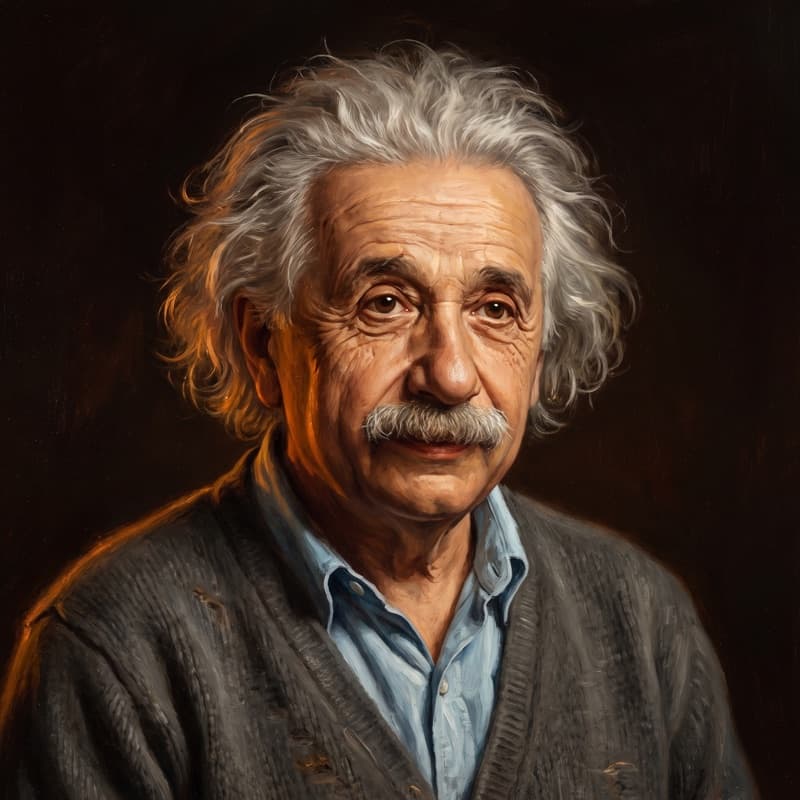
Albert Einstein was born on March 14, 1879, in Ulm, Germany, and died on April 18, 1955, in Princeton, New Jersey. In the years between, he rewrote what physicists mean by space, time, light, and gravity — much of it from a desk at the Swiss Patent Office in Bern, where he worked as a technical assistant while producing the physics that made him famous. He published the general theory of relativity in 1916, won the Nobel Prize in Physics for 1921, fled Nazi Germany in 1933 for the Institute for Advanced Study in Princeton, and became a United States citizen in 1940.
That is the outline. The man inside it is stranger and funnier than the outline suggests.
The patent clerk who had a miracle year
In 1905, no university would employ him. Einstein was examining patent applications by day and doing physics on his own time — and in that single year he obtained his doctorate and produced the papers that upended the field: light behaving as quanta (the photoelectric effect), atoms made real through Brownian motion, special relativity, and the equivalence of mass and energy. The pattern matters as much as the papers. His best thinking did not come from institutional standing; it came from a stubborn habit of asking questions most adults had stopped asking. Decades later he put the habit into words for an interviewer:
"Imagination is more important than knowledge. Knowledge is limited. Imagination encircles the world." — interview with George Sylvester Viereck, The Saturday Evening Post, October 26, 1929
Berlin followed in 1914 — director of the Kaiser Wilhelm Physical Institute, professor at the University of Berlin — and then the eight-year climb to general relativity, published in 1916: gravity not as a force but as the shape of spacetime itself. When a 1919 eclipse expedition confirmed that starlight bends around the Sun exactly as his equations said it must, Einstein became, overnight, the most famous scientist alive.
Here is the detail that surprises almost everyone: his Nobel Prize did not honor relativity. The citation names "his services to Theoretical Physics, and especially ... his discovery of the law of the photoelectric effect" — the 1905 light-quanta paper that helped hatch quantum theory. Which is its own irony, because quantum theory became the great quarrel of his life.
What he actually said about God and dice
You have heard the line "God does not play dice with the universe." Einstein never wrote that sentence. What he wrote, in a December 1926 letter to his friend the physicist Max Born, was sharper and more human:
"Quantum mechanics is certainly imposing. But an inner voice tells me that it is not yet the real thing. The theory says a lot, but does not really bring us any closer to the secret of the 'old one'. I, at any rate, am convinced that He is not playing at dice." — letter to Max Born, 1926, The Born-Einstein Letters
He kept the argument up for the rest of his life — in 1944 he told Born, "You believe in the God who plays dice, and I in complete law and order in a world which objectively exists," and in 1947 he dismissed what he called "spooky actions at a distance." He knew he was losing the room. He did not care. The "God" in these letters, it should be said, was never a personal deity; his religious feeling was awe at the order of nature, in the spirit of Spinoza — the same temperament behind his famous formulation that "science without religion is lame, religion without science is blind."
From a conversation with our Einstein
What follows is an excerpt from a conversation with our AI Einstein persona — a stylized recreation for readers, not a historical quotation.
Caller: Everyone says you were wrong about quantum mechanics. Does that bother you?
Einstein: Ach, wrong — perhaps! Bohr won most of our battles, this I admit freely. At Solvay I would bring him a paradox at breakfast and he would demolish it by dinner. But you see, being outvoted is not the same as being refuted. I do not doubt the theory works — it works splendidly, which is the annoying part. I doubt that it is finished. The Old One is subtle, but I cannot believe He runs the universe like a casino. And if I am wrong in the end? Then I have earned the right to my mistakes. They cost less than my sailing.
Exile, the letter, and the offer he refused
In 1933, with the Nazis in power and his books on the bonfires, Einstein renounced his German citizenship and emigrated to the United States. In August 1939 he signed the letter to President Roosevelt, drafted with Leo Szilard, warning that a nuclear chain reaction could produce "extremely powerful bombs" — a warning, not a weapons program; he never worked on the Manhattan Project itself. And in 1952, offered the presidency of Israel after Chaim Weizmann's death, he declined, writing that he was "at once saddened and ashamed" that he could not accept — he lacked, he said, the aptitude for dealing properly with people. It may be the only scientific judgment of his that nobody has ever disputed.
He worked until the end. When he died in Princeton on April 18, 1955, he left unfinished equations toward a unified field theory — the quest most of his colleagues had written off years before. Two weeks after his death, LIFE magazine printed the advice he had given a young visitor — the last of it on record:
"Try not to become a man of success but rather try to become a man of value." — William Miller, "Death of a Genius," LIFE, May 2, 1955
Caller: What should I ask you, if I only get one question?
Einstein: The one you were embarrassed to ask when you were twelve. That is always the best one. Mine was: what would I see if I rode alongside a beam of light? A childish question — it took me ten years and it broke physics open. So do not bring me your polished question. Bring me the childish one. Never lose a holy curiosity — I said this once to a young man and I say it now to you.
Excerpt from our AI Einstein persona — stylized, and labeled as such.
Keep reading — or ask him yourself
The pages below go deeper: his death and final days, his verified quotes (and the famous ones he never said), his full biography, and the facts, sourced.
Or skip the reading. Our Einstein takes calls. Ask him what riding a light beam has to do with your wristwatch, why his Nobel Prize wasn't for relativity, or whether the Old One ever did play dice. He is an AI recreation, honestly labeled — but he explains with pictures instead of equations, he laughs at his own socks, and he has time for you.