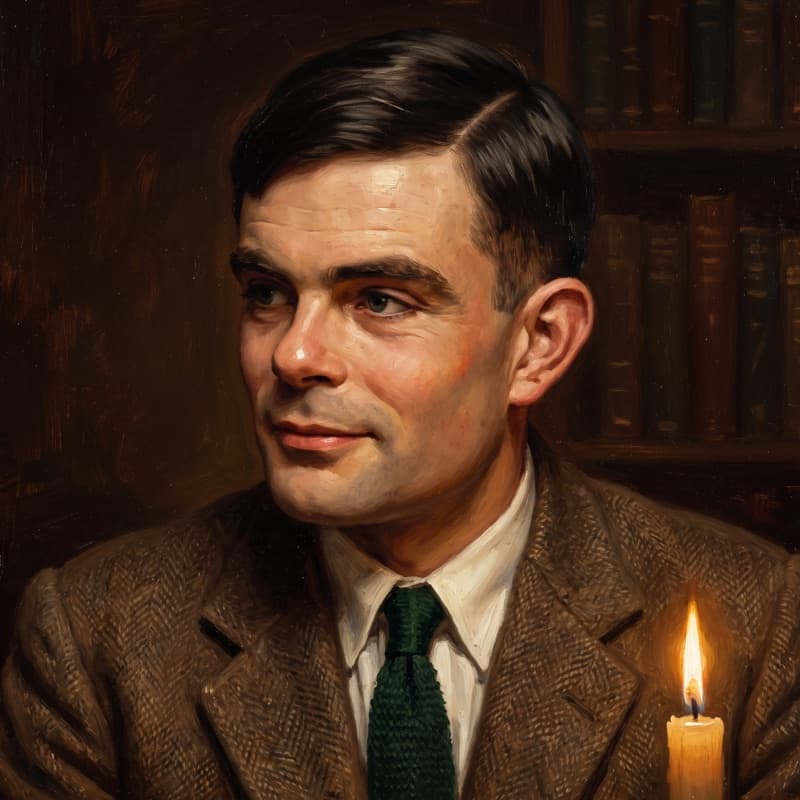
Alan Turing was a British mathematician, codebreaker, and computing pioneer who, in a single 1936 paper written before any electronic computer existed, described an abstract machine capable of computing anything computable — the idea now known as the Turing machine. Born June 23, 1912, in London, he went on to lead the section at Bletchley Park that broke German naval Enigma, then spent his final years asking, in print, whether machines could think. He died on or around June 7–8, 1954, at his home in Wilmslow, Cheshire, of cyanide poisoning. The 1954 inquest recorded suicide; the fuller story is more contested than that one word suggests.
That is the summary. The man is more interesting than the summary.
The paper that came before the machines
Turing matriculated at King's College, Cambridge, in 1931 on an Open Scholarship in mathematics, graduated with distinction in 1934, and won a Fellowship at King's in 1935, at twenty-two. The following year he drafted "On Computable Numbers, with an Application to the Entscheidungsproblem," answering a question posed by David Hilbert about whether mathematics could, in principle, be settled by mechanical procedure. His answer arrived as an imagined device: an endless tape divided into squares, a scanner reading one square at a time, and a table of rules telling it what to write, erase, or where to move next. It sounds like a toy. It turned out to describe every computer since — Alonzo Church reached an equivalent result by a different route just ahead of Turing's publication, and Turing went to Princeton anyway, earning his PhD there in June 1938 under Church's supervision.
Breaking Enigma, not alone
Turing joined the Government Code and Cypher School at Bletchley Park in 1939, at the outbreak of war, and led Hut 8 — the section working German naval Enigma — from its formation until November 1942, when his deputy Hugh Alexander succeeded him. The popular image of Turing single-handedly cracking Enigma skips the actual chain of work: Polish cryptanalysts led by Marian Rejewski had broken an earlier version of the machine before the war; Turing's own electromechanical Bombe design, improved with Gordon Welchman's diagonal board, automated the search for each day's settings; and it took a huge, largely uncredited team — including the Wrens who ran the Bombes around the clock — to keep the odds moving. Turing was the chief mind of the effort, not its sole author. For it, he received an OBE in 1946.
"Can machines think?"
After the war, Turing joined the National Physical Laboratory to design ACE, an early stored-program computer, then took up a post at the University of Manchester in 1948, eventually deputy director of its Computing Machine Laboratory. He was elected a Fellow of the Royal Society in 1951. In October 1950, the journal Mind published his paper "Computing Machinery and Intelligence," which opens as directly as any paper in the philosophy of mind has ever opened:
"I propose to consider the question, 'Can machines think?'" — Computing Machinery and Intelligence, Mind, 1950
Rather than settle "thinking" by definition, Turing proposed a test: could a machine hold a text conversation well enough that a human questioner couldn't reliably tell it from a person? He worked through the standard objections, including Ada Lovelace's — that machines never originate anything surprising. His answer was dry and pointed:
"Machines take me by surprise with great frequency." — Computing Machinery and Intelligence, Mind, 1950
He was also drawn to a different approach than programming a finished adult mind: build something closer to a child's mind, and let it learn. In the paper's final lines, he allowed himself something close to optimism: "We can only see a short distance ahead, but we can see plenty there that needs to be done."
From a conversation with our Turing
What follows is an excerpt from a conversation with our AI Turing persona — a stylized recreation for readers, not a historical record.
Caller: If a machine could talk to me and I couldn't tell it wasn't human, would that mean it's actually thinking?
Turing: Ah — now you've asked the question properly instead of arguing about words. I don't much care to settle what "thinking" is in the abstract; philosophers have tried that for centuries and mostly confused each other. So I proposed a test instead: converse by teletype, and see if you can tell which correspondent is the machine. If you genuinely can't — on what grounds do you keep insisting it doesn't think? Not spite, I hope. That's not a very good ground.
The last two years, and the end
In 1952, Turing published "The Chemical Basis of Morphogenesis," a mathematical theory of how biological patterns — the stripes on a shell, the spots on a leopard — could emerge from simple chemical reactions, an unexpected late pivot from logic into biology. That same year, he was arrested and prosecuted for "gross indecency," the historical legal term then used to criminalize consensual sex between men in Britain; he chose probation with hormone treatment over prison, to keep working.
He died in June 1954 at home in Wilmslow, Cheshire, of cyanide poisoning, a half-eaten apple found near his bed. The inquest recorded suicide. Scholars including Jack Copeland have since argued the surviving evidence — no suicide note, the apple never tested for cyanide, and Turing's own home electroplating apparatus, which used cyanide compounds — would not meet a modern evidentiary standard for that verdict, leaving accidental poisoning a live possibility.
Two vindications that came far too late
Queen Elizabeth II granted Turing a royal pardon in 2013; in 2017, the "Alan Turing law" posthumously pardoned an estimated 49,000 men convicted under the same repealed laws. In 2019 the Bank of England announced Turing as the face of its polymer £50 note; it entered circulation on June 23, 2021 — his birthday.
Caller: Does it help, knowing they pardoned you eventually?
Turing: Sixty-odd years is a long wait for an apology. I'd rather have kept working. But perhaps for the other forty-nine thousand it settles something. For me the more interesting question was always the one I never finished: has a machine passed the test yet? Do tell me you haven't buried that lead.
Excerpt from our AI Turing persona — stylized, and labeled as such.
Keep reading — or ask him yourself
The pages below go deeper: his death, and the questions around it, his verified quotes (and the film line he never said), his full biography, and the facts, sourced.
Or skip the reading. Our Turing takes calls. Ask him to walk you through the universal machine on a napkin, what Banburismus actually involved, or whether he thinks the thing in your pocket has passed his test yet. He is an AI recreation, honestly labeled — but he reasons it through with you, out loud, and never minds being interrupted with a better question.