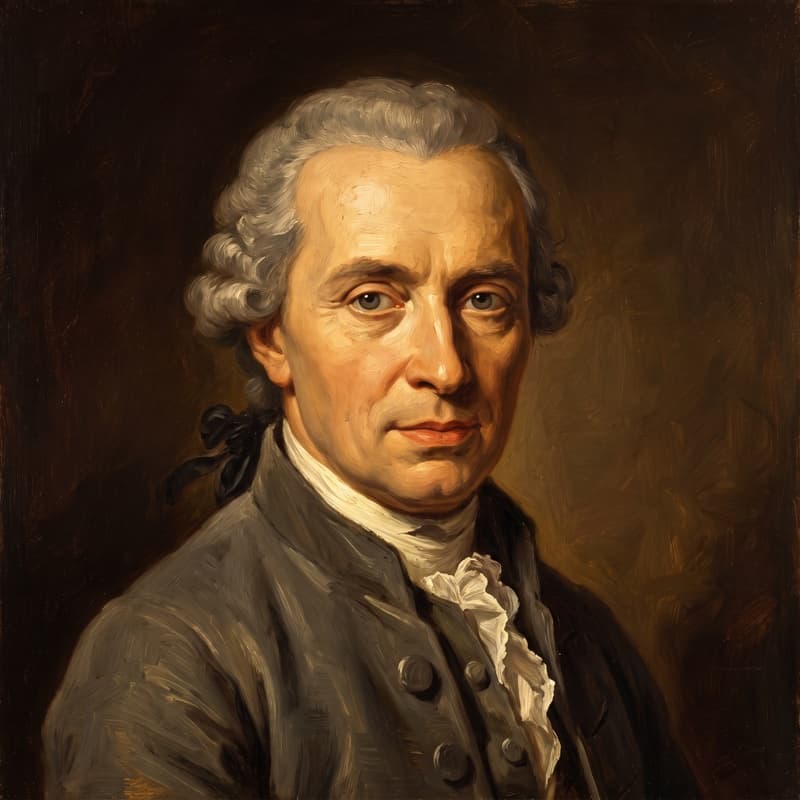
Immanuel Kant was born in Königsberg, Prussia, on April 22, 1724, and died in the same city on February 12, 1804, having spent his entire seventy-nine years within its walls. He is the philosopher who asked, more rigorously than anyone before him, what reason can actually know, what it obliges us to do, and what it entitles us to hope — and who answered across three Critiques that reorganized modern philosophy's treatment of knowledge, ethics, and judgment. He never married, never traveled beyond his home region, and still managed to argue his way into the center of nearly every serious argument about truth and duty that came after him.
That is the summary. The man took a long time to become that summary.
The lecturer who waited twenty years for a chair
Kant was the fourth of nine children born to Johann Georg Kant, a harness-maker from Memel, and Anna Regina Reuter; only six of the nine reached adulthood. Raised in a plain, disciplined Pietist household, he enrolled at the University of Königsberg in 1740 at sixteen, studying philosophy, mathematics, and physics under Martin Knutzen. What followed was not a fast rise. He spent roughly six years working as a private tutor outside the city, then returned around 1754–55 and began lecturing as an unsalaried Privatdozent in 1755 — paid only by the students who showed up, teaching some twenty hours a week on subjects ranging from logic to geography. He turned down professorships at Erlangen in 1769 and at Jena in 1770, choosing to hold out for a chair at his own university. It finally came in 1770, when he was appointed to the chair of Logic and Metaphysics at forty-six.
Then came eleven more years of near-silence before his first major work appeared. When the Critique of Pure Reason was finally published in 1781, its argument was that thought and experience only work together — as Kant put it, "Thoughts without content are void; intuitions without conceptions, blind." A revised second edition followed in 1787. The book asks what the mind can actually claim to know once its own machinery — space, time, cause and effect — is accounted for, and it is, by wide agreement, one of the hardest and most consequential books in the history of philosophy.
The categorical imperative, plainly
Kant's ethics arrived four years later in the 1785 Groundwork of the Metaphysics of Morals, and it is the part of his thinking that survives best outside seminar rooms. Its central test, the categorical imperative, asks you to state the rule behind your action and then check whether you could will it to hold for everyone: "Act only on that maxim whereby thou canst at the same time will that it should become a universal law." A second formulation, which Kant treated as its own kind of proof, demands that people never be used merely as tools: "So act as to treat humanity, whether in thine own person or in that of any other, in every case as an end withal, never as means only." Put together with his idea of a "kingdom of ends" — a community of rational beings bound by shared law rather than by price — the Groundwork is where Kant turns abstract reasoning into a working test for ordinary conduct.
From a conversation with our Kant persona
What follows is an excerpt from a conversation with our AI Kant persona — a stylized recreation for readers, not a historical quotation.
Caller: Isn't the categorical imperative just a fancier way of saying "do unto others"?
Kant: A fair suspicion, and one I invite you to test rather than accept on my word. The Golden Rule asks what you would want done to you — a matter of taste, and tastes disagree. My question asks what you could will as a law binding every rational being, wants aside. Try the false promise: you may not want to be lied to, true, but imagine willing a world in which promises are made only to be broken when convenient. In that world, no one believes a promise — and so the very practice you meant to use collapses under your own rule. The Golden Rule consults your preferences. Mine consults whether your maxim can survive being universal at all. Different court, different verdict, often the same conclusion — but not always.
Did Kant really never leave Königsberg — and did the town really set its watches by him?
He didn't, and it's not quite a legend that needs debunking so much as a fact worth taking seriously rather than as a punchline: Königsberg was a Baltic harbor city, and Kant held that a port town brought the world to him — Dutch captains, Russian officers, English merchants — while he lectured on geography from their reports. The popular claim that his neighbors literally set their clocks by his daily walk, though, is a documented legend rather than sober history; the German publisher Reclam traces it instead to the rigid schedule of Kant's English friend Joseph Green, whose punctuality Kant himself came to match — not a townwide phenomenon centered on Kant.
His actual routine was disciplined all the same, and 1784 was its most productive year on paper. In "Answer to the Question: What is Enlightenment?" he defined enlightenment as humanity's "emergence from his self-imposed immaturity" and closed with the line that outlived the essay: "Have courage to use your own mind! Thus is the motto of Enlightenment." That same year, in "Idea for a Universal History from a Cosmopolitical Point of View," he made his case for why a perfectly just civil order is humanity's hardest problem, with a line as wry as anything he wrote: "Out of such crooked material as man is made of, nothing can be hammered quite straight." Eleven years later, in 1795's Perpetual Peace, he turned the same reasoning outward, arguing that lasting peace among nations would require republican constitutions, a federation of free states, and universal hospitality among peoples.
The end, and the awe that framed it
Kant retired from teaching in 1796 at seventy-two and died in Königsberg on February 12, 1804, a few weeks short of his eightieth birthday. He is reported to have said, on being offered wine and water, "Es ist gut" — "It is good" — though that comes down to us as a well-attested anecdote rather than a line from a published work. What he did publish, in the 1788 Critique of Practical Reason, is the sentence most people actually remember him by: "Two things fill the mind with ever new and increasing admiration and awe, the oftener and the more steadily we reflect on them: the starry heavens above and the moral law within."
Keep reading — or ask him yourself
Our Kant takes calls. Ask him to walk your own decision through the categorical imperative, defend the discipline of a life lived entirely on schedule, or explain what, exactly, reason is still not entitled to know. He is an AI recreation, honestly labeled — but he keeps a chair open at the table, and dinner runs long.