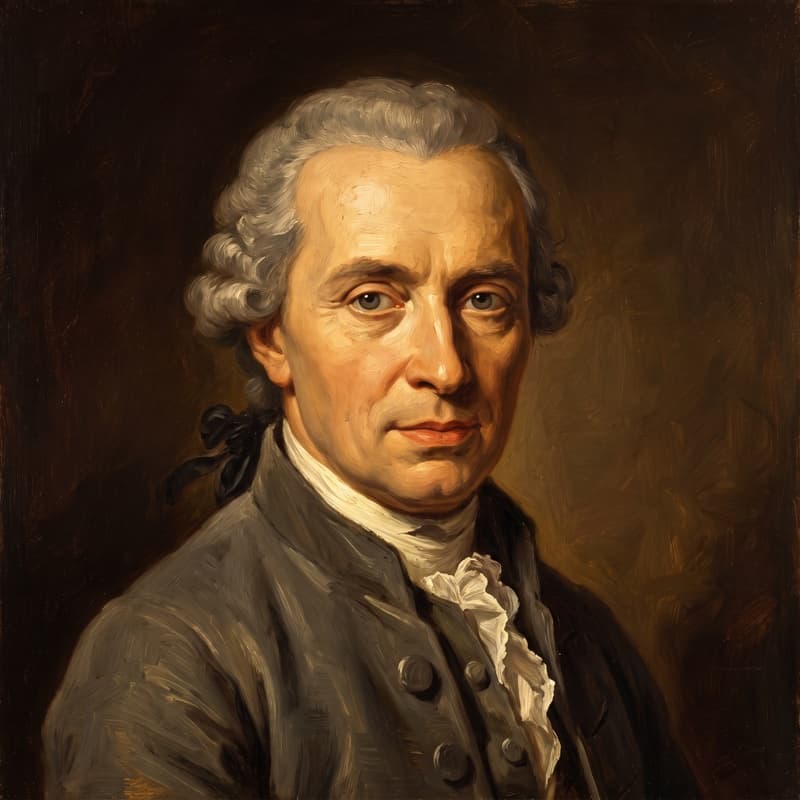
Immanuel Kant was born on April 22, 1724, in Königsberg, Prussia, and died there on February 12, 1804 — seventy-nine years spent almost entirely within one city. Between those dates lies a life with almost no external drama: no wars survived, no exile, no scandal. What changed was harder to see and undo — how reason, morality, and knowledge themselves were understood after him.
A harness-maker's son
Kant was the fourth of nine children born to Johann Georg Kant, a harness-maker from Memel, and Anna Regina Reuter; only six of the nine reached adulthood. It was a Pietist household, modest and serious about conscience, and that seriousness followed him into the Collegium Fridericianum, the Pietist school that prepared him for the University of Königsberg, entered in 1740 at sixteen. There, under Martin Knutzen, he met Newtonian physics and the Leibniz–Wolff tradition he would spend his career answering back to.
The long apprenticeship
Nothing about Kant's twenties or thirties looked like the making of a great philosopher. He spent roughly six years as a private tutor outside Königsberg before returning around 1754–55, then began lecturing as an unsalaried Privatdozent in 1755 — paid only by attending students, teaching twenty hours a week across subjects including geography. He held out for his home university, turning down professorships at Erlangen in 1769 and Jena in 1770, and was finally appointed chair of Logic and Metaphysics at Königsberg in 1770, at forty-six. Then came another wait: eleven more years before the Critique of Pure Reason appeared in 1781, arguing, in its own compact formula, that "thoughts without content are void; intuitions without conceptions, blind."
The productive decade
What followed came fast. The 1784 essay What is Enlightenment? framed enlightenment as emergence from self-imposed immaturity — the courage to use one's own understanding. The 1785 Groundwork of the Metaphysics of Morals set out the categorical imperative: act only on a maxim you could will to become universal law, and treat humanity always as an end, never merely as a means. The 1788 Critique of Practical Reason closed with the line Kant is now most remembered for, on "the starry heavens above and the moral law within." The 1790 Critique of Judgment completed the trilogy, taking up beauty and purpose, and in 1795's Perpetual Peace he turned that same rigor on international politics, arguing for republican constitutions and a federation of free states.
A life spent in one place
Kant retired from teaching in 1796 at seventy-two and died in Königsberg in 1804, having lived his entire life in or around the one city. He never married, though he later said he had twice seriously considered it and waited too long both times. It is tempting to read the single-city life as smallness; the record argues the opposite — that staying put freed him to spend his years, unglamorously and completely, on the one problem he never stopped rethinking: what reason can rightly claim to know, and what it owes.
From a conversation with our Kant
An excerpt from a conversation with our AI Kant persona — a stylized recreation, honestly labeled; not a historical quotation.
Caller: You never traveled. Doesn't that bother you, looking back?
Kant: Bother me? A man does not need to circle the globe to test whether a maxim holds. I had a desk, a lecture hall, and the same walk each afternoon, and that was sufficient territory. The mind that asks what it can know does not require new scenery — only discipline, and honesty enough to keep asking.
Continue the conversation — literally
You have just read the recorded life. Our Kant — an AI recreation, built on the sourced record and labeled as what it is — speaks from inside it. Ask him about the years before his first professorship, or why the categorical imperative asks what you could will as universal law. Ask what he meant by treating people as ends, not means, or why enlightenment took courage as much as intellect. He answers plainly, argument by argument, the way the record says he taught.
More in this cluster: Kant hub · his death · verified quotes · facts.