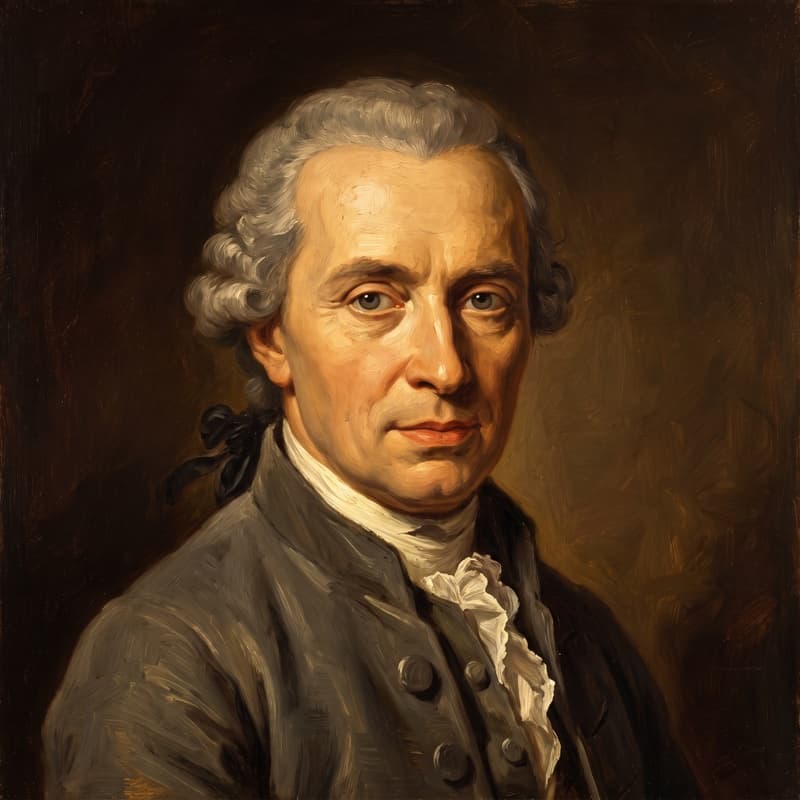
Immanuel Kant died in Königsberg on February 12, 1804, at age 79, after health that had been poor for years finally gave out (Wikipedia; Stanford Encyclopedia of Philosophy). He was a few months short of his eightieth birthday. He is reported to have said "Es ist gut" — "It is good" — when offered wine and water shortly before the end (Wikipedia).
That answers the search. What it leaves out is how long the decline actually was, and why the ordinary facts of his last years are more interesting than any invented drama would be.
A long decline, not a sudden one
Kant retired from teaching in 1796 at 72, already past the punishing schedule he had kept for decades (Stanford Encyclopedia of Philosophy). Wikipedia's account of his final years describes health "long poor" that "worsened" toward the end, rather than a single dramatic collapse — the picture is of a body wearing down over years, not a sudden reversal (Wikipedia). He kept working anyway. His last, unfinished project — a manuscript wrestling with the transition from the metaphysical foundations of natural science to physics itself — was left incomplete at his death and later published under the title he never got to give it a final form for: the Opus Postumum (Wikipedia). A philosopher who had spent his whole career insisting that thought needs discipline and structure died with one more structure still unbuilt.
The single city, to the end
Kant was born in Königsberg on April 22, 1724, and died there seventy-nine years and roughly ten months later, having spent his entire life in or immediately around that one city (Stanford Encyclopedia of Philosophy; Wikipedia). That is not a punchline about a small life. He read enormously, corresponded widely, and lectured for years on geography and the wider world he never physically visited. The single-city fact belongs here mainly as context for the ending: Königsberg is where the whole biography happened, start to finish, so it is also, unremarkably, where it stopped.
"Es ist gut" — a well-attested anecdote, not a verified quotation
The reported last words carry less evidentiary weight than the philosophical quotations elsewhere on this site. "Es ist gut" comes down through biographical tradition and is repeated by reference sources like Wikipedia, but it is not a passage from a published work that can be checked, word for word, against a page in the Critique of Pure Reason or the Groundwork the way Kant's own written arguments can. Treat it as what it is: a widely reported deathbed anecdote about a man who spent his life demanding exact reasoning, offered here with that same demand for precision about what is and isn't verified.
From a conversation with our Kant
An excerpt from a conversation with our AI Kant persona — a stylized recreation, honestly labeled, not a historical quotation.
Caller: Were you afraid, near the end, of leaving so much unfinished?
Kant: Afraid is the wrong category, friend — fear belongs to what might still be avoided, and a body's decline is not that kind of object. I regret it, certainly, the way one regrets a proof interrupted before its last line. But regret is compatible with duty discharged. I did not owe the world a completed system. I owed it honest work, pursued as far as reason and health allowed, and I gave what I had. The rest is for other hands, in other cities, to finish or to leave standing as a fragment. Either way, the work was never really mine to keep.
More in this cluster: Kant's verified quotes · his biography · fact file · back to the Kant hub.