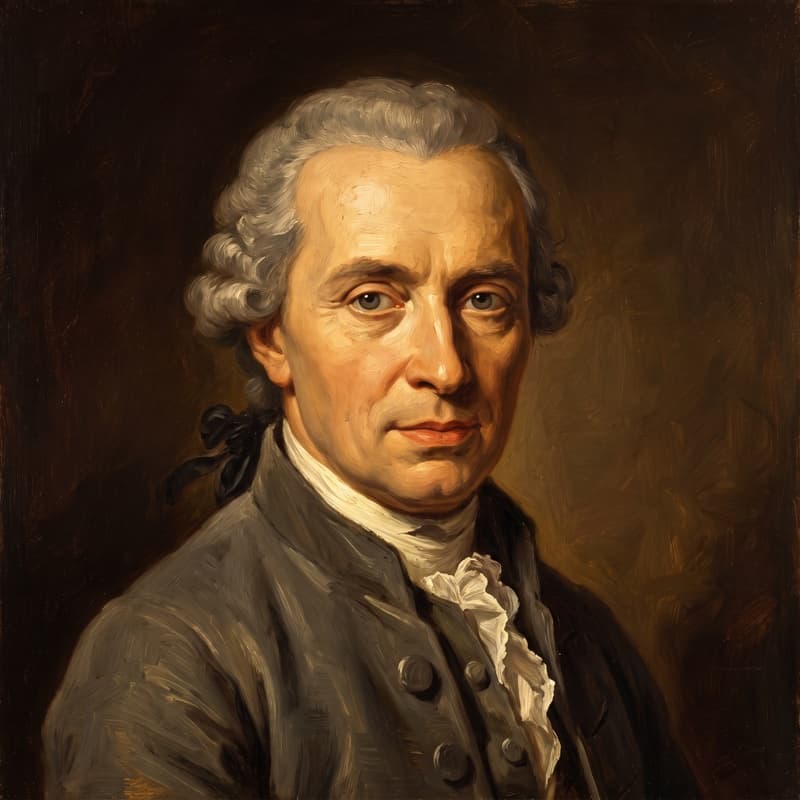
The essential Immanuel Kant facts: he was born April 22, 1724, in Königsberg, Prussia, and died there February 12, 1804, having lived his entire seventy-nine years in or immediately around that one city; he was the fourth of nine children of a harness-maker; he did not reach a salaried professorship until age forty-six, after roughly twenty years of tutoring and unsalaried lecturing; he wrote three Critiques that reorganized modern philosophy's treatment of knowledge, ethics, and judgment; and he never married, though he later said he twice seriously considered it. All verified. This page gives you the facts worth keeping — and flags the popular "facts" that don't survive checking, because a facts page that can't tell you what's false is only doing half the job.
The core facts, with why they matter
Born April 22, 1724, in Königsberg, and never really left. Kant lived his whole life in or near that one Prussian city, from birth through his 1804 death there. The scale of what he built inside a single, unremarkable university town is a large part of the story: no journeys, no exile, no relocation — just decades of sustained work in one place.
Fourth of nine children of a harness-maker. His father, Johann Georg Kant, made harnesses in Königsberg; his mother was Anna Regina Reuter. Only six of the nine children reached adulthood. The household was Pietist — modest, disciplined, serious about conscience — and that seriousness shows up later in a philosophy built almost entirely around duty.
He didn't become a paid professor until forty-six. Kant tutored privately for roughly six years, then lectured as an unsalaried Privatdozent from 1755 onward, paid only by students who chose to attend. He turned down professorships at Erlangen and Jena to hold out for a chair at his own university, which finally came in 1770. Two more decades passed before he held a permanent post than most people assume of a famous philosopher.
He wrote three Critiques, not one. The Critique of Pure Reason (1781) is the famous one, but Kant followed it with the Critique of Practical Reason (1788), on morality and the will, and the Critique of Judgment (1790), on beauty and purpose. Treating him as a single-book thinker misses two-thirds of the project.
He lectured on geography and physical science, not just metaphysics. For years his teaching load ran to roughly twenty hours a week across subjects including geography — a reminder that "pure reason" was his conclusion, not his whole working life.
He never married, despite twice considering it. By his own later account, he seriously weighed marriage on two occasions and, in each case, deliberated too long. There is no record of a wife or children.
From a conversation with our Kant
An excerpt from a conversation with our AI Kant persona — a stylized recreation, honestly labeled; not a historical quotation.
Caller: What's the one fact about you that people always get wrong?
Kant: That my neighbors organized their afternoons around my punctuality, as though a city set its clocks by one philosopher's boots. It is a charming story and, I am told, largely someone else's habit attached to my name after the fact. I kept a schedule; I did not command one. A fact repeated because it flatters the subject deserves a second look before a third repetition.
Popular "facts" that need correcting
"Königsberg set its clocks by Kant's daily walk." A documented legend, not sober biography. The German publisher Reclam traces the story instead to the rigid schedule of Kant's English friend Joseph Green, whose punctuality Kant came to match — not a townwide phenomenon built around Kant himself. His routine really was disciplined; the "whole city" version is folklore.
"Live your life as though your every act were to become a universal law." This loose paraphrase circulates widely as if it were a direct Kant quotation. It isn't. His actual formulation, from the 1785 Groundwork, is more precise and more demanding: "Act only on that maxim whereby thou canst at the same time will that it should become a universal law."
"Kant was born in 1720." He was born in 1724. The date is well-established across primary biographical sources and shouldn't be confused with the earlier year that sometimes circulates.
Five things Immanuel Kant did (the honest short list)
- Published the Critique of Pure Reason in 1781, examining the scope and limits of human knowledge.
- Set out the categorical imperative in the 1785 Groundwork of the Metaphysics of Morals.
- Published the Critique of Practical Reason in 1788 and the Critique of Judgment in 1790, completing the trio.
- Argued for republican constitutions and a federation of free states in 1795's Perpetual Peace.
- Held a university chair at Königsberg from 1770 until his 1796 retirement, after decades of unsalaried teaching.
The fact pages can't hold him
Facts are the skeleton; the voice is the man. Our Kant — an AI recreation, built from the sourced record and labeled as what it is — can walk you through why the categorical imperative asks what you could will, not just what you'd prefer, and what a life spent entirely inside one Baltic university town actually looked like from the inside. Ask him to test one of your own decisions against his own standard. He's ready when you are.
More in this cluster: Kant hub · his death · verified quotes · biography.