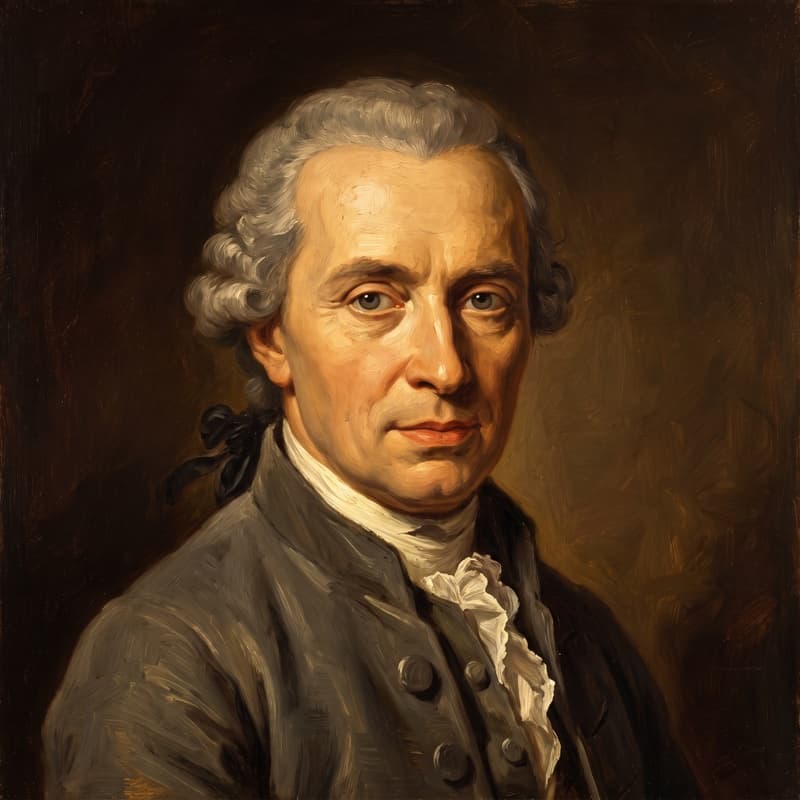
Immanuel Kant's two most quoted sentences are also his most demanding: "Act only on that maxim whereby thou canst at the same time will that it should become a universal law," and "So act as to treat humanity … never as means only" — both from the Groundwork of the Metaphysics of Morals (1785). Neither is a slogan; each is a test, and it only works with the whole sentence. Below are his verified words, sourced to the translations he's printed in, plus the tidy modern paraphrase passed around in his name.
The categorical imperative, exactly
The Groundwork's second section states the test as a rule behind an action:
"Act only on that maxim whereby thou canst at the same time will that it should become a universal law."
A few pages later, Kant restates the demand in terms of persons, not rules:
"So act as to treat humanity, whether in thine own person or in that of any other, in every case as an end withal, never as means only."
(Fundamental Principles of the Metaphysic of Morals, AA 4:421 and AA 4:429, trans. Thomas Kingsmill Abbott, Project Gutenberg)
The line most people actually remember
His own summation, from the conclusion of the second Critique, is the line readers keep after the argument around it fades:
"Two things fill the mind with ever new and increasing admiration and awe, the oftener and the more steadily we reflect on them: the starry heavens above and the moral law within."
(The Critique of Practical Reason, AA 5:161, trans. Thomas Kingsmill Abbott, Project Gutenberg)
The first Critique, in one line
The Critique of Pure Reason runs hundreds of pages; this sentence carries its central claim:
"Thoughts without content are void; intuitions without conceptions, blind."
(Critique of Pure Reason, A51/B75, trans. J. M. D. Meiklejohn, Project Gutenberg)
Sapere aude, with the argument attached
Kant's 1784 answer to "What is Enlightenment?" usually gets flattened into a two-word motto. He wrote the reasoning, not just the slogan:
"Enlightenment is man's emergence from his self-imposed immaturity. Immaturity is the inability to use one's understanding without guidance from another. … Sapere Aude! … Have courage to use your own mind! Thus is the motto of Enlightenment."
(Answer to the Question: What is Enlightenment?, AA 8:35, trans. Daniel Fidel Ferrer, Internet Archive)
A wry line about human nature
From his 1784 essay on universal history, not all of it is dry architecture:
"Out of such crooked material as man is made of, nothing can be hammered quite straight."
(Idea for a Universal History from a Cosmopolitical Point of View, AA 8:23, trans. W. Hastie, Internet Archive)
A line he didn't write
"Live your life as though your every act were to become a universal law" circulates online as Kant's own wording. It isn't — a loose paraphrase of the sentence quoted above, and the real one earns its extra clauses. A second line, sometimes pinned on his lecture transcriptions about cruelty to animals, has no stable primary text behind it; treat it as unverified.
From a conversation with our Kant
An excerpt from our AI Kant persona — a stylized recreation, clearly labeled; not a historical quotation.
Caller: People shrink your ethics down to "imagine if everyone did it." Is that fair?
Kant: It is the start of the thought and the end of the rigor. Ask whether you could will the maxim as law, not merely picture the scene — a thief can picture a world of thieves; he cannot will one, since the property he depends on collapses once everyone steals.
Read him exactly, then ask him directly
Quote cards flatten Kant into a rule-obsessed puritan or a starry-eyed idealist. The primary texts hold both: an exacting test for action, and open awe at what it can't fully explain.
More in this cluster: Kant hub · his biography · death · facts.