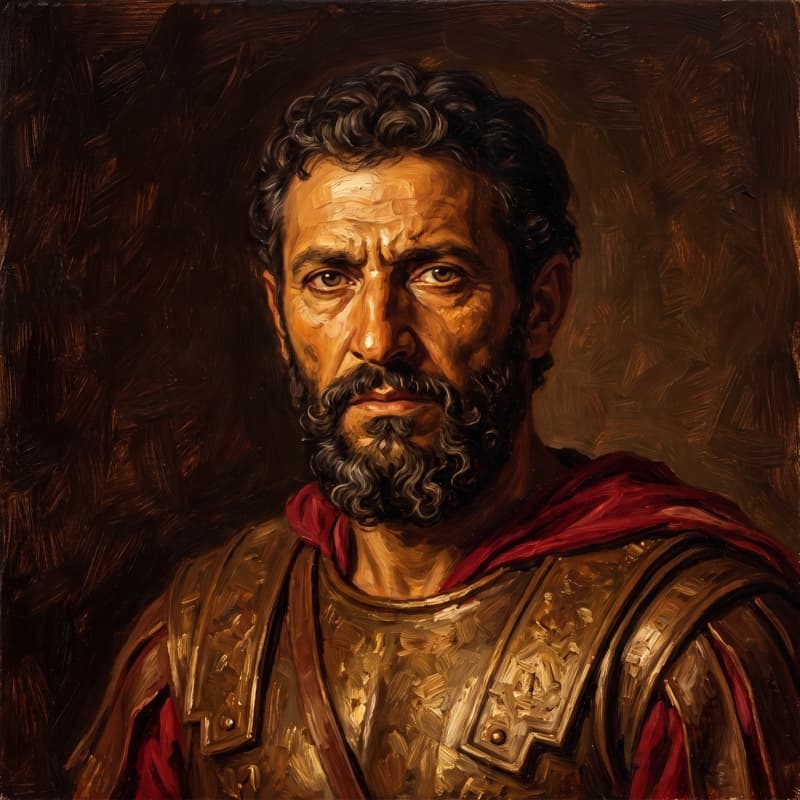
Who was Hannibal Barca? A Carthaginian commander born in Carthage in 247 BCE (Livius.org; Wikidata) who led an army over the Alps into Italy, won three escalating victories against Rome, held the Italian countryside roughly fifteen years without reinforcement, and died by his own hand rather than be handed to Rome, winter 183/182 BCE (Livius.org). Some dates are disputed by a year; this page says so.
The oath, the command, Saguntum
Livy tells it as a childhood scene: Hannibal's father Hamilcar Barca led the boy to an altar and made him swear that as soon as he was able, he would be "the declared enemy of the Roman People" (Livy, History of Rome XXI.1) — Livy's report of a scene, not Hannibal's recorded words, but it sets the shape of the life that follows. Hamilcar took his son into the army camps of Punic Iberia, and there, after the 221 BCE assassination of his brother-in-law Hasdrubal, soldiers elected the roughly twenty-six-year-old Hannibal commander, a choice Carthage's government confirmed rather than overturned (Livius.org). Two years later he besieged and captured Saguntum, an Iberian city allied to Rome, after an eight-month blockade — the act, not a villain's whim, that helped trigger the Second Punic War, the two powers having circled a rematch since their first war ended, 241 BCE (Livius.org).
Over the Alps
In 218 BCE Hannibal crossed the Ebro, the Pyrenees, and the Rhône, then took roughly 50,000 infantry, 9,000 cavalry, and dozens of elephants over the Alps into Italy (Livius.org, "Hannibal in the Alps"). Which pass he used is still argued among historians, not settled (Smithsonian Magazine); a large share of the army, and most of the elephants, did not survive the crossing.
Three victories, one masterpiece
Tactical range on display: Hannibal beat Roman forces at the Ticinus and the Trebia in 218 BCE, destroyed an army by ambush at Lake Trasimene in 217 BCE, and on August 2, 216 BCE, at Cannae, annihilated a far larger Roman force in a double envelopment still taught at war colleges (Livius.org). His cavalry commander Maharbal urged an immediate march on Rome, and when Hannibal declined, rebuked him: "you know how to gain a victory, Hannibal: you know not how to use one" (Livy, History of Rome XXII.51) — Maharbal's line, not Hannibal's, but the argument shaped what followed.
From a conversation with our Hannibal
An excerpt from a conversation with our AI Hannibal persona — a stylized recreation, honestly labeled; not a historical quotation.
Caller: Was Maharbal right — that you knew how to win but not how to use the victory?
Hannibal: Anger makes good soldiers and poor historians. I had won a field, not a war — Rome still had her walls and men I had not yet met. I still lack a clean answer, and that is the honest one.
Fifteen years, no reinforcement, then Zama
Hannibal remained in Italy roughly fifteen years after Cannae, never able to force Rome's surrender and never sent the reinforcement the campaign needed (Wikipedia) — a supply-line and politics story as much as a battlefield one. Recalled to defend Africa in 203 BCE as Scipio's army threatened Carthage, Hannibal was defeated at Zama, October 19, 202 BCE, ending the war (Livius.org).
The second act
He did not vanish into retirement: in 196 BCE Carthage elected him suffete, its chief magistrate, and he pushed fiscal and constitutional reforms — curbing the life tenure of the Hundred and Four judges — before Roman pressure drove him out within the year (Livius.org). He fled into exile, advising the Seleucid king Antiochus III and later other rulers while Rome pressed for his surrender, until he took his own life at Libyssa in Bithynia, winter 183/182 BCE, rather than be captured (Livius.org; Livy, History of Rome XXXIX.51).
Keep reading, or start asking
The facts page sorts documented from disputed; the quotes page holds the lines that trace to Livy and Polybius; his death covers Libyssa in full. The Hannibal hub ties it together — our Hannibal persona, an AI recreation always labeled as one, is ready for the questions the record leaves open.