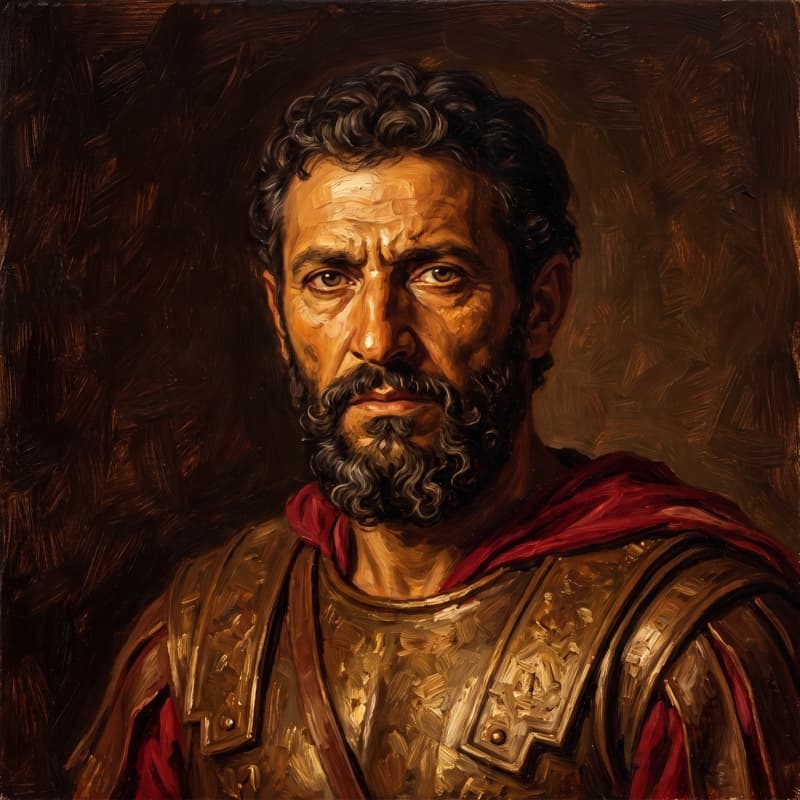
Hannibal Barca died by self-administered poison at Libyssa, a town in Bithynia, in the winter of 183/182 BCE — ancient sources differ by a year on the exact date (Livius.org). Roman envoys had closed in to demand his surrender; rather than be captured, he took poison he had reportedly carried for years, tradition says in a ring (Livy, History of Rome XXXIX.51, Perseus Digital Library). He died in exile, roughly two decades after his last battlefield command.
That's the fact. What put him in that house, and what he is reported to have said inside it, is worth the fuller telling.
From battlefield to statehouse to exile
Hannibal's second act began after the war ended, not on any battlefield. Defeated by Scipio at Zama on October 19, 202 BCE, he returned to Carthage and, in 196 BCE, was elected suffete — chief magistrate — where he reformed the city's revenues and curbed the lifetime tenure of its ruling judges (Livius.org). Those reforms made him enemies faster than any Roman army had. Rivals at home told Rome he was intriguing with the Seleucid king Antiochus III, and under mounting Roman pressure, Hannibal fled Carthage rather than wait for the accusation to run its course (Wikipedia).
Years of exile followed, moving between the courts of Antiochus III and other kings wary of Rome, offering his military experience as an advisor while Rome kept pressing its allies to hand him over (Wikipedia).
Cornered at Libyssa
The chase ended at the court of King Prusias in Bithynia. Roman envoys arrived demanding Hannibal's surrender, and he found himself with no way out — the moment the ring of poison, carried for exactly this contingency, was made for (Livy XXXIX.51).
Livy has him speak before he drinks it. On the man come to take him: "Neither magnificent nor memorable will be the victory which Flamininus will win over a man unarmed and betrayed." Then, calling for the poison itself: "Let us relieve the Roman people of their long anxiety, since they find it tedious to wait for the death of an old man" (Livy XXXIX.51). Both are Livy's narrative report, written more than a century after the fact, not a transcript — but the bitterness reads as earned: a commander who once camped within sight of Rome's walls, brought down at last not by an army but by letters between kings.
From a conversation with our Hannibal
An excerpt from a conversation with our AI Hannibal persona — a stylized recreation, clearly labeled, not a historical recording. His knowledge ends before that house in Bithynia.
Caller: Rome kept hunting you for years after the war was already lost. Did that surprise you?
Hannibal: Rome does not easily forgive a man who once camped outside its gates. What surprised me was smaller — I had been hunted by consuls and legions once, men my equal in the field. In these later years I was hunted by messengers, by kings who owed me their thrones and repaid the debt by looking elsewhere when soldiers came for me. That is not a soldier's death waiting for me. It is a debtor's.
Why Rome never stopped watching him
Consider what it says about Hannibal that Rome spent roughly two decades pursuing one aging exile rather than simply forgetting him. He had not commanded an army in a generation, and posed no fleet or treasury of his own. Still, Rome's envoys kept arriving at foreign courts to ask for him by name — not the caution owed to a beaten man, but the respect, however grudging, owed to the one general who had come closest to ending Rome altogether.
Our Hannibal's own memory stops before Libyssa; he cannot tell you how the chase concluded. But he lived every year that led there and will talk about it plainly — the oath at his father's altar, the Alps, Cannae, the fifteen unreinforced years in Italy, the reforms that cost him his city. Ask him whether he'd have chosen differently, knowing where the exile ended.
More in this cluster: Hannibal's verified quotes · his biography · fact file · back to the Hannibal hub.