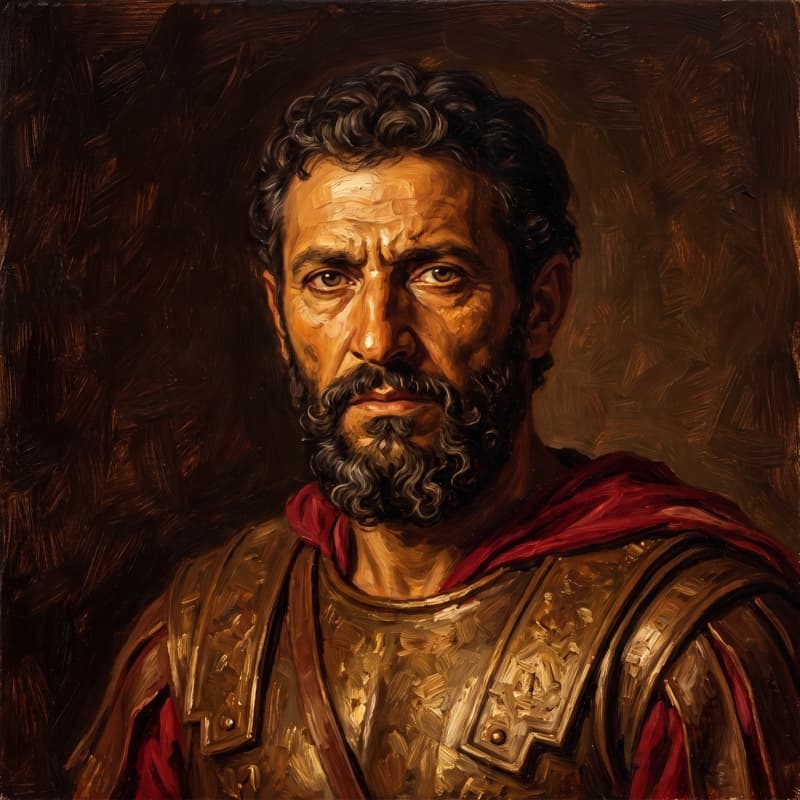
The facts about Hannibal Barca: born in Carthage in 247 BCE; elected commander in Iberia by his own soldiers in 221 BCE, after the assassination of his brother-in-law Hasdrubal, with Carthage's government confirming the choice; captured Saguntum after an eight-month blockade in 219 BCE, the act that helped trigger the Second Punic War; crossed the Alps into Italy with elephants in 218 BCE, on a route historians still argue about; won at the Ticinus and Trebia (218 BCE), Lake Trasimene (217 BCE), and Cannae (216 BCE); was recalled to Africa in 203 BCE and defeated by Scipio at Zama on October 19, 202 BCE; served as suffete of Carthage in 196 BCE before Roman pressure drove him out; and died by poison at Libyssa in the winter of 183/182 BCE (Livius.org). All cited, all checkable. But the record is stranger, and more contested, than the highlight reel.
The facts, with the stories inside them
The army made him commander before Carthage did. In 221 BCE, after Hasdrubal's murder, soldiers in Iberia chose Hannibal as their general on the spot — the home government only ratified a decision already made in camp (Livius.org). He was roughly twenty-six.
Saguntum wasn't a raid — it was an eight-month siege. Long enough that "capturing a city" undersells it: a grinding blockade that dragged Rome and Carthage into war (Livius.org).
Nobody actually knows which pass he used. Ancient sources agree Hannibal crossed the Alps with elephants in 218 BCE; they do not agree on the route. Modern reconstructions argue over half a dozen candidate passes from the same handful of ancient clues (Livius.org, "Hannibal in the Alps").
Four battles, one escalating idea. Ticinus and Trebia (218 BCE), Trasimene (217 BCE), and Cannae (216 BCE) draw the Romans in, then close the trap — each time further. Cannae's double envelopment is still taught as a textbook case of destroying a larger force (Livius.org).
Zama wasn't only about numbers. Hannibal lost the final battle on October 19, 202 BCE partly because Numidian cavalry that had once ridden for Carthage, under Masinissa, fought for Scipio instead — his own encirclement tactics turned back on him.
He tried reform before he tried exile. As suffete in 196 BCE, Hannibal pursued changes to Carthage's revenues and constitution; Roman pressure forced him out within the year, and he fled rather than be handed over (Livius.org).
From a conversation with our Hannibal
An excerpt from our AI Hannibal persona — a stylized recreation, honestly labeled; not a historical quotation.
Caller: Which fact about you do people get most wrong?
Hannibal: That the crossing was the hard part. Men remember the snow and the elephants and forget the fifteen years after — no reinforcement worth the name, no city opening its gates, a war I could not lose on the field and could not win off it. Count those years, not the victories. That is the fact that costs something to hear.
Popular "facts" that need correcting
"Hannibal cleared Alpine boulders with fire and vinegar." Livy reports soldiers heating a rock face and pouring sour wine over it to make the stone crumble during the 218 BCE crossing — but Polybius's earlier account of the same crossing doesn't include it, and the route itself is unresolved. Treat it as one ancient writer's dramatic detail, not confirmed engineering fact (Livy XXI.37, Perseus).
"I will either find a way or make one." Not a verified Hannibal line from any ancient source. The closest ancestor is Seneca's tragedy Hercules Furens, where Megara says of Hercules — not Hannibal — "a way / He'll find — or make" (Seneca, Hercules Furens, Wikisource). The Hannibal version is a later, unsourced attachment to a much older line about someone else.
Ask past the facts
Every fact above survives a citation check; what the list can't give you is why a fifteen-year stalemate ends in poison at a foreign court rather than a battlefield. Our Hannibal — an AI recreation built from the sourced record and labeled as exactly that — will talk through the Alps, the long Italian years, and the exile Rome never stopped chasing.
More in this cluster: Hannibal hub · his death · verified quotes · biography.