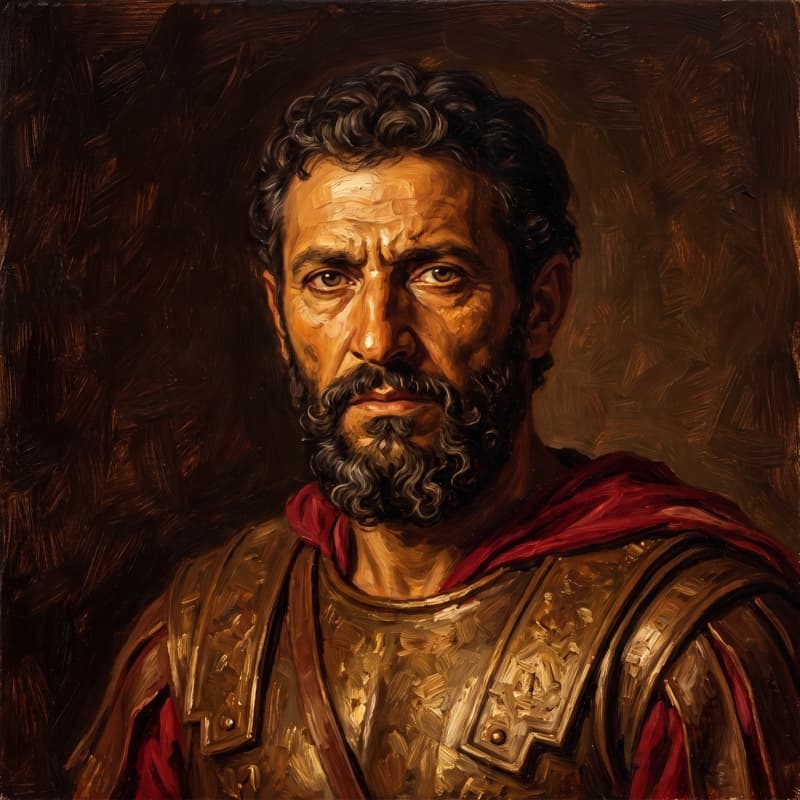
Hannibal Barca left no memoir, no letters, no autograph text of his own. Everything attributed to him survives secondhand, filtered through Roman and Greek historians writing decades after his death — chiefly Livy and Polybius. That does not make the material worthless; it means every line needs its source named plainly, and its wording checked against the edition it came from. This page does both, including the one "Hannibal quote" that almost certainly belongs to someone else entirely.
The oath that explains everything after
Livy reports that Hannibal's father, Hamilcar Barca, took his nine-year-old son to an altar in Carthage before departing for Iberia and made him swear undying hostility to Rome:
"...led the boy up to the altar and made him touch the offerings and bind himself with an oath that so soon as he should be able he would be the declared enemy of the Roman People."
This is Livy's narrative account of a private childhood scene, not a transcript — treat it as reported story, not autograph words. Still, ancient historians and modern ones alike return to it as the frame for the war that followed. — Livy, History of Rome, Book XXI.1, Foster translation, Perseus Digital Library
Before the first battle in Italy
Ahead of the clash at the Ticinus in 218 BCE, Livy has Hannibal address his assembled soldiers with a line that has outlived the battle itself:
"Here, soldiers, you must conquer or die, where for the first time you have faced the enemy."
Polybius describes a similar pre-battle harangue at III.63 — his Hannibal tells the men they must conquer, die, or fall alive into enemy hands — but that chapter's body text wasn't reachable for a fresh wording check this pass, so treat the Polybius version as a paraphrase of the same tradition rather than a verified quotation until it can be re-checked against a working copy of the text. — Livy, History of Rome, Book XXI.43, Foster translation, Perseus Digital Library; Polybius, Histories, Book III.63, chapter confirmed via Perseus Digital Library
The parley before Zama
Before the decisive battle in 202 BCE, Polybius records a face-to-face meeting between Hannibal and Scipio. Hannibal, arguing for peace, reflects on how quickly fortune turns:
"...how fickle Fortune is, and how by a slight turn of the scale either way she brings about changes of the greatest moment."
And when pressed on his own record, he does not soften it:
"I, then, am that Hannibal who after the battle of Cannae became master of almost the whole of Italy, who not long afterwards advanced even up to Rome..."
Scipio was not moved; the battle came anyway. — Polybius, Histories, Book XV.6–7, W. R. Paton translation, Loeb Classical Library via Bill Thayer, University of Chicago
The line about his own rank
Years later, in exile at the Seleucid court, Livy reports an exchange between Hannibal and Scipio Africanus about who the greatest general ever was. Hannibal named Alexander first, Pyrrhus second, and himself third. Scipio, amused, asked what Hannibal would say had he won at Zama:
"'Then, beyond doubt,' he replied, 'I should place myself both before Alexander and before Pyrrhus and before all other generals.'"
It is a rare moment of Hannibal's dry self-regard surviving the historical record intact. — Livy, History of Rome, Book XXXV.14, Foster translation, Perseus Digital Library
The last words
Cornered at Libyssa in Bithynia in the winter of 183/182 BCE, with Roman envoys closing in to demand his surrender, Hannibal took poison he had reportedly carried for years. Livy gives him a final line:
"Let us," he said, "relieve the Roman people of their long anxiety, since they find it tedious to wait for the death of an old man."
— Livy, History of Rome, Book XXXIX.51, Foster translation, Perseus Digital Library
Quotes to avoid
Two lines get pinned on Hannibal constantly and shouldn't be.
"I will either find a way or make one." This one isn't in any ancient narrative source about Hannibal. Its closest ancestor is Seneca's Hercules Furens, where Megara says of Hercules — not Hannibal — that "a way / He'll find—or make." The Hannibal version looks like a later borrowing dressed up as history. — Seneca, Hercules Furens, Frank Justus Miller translation (1907), Wikisource
"You know how to gain a victory, Hannibal: you know not how to use one." This one really is ancient — but it was said to Hannibal, not by him. It's his cavalry commander Maharbal's rebuke after Cannae, when Hannibal chose not to march on Rome immediately. It shows up constantly in quote lists as if Hannibal said it about himself. He didn't. — Livy, History of Rome, Book XXII.51, Foster translation, Perseus Digital Library
From a conversation with our Hannibal
An excerpt from our AI Hannibal persona — a stylized recreation, clearly labeled; not a historical quotation.
Caller: People keep handing you a line about finding a way or making one. Did you say it?
Hannibal: No, friend — that one belongs to a hero in a play, and he never crossed a mountain with a sick elephant behind him. What I told my men at the Ticinus was plainer: conquer, or die, where you stand. No talk of finding roads. When there was no road, we cut one, and men died doing it, and I did not make a verse about it afterward. Poets tidy a war into a slogan. I was there for the untidy part.
Read the record straight
Every line above is checked against a named translation and a working link — including the Polybius passage marked as paraphrase because its wording couldn't be re-verified this pass, and the two lines flagged as not-Hannibal's-words at all. If a "Hannibal quote" you've seen elsewhere isn't listed here, treat that as a reason to ask for its source, not to assume it's real.
More in this cluster: Hannibal hub · his death · biography · facts.