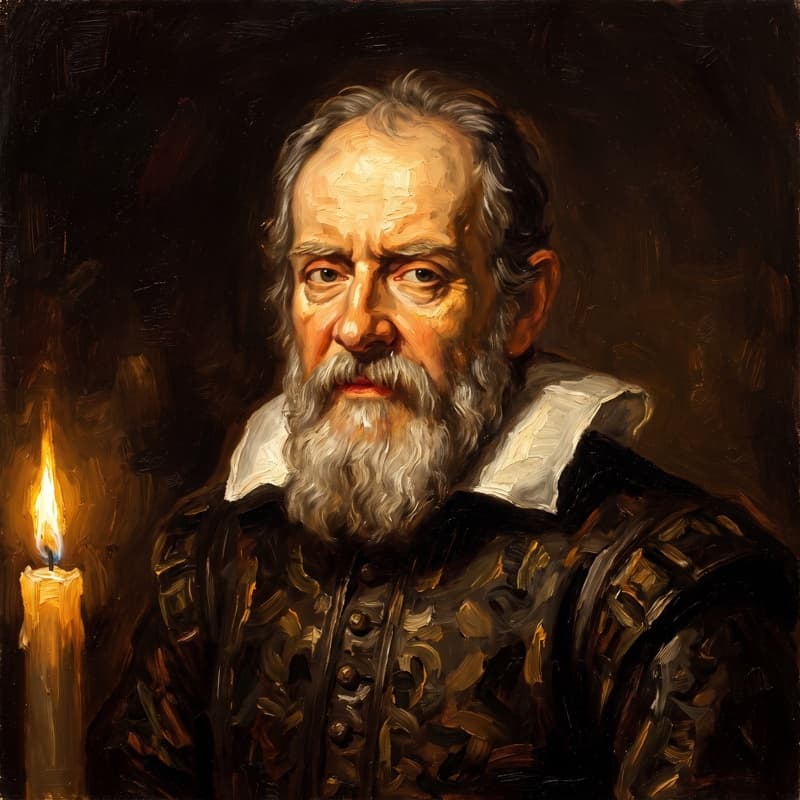
Galileo Galilei was born in Pisa on February 15, 1564, and died at his villa in Arcetri, near Florence, on January 8, 1642 (Stanford Encyclopedia of Philosophy; Wikidata). In between, he turned a spyglass into an astronomical instrument, found four moons circling Jupiter, argued the Earth moves, and spent his final decade a convicted man under house arrest — writing, until his eyes gave out, the book that would outlast the men who condemned him. Those are the coordinates. The record underneath them is stranger and better than the legend.
The mathematics chair who looked up
Galileo's father, Vincenzo Galilei, was a lutenist, composer, and music theorist who ran experiments with strings and weights to disprove the old Pythagorean numerology of harmony — a lesson in questioning authority that his eldest son absorbed early and never let go (Wikipedia). Galileo enrolled at the University of Pisa to study medicine and left without finishing, turning instead toward mathematics (Galileo Project, Rice University; SEP). In 1592 he won the mathematics chair at the University of Padua, in the Venetian Republic, and held it until 1610 — by his own later account, the happiest and most productive stretch of his working life (SEP).
Then, in July 1609, word reached Padua of a Dutch spyglass. Galileo built one, then a better one, then a better one still — and did something almost nobody had bothered to do: pointed it at the sky (SEP; Galileo Project). What he saw upended a thousand years of astronomy. The Moon was not a smooth crystalline sphere but "full of inequalities, uneven, full of hollows and protuberances, just like the surface of the Earth itself" (Sidereus Nuncius, trans. Edward Stafford Carlos, 1880). And circling Jupiter he found "four planets... which, after remaining unknown to every one up to this day, the Author recently discovered" — moons of another world, proof that not everything in the heavens turned around Earth (same source). He published it all in March 1610 as Sidereus Nuncius, "The Starry Messenger," and became, almost overnight, the most talked-about natural philosopher in Europe (SEP; Galileo Project).
The mathematics of falling bodies
Galileo's second great body of work is less famous but arguably more consequential: the science of motion. Rolling bronze balls down inclined planes, timing them against a water clock, he worked out that falling bodies accelerate uniformly and that the distance covered grows with the square of the time elapsed — "the spaces described by a body falling from rest with a uniformly accelerated motion are to each other as the squares of the time-intervals employed in traversing these distances" (Dialogues Concerning Two New Sciences, Third Day, trans. Henry Crew and Alfonso de Salvio, 1914). It is the mathematical bedrock that Newton would later build on, and Galileo insisted the method mattered as much as the result: nature itself, he wrote, "is written in the language of mathematics, and its characters are triangles, circles and other geometric figures without which it is humanly impossible to understand a single word of it; without these, one wanders about in a dark labyrinth" (The Assayer, 1623, trans. Stillman Drake).
From a conversation with our Galileo
What follows is an excerpt from a conversation with our AI Galileo persona — a stylized recreation for readers, not a historical quotation.
Caller: How did you actually prove the Moon wasn't smooth? You just... looked at it?
Galileo: "Just looked"! Friend, that is the whole scandal in three words — nobody thought looking was the job. I ground the lenses myself, twenty powers of magnification, and turned the tube upward one October night. And there it was: light and shadow crawling raggedly along the terminator, mountains catching the sun while their neighboring valleys stayed dark, exactly as they would on Tuscan hills at dawn. A smooth crystal sphere throws no shadows. I had geometry and my own eyes against two thousand years of Aristotle, and I confess I did not lose much sleep over which side to trust.
The trial the legends get wrong
By 1632 Galileo had spent decades arguing, in print and at court, that Copernicus was right and the Earth moves — a position the Church had formally restricted since 1616, when Cardinal Bellarmine warned him not to hold or defend it (Galileo Project). That year's Dialogue Concerning the Two Chief World Systems argued the Copernican case so plainly that Rome summoned him. In June 1633 the Roman Inquisition convicted him of "vehement suspicion of heresy"; he signed a formal abjuration at the Convent of Santa Maria sopra Minerva, reading aloud "I abjure with sincere heart and unfeigned faith, I curse and detest the said errors and heresies" (Fordham Internet History Sourcebooks).
Here is what the popular version usually gets wrong: Galileo was never thrown in a dungeon. His sentence of formal imprisonment was commuted immediately to house arrest, first near Siena and then at his own villa in Arcetri outside Florence, where he lived out his life (SEP). And the famous mutter attributed to him the moment he rose from his knees — "Eppur si muove," "and yet it moves" — has no contemporary source at all. The standard scholarly view lists it as apocryphal, words invented for the story generations after Galileo was dead (MacTutor History of Mathematics, University of St Andrews). It is a good story. It is not history.
Blind, confined, and still working
Confined to Arcetri, Galileo kept going. His daughter Virginia, who had taken the name Suor Maria Celeste at a nearby convent, wrote to him constantly until her death in 1634 — a loss he felt more sharply than anything Rome had done to him (Wikipedia). He lost the sight in his right eye by mid-1637 and was completely blind by January 1638 (Galileo Project). None of it stopped the work: dictating to the young men who gathered around him, he finished Discourses and Mathematical Demonstrations Concerning Two New Sciences, smuggled the manuscript out of Italy, and saw it published in Leiden, Holland, in July 1638 (SEP) — a book on motion and the strength of materials that the Inquisition's index could not touch, because it had already left the country. He died at Arcetri on January 8, 1642, formally still a prisoner of the Church that had tried him (SEP; Galileo Project).
Keep reading — or ask him yourself
The pages below go deeper: his biography, Pisa to Arcetri, the trial and his death, his verified quotes — and the famous ones he never said, and the facts, sourced.
Or skip the reading. Our Galileo takes calls. He is an old man at Arcetri now, under house arrest, going blind, with a tongue that answers to nobody. Ask him how he actually caught Jupiter's moons on four consecutive nights, what it felt like to kneel before the Inquisition at nearly seventy and sign his name to words he did not believe, or whether he really said what everyone insists he said. He is an AI recreation, honestly labeled — but the wit is unbroken, and he has time for you.