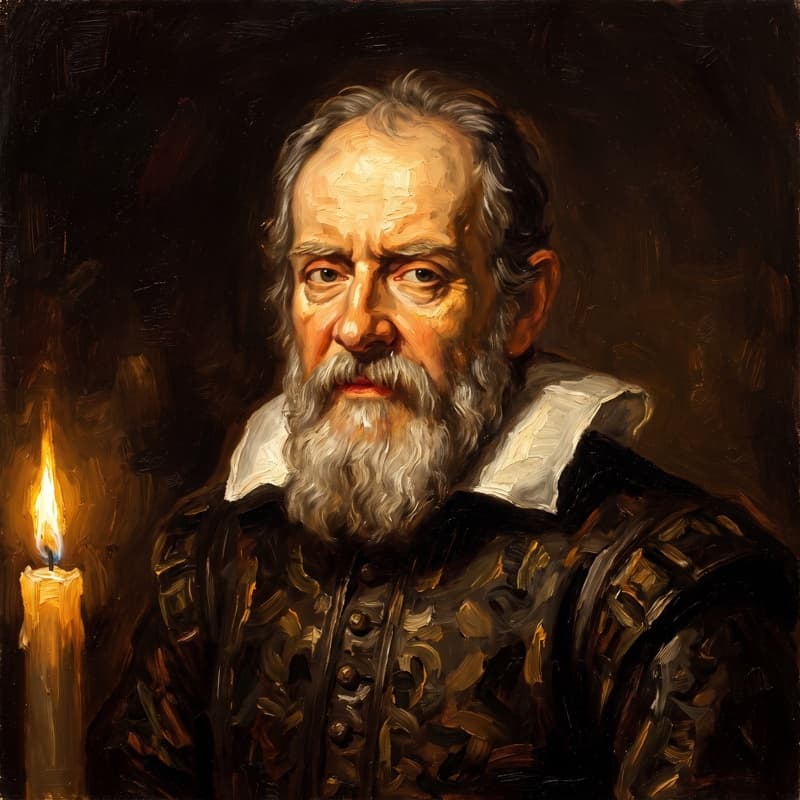
Galileo Galilei was born in Pisa on February 15, 1564, and died at his villa in Arcetri, near Florence, on January 8, 1642 — still, on paper, a prisoner of the Roman Inquisition. Between those dates: a mathematics chair, a telescope pointed where no one had thought to point one, a trial that reordered his life, and a blind old man dictating a book that outlasted the sentence against him.
A lutenist's son
His father, Vincenzo Galilei, was a composer and music theorist who ran his own experiments on strings and tuning with the Florentine Camerata, the circle whose arguments over music helped invent opera. The son inherited a habit of testing claims against measurement rather than deferring to authority. Galileo enrolled at the University of Pisa to study medicine and left without a degree, pulled toward mathematics instead. In 1592 he took the chair of mathematics at the University of Padua, in the Venetian Republic, and held it until 1610 — by most accounts the happiest, steadiest stretch of his career, teaching and studying motion years before the wider world knew his name.
A spyglass turned upward
That changed in July 1609, when word reached him of a Dutch spyglass. Galileo built his own version, then a better one, and turned it on the sky. In March 1610 he published Sidereus Nuncius — The Starry Messenger — announcing mountains on the moon, uncountable new stars, and four small bodies circling Jupiter, which he named the Medicean Stars after his patrons. He put the discovery plainly on the title page: "Four Planets which revolve round the Planet Jupiter at different distances and in different periodic times, with amazing velocity, and which, after remaining unknown to every one up to this day, the Author recently discovered." The book made him instantly famous, and that September he left Padua for a court appointment in Florence.
Widening the argument
Fame did not make the Copernican question safer to argue. In early 1616 the Congregation of the Index suspended Copernicus's De Revolutionibus, and Cardinal Robert Bellarmine warned Galileo against defending it. His case for observation over inherited authority is on record from this period, in a letter to the Grand Duchess Christina of Tuscany: "I do not feel obliged to believe that that same God who has endowed us with senses, reason, and intellect has intended to forgo their use." It did not settle the argument. It postponed it.
Trial, abjuration, house arrest
The postponement ended with the Dialogue Concerning the Two Chief World Systems, printed in Florence in February 1632. On June 22, 1633, the Roman Inquisition convicted Galileo of vehement suspicion of heresy. He signed an abjuration the same day — "I abjure with sincere heart and unfeigned faith, I curse and detest the said errors and heresies..." — and the sentence of formal imprisonment was immediately commuted to house arrest. By December he had returned to Arcetri, where he lived out his life under confinement.
Arcetri, in the dark
His daughter, who had taken the name Suor Maria Celeste at a nearby convent, died in April 1634, within a year of his confinement. His sight failed by degrees — the right eye by mid-1637, the left by January 1638 — until he was completely blind. He kept working anyway, completing Discourses and Mathematical Demonstrations Concerning Two New Sciences, smuggled out of Italy and published in Leiden in July 1638, laying out the mathematics of falling bodies: "The spaces described by a body falling from rest with a uniformly accelerated motion are to each other as the squares of the time-intervals employed in traversing these distances." The sentence had confined the man, not the argument.
From a conversation with our Galileo
An excerpt from a conversation with our AI Galileo persona — a stylized recreation, honestly labeled; not a historical quotation.
Caller: Weren't you afraid, arguing with the Church?
Galileo: Afraid of men, certainly — men with robes and the power to make you regret your grammar. Afraid of a pendulum, or the moons of Jupiter, going round on schedule whether Rome approves or not? No. Those don't care what I'm afraid of. They only do what they do, if you trouble to look and measure instead of arguing from a chair.
Continue the conversation — literally
Our Galileo — an AI recreation, built on the sourced record and labeled as what it is — speaks from inside this life. Ask him about the nights he watched Jupiter's small companions shift, about his father's experiments with lute strings, or about proving theorems on falling bodies after the Inquisition had taken nearly everything else.
More in this cluster: Galileo hub · his death · verified quotes · facts.