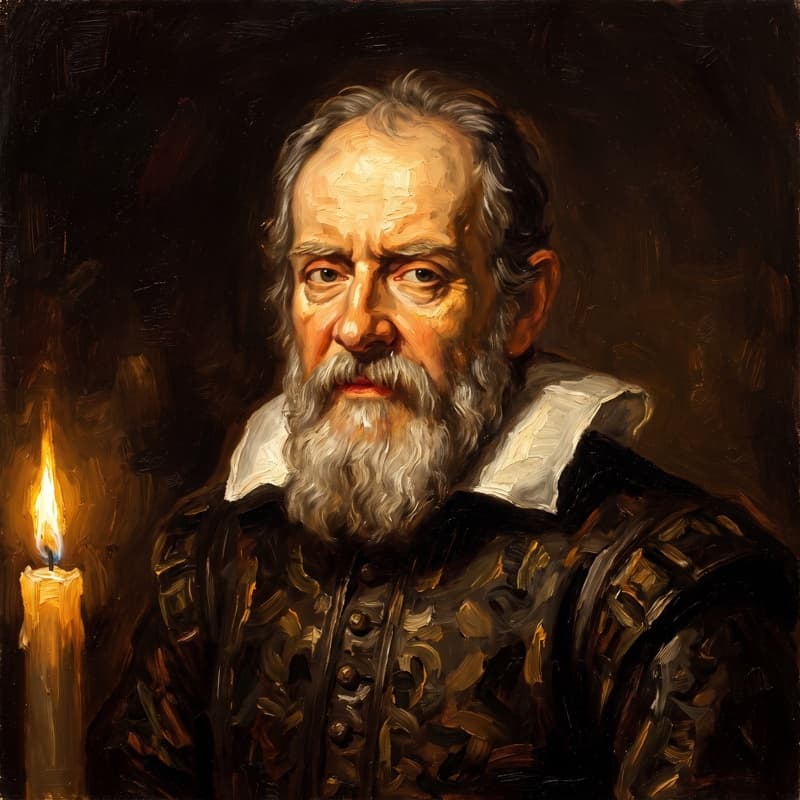
Galileo Galilei's most reliably documented quotes come from four places: the 1610 pamphlet that made him famous, the 1638 book that finished his career, a 1615 letter defending science against theology, and the document he was forced to sign in 1633. Put them in order and you get something better than a highlight reel — you get the shape of an argument that took thirty years to lose in public and win in the long run. As with any figure this quoted, a second list matters just as much: the lines the internet loves that Galileo never actually wrote.
1623: The book of nature is written in mathematics
In The Assayer, Galileo laid out the claim everything else here rests on:
"Philosophy is written in this grand book, the universe, which stands continually open to our gaze. But the book cannot be understood unless one first learns to comprehend the language and read the letters in which it is composed. It is written in the language of mathematics, and its characters are triangles, circles and other geometric figures without which it is humanly impossible to understand a single word of it; without these, one wanders about in a dark labyrinth."
It's the single sentence that best explains why he spent a career pointing instruments at things instead of arguing from authority.
The mathematics of falling bodies
By the time he wrote Two New Sciences at Arcetri, house arrest had not slowed the argument down — it had only removed the audience. The Third Day opens with a definition:
"A motion is said to be equally or uniformly accelerated when, starting from rest, its momentum receives equal increments in equal times."
And a theorem built on it:
"The spaces described by a body falling from rest with a uniformly accelerated motion are to each other as the squares of the time-intervals employed in traversing these distances."
Two sentences, and the mathematics of motion has a foundation it did not have before.
1610: Four wandering stars around Jupiter
Sidereus Nuncius announced the telescope's first real discoveries, and its title page still reads like a dispatch from the front:
"Four Planets which revolve round the Planet Jupiter at different distances and in different periodic times, with amazing velocity, and which, after remaining unknown to every one up to this day, the Author recently discovered."
Watching those points of light move night after night, Galileo drew the only conclusion the evidence allowed:
"I therefore concluded, and decided unhesitatingly, that there are three stars in the heavens moving about Jupiter, as Venus and Mercury round the Sun."
He also looked at the Moon and refused the old picture of a perfect sphere, describing a surface that was instead "full of inequalities, uneven, full of hollows and protuberances, just like the surface of the Earth itself."
Faith and observation: the 1615 letter
Writing to the Grand Duchess Christina in defense of Copernican astronomy, Galileo made his clearest statement on science and scripture:
"I do not feel obliged to believe that that same God who has endowed us with senses, reason, and intellect has intended to forgo their use and by some other means to give us knowledge which we can attain by them."
In the same letter he approvingly quotes a line he credits to Cardinal Cesare Baronius — not his own coinage, but one he clearly liked enough to make famous:
"That the intention of the Holy Ghost is to teach us how one goes to heaven, not how heaven goes."
1633: What he actually signed
Here is the document, not the legend. On June 22, 1633, before the Roman Inquisition, Galileo signed a formal abjuration:
"I abjure with sincere heart and unfeigned faith, I curse and detest the said errors and heresies..."
That is the real record. The famous mutter said to follow it — "Eppur si muove," "and yet it moves" — is the legend built on top of the record. See below.
From a conversation with our Galileo
An excerpt from our AI Galileo persona — a stylized recreation, clearly labeled; not a historical quotation.
Caller: Did you really whisper "and yet it moves" after you signed?
Galileo: A fine story, and I did not write it. What I signed was ink; what the planet does is not governed by ink. If I had muttered such a thing to the walls of the Minerva, I'd have been a fool twice over — once for the danger, once for saying aloud what the mathematics already said quietly, every day, to anyone who bothered to look through a glass.
Quotes Galileo never said
Several popular "Galileo quotes" have no solid primary source:
- "Eppur si muove" ("And yet it moves"). No contemporary account of the abjuration reports it; it is listed as "apocryphal words" with no primary source (MacTutor, University of St Andrews).
- "In questions of science, the authority of a thousand is not worth the humble reasoning of a single individual." Traced only to François Arago's 1874 Eulogy of Galileo — a nineteenth-century tribute, not a Galileo text (MacTutor, University of St Andrews).
- "Measure what is measurable, and make measurable what is not so." Sourced only to a 1959 quotation anthology, with no primary Galileo text behind it (MacTutor, University of St Andrews).
More in this cluster: Galileo hub · his death · biography · facts.