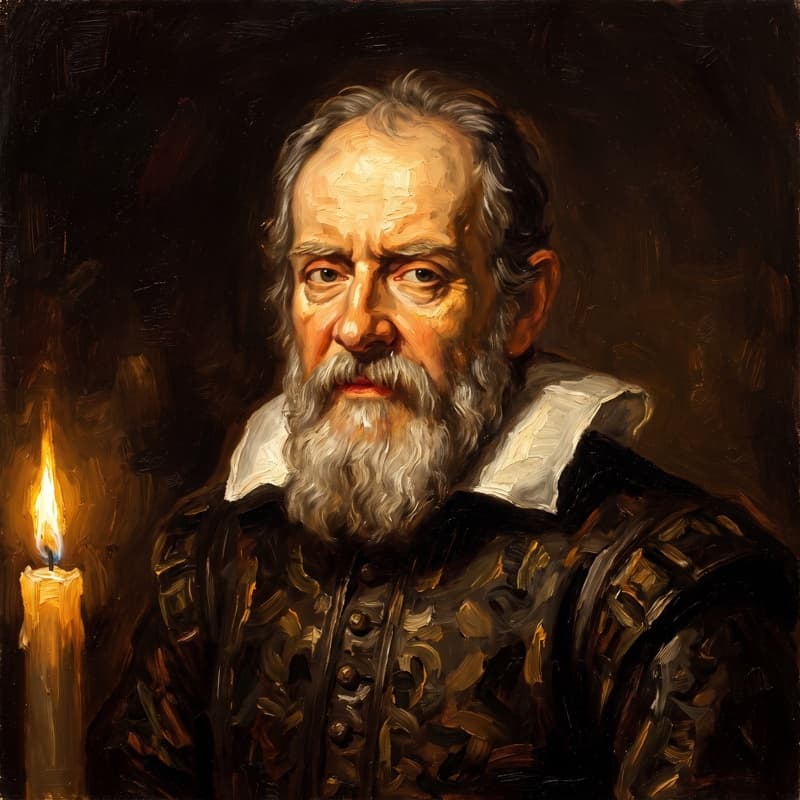
The facts about Galileo Galilei: born February 15, 1564, in Pisa (Stanford Encyclopedia of Philosophy; The Galileo Project; Wikidata); son of a lutenist and music theorist (Wikipedia); mathematics chair at Padua, 1592–1610 (SEP); built his own telescope in 1609 and published Sidereus Nuncius in March 1610 (Galileo Project; primary text at Internet Archive); worked out the mathematics of falling bodies in Two New Sciences (University of Virginia); admonished by the Church in 1616, tried and convicted in 1633 — two separate episodes, seventeen years apart (SEP); completely blind by January 1638 (Galileo Project); died January 8, 1642, at Arcetri, still under Inquisition confinement (SEP; Galileo Project; Wikidata). All sourced, all checkable. A few of the "facts" everyone repeats about him don't survive that checking — this page sorts the record from the legend.
The facts, with the stories inside them
Born February 15, 1564, in Pisa. First child of Vincenzo Galilei and Giulia degli Ammannati (SEP; Wikidata).
His father argued with authority for a living — on strings, not stars. Vincenzo Galilei was a leading lutenist, composer, and music theorist tied to the Florentine Camerata, the circle whose experiments helped give rise to opera (Wikipedia). The son who later insisted mathematics settles questions about the heavens learned that habit at home first.
The Padua years, 1592–1610, were his most productive. He held the mathematics chair at the University of Padua, in the Venetian Republic, and used a tolerant state's freedom to work out much of the mechanics he would publish decades later (SEP).
He did not invent the telescope — he made it worth using. In 1609 Galileo heard that a Dutch instrument could make distant things appear near, built his own version within weeks, and kept improving it — the invention wasn't his, but aiming it at the sky was (Galileo Project). Sidereus Nuncius, published in Venice in March 1610, announced mountains on the Moon and four satellites of Jupiter he named the Medicean Stars (Galileo Project; Internet Archive).
He also worked out how things fall. In Two New Sciences, Galileo defined uniformly accelerated motion and showed that a falling body's distance grows with the square of the time elapsed — foundational to the physics that followed (University of Virginia).
1616 and 1633 were two different collisions with the Church, not one. In 1616 Cardinal Robert Bellarmine admonished him not to hold or teach the Copernican view. Seventeen years later, after his 1632 Dialogue argued the Copernican case anyway, the Roman Inquisition convicted him of "vehement suspicion of heresy" (SEP). His sentence specified formal imprisonment but was commuted immediately to house arrest — near Siena, then at his own villa in Arcetri. No dungeon, no cell (SEP).
He spent his final years completely blind. He lost sight in his right eye by July 1637 and his left by January 1638, dictating his last book once he could no longer read it (Galileo Project).
He died January 8, 1642 — still, on paper, a prisoner. Nine years after his conviction, Galileo died at Arcetri, still formally under the Inquisition's confinement (SEP; Galileo Project; Wikidata).
From a conversation with our Galileo
An excerpt from our AI Galileo persona — a stylized recreation grounded in the sourced record, not a historical quotation.
Caller: People say you spent your last years locked in a dungeon. True?
Galileo: A dungeon! I had a garden, a telescope by the window, and my daughter's convent bell close enough to hear at Vespers. Call it what it was — a sentence commuted to a villa, a strange kind of mercy for a man convicted of looking too carefully. The cell they truly wanted to put me in was smaller than any room: an argument I was meant to stop having. That one I never signed for.
Check the quotes and the legends while you're here
The most repeated "Galileo lines" are the least reliable ones. "Eppur si muove" — supposedly muttered right after his abjuration — has no contemporary source; the standard reference on his quotations lists it as apocryphal words with no documented origin (MacTutor History of Mathematics, University of St Andrews). The same page traces two other viral "Galileo quotes" to a 19th-century eulogy and a 1959 anthology, not to Galileo himself. Our quotes page covers what he actually wrote, sourced to primary translations.
Ask past the facts
Every fact above survives checking; what a fact list can't give you is the man arguing them. Our Galileo — an AI recreation grounded in the same cited record, labeled as exactly that — will talk about the nights spent following Jupiter's small companions and the argument he lost in Rome but never conceded. Bring him the question the textbook rushed past.
More in this cluster: Galileo hub · his death · verified quotes · biography.