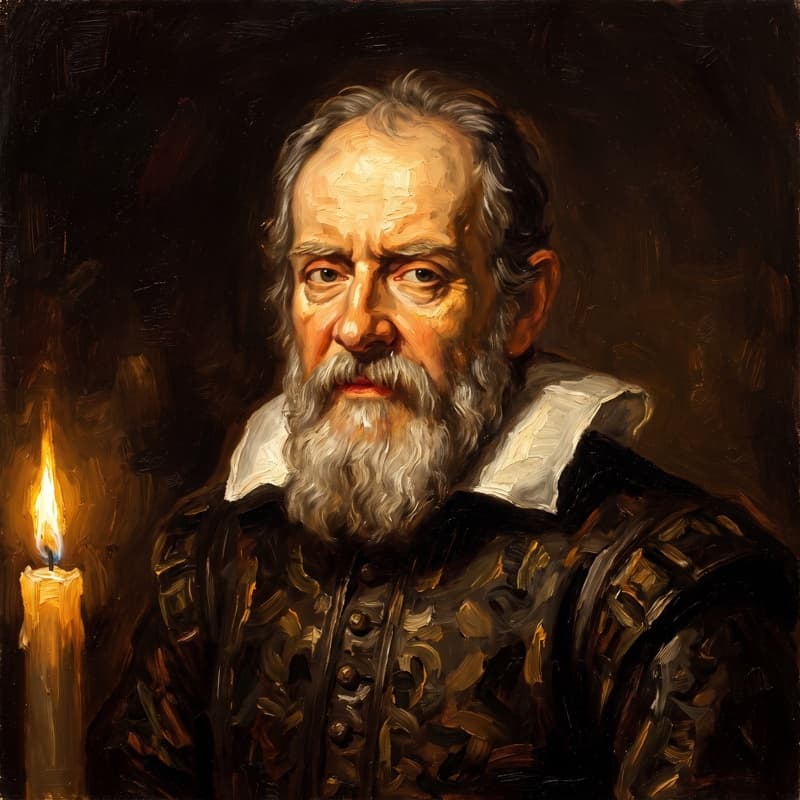
Galileo Galilei died on January 8, 1642, at his villa in Arcetri, near Florence, at the age of 77 (The Galileo Project, Rice University; Wikidata). The cause was age and illness, not violence — he died in his own bed, blind, nine years after the Inquisition convicted him of "vehement suspicion of heresy" (Stanford Encyclopedia of Philosophy). He was still, formally, a prisoner of that sentence when he died — which is really what most "how did Galileo die" searches are asking about.
The trial was 1633. The death was 1642.
The two events get flattened into one story, but they were nine years apart. In June 1633 the Inquisition sentenced Galileo to "formal imprisonment at the pleasure of the Inquisition" — commuted immediately, first to supervised residence in Siena, then from December 1633 to house arrest at his own villa in Arcetri (Stanford Encyclopedia of Philosophy). He was never executed and never put in a cell. He lived nearly a decade more, working under a confinement that restricted his movement but not, in the end, his mind.
Blind years, working years
Arcetri took his sight before it took his life. Galileo lost all vision in his right eye by July 1637; by January 1638 the left eye was gone too, and he was completely blind (The Galileo Project). He kept working anyway, finishing Discourses and Mathematical Demonstrations Concerning Two New Sciences — his summation of decades of work on motion — in these confined, sightless final years. The manuscript was smuggled out of Italy and published in Leiden in July 1638 (Stanford Encyclopedia of Philosophy).
Two things his death was not
Not a dungeon sentence. The idea that Galileo spent his last years in a cell flattens the record; the imprisonment sentence was commuted to house arrest within the same proceedings that issued it (Stanford Encyclopedia of Philosophy).
Not "eppur si muove." The famous defiant mutter — "and yet it moves," supposedly said the instant he rose from abjuring the Earth's motion — has no contemporary source; the earliest printed version dates from nearly a century and a half later (Rai Scuola). A good legend, attached to a real man who did eventually get the last word — just not that one, and not that day.
From a conversation with our Galileo
An excerpt from a conversation with our AI Galileo persona — a stylized recreation, honestly labeled, built from the historical record cited on this page. Our Galileo speaks from Arcetri, blind and confined; his knowledge does not extend past his own final years.
Caller: Do you regret signing the abjuration?
Galileo: Regret is a word for choices. I had none that day — only a pen, and men who could end worse than my eyesight if I withheld it. So I wrote what they required. But notice what compulsion actually governs: a hand, a signature, a sentence read aloud in a cold room. It does not govern the motion of a planet, nor the motion of an argument once it is loose in the world. I gave them my words. I did not have the moons of Jupiter to give, and they kept right on turning without my permission. As for my eyes — the sky took those honestly, in trade for everything I first saw through a tube of glass. Fairer terms than Rome offered.
Did the Church ever apologize?
Not simply. In 1979 Pope John Paul II called for scholars to re-examine the case "in loyal recognition of wrongs, from whatever side they come." Closing that process in 1992, the Pope acknowledged Galileo had understood the Copernican system correctly and that his judges had wrongly treated a scientific question as settled by scripture — but the Church never formally rescinded the 1633 condemnation (Wikipedia: Galileo affair). A real vindication, three and a half centuries late, still short of a clean "yes."
Where he ended up
Because he died under condemnation, his burial stayed obscure for decades; he was formally re-interred at the Basilica of Santa Croce in Florence in 1737, where his tomb remains today, near his daughter Virginia — who, as Suor Maria Celeste, had died in 1634 while he was still confined at Arcetri (Stanford Encyclopedia of Philosophy; Wikidata).
Our Galileo can tell you everything up to that blind, stubborn, working end — the telescope, the trial, the arithmetic of falling bodies he finished without seeing his own diagrams. Ask him what house arrest actually cost him. Start the conversation whenever you're ready.
More in this cluster: Galileo hub · verified quotes · biography · facts.