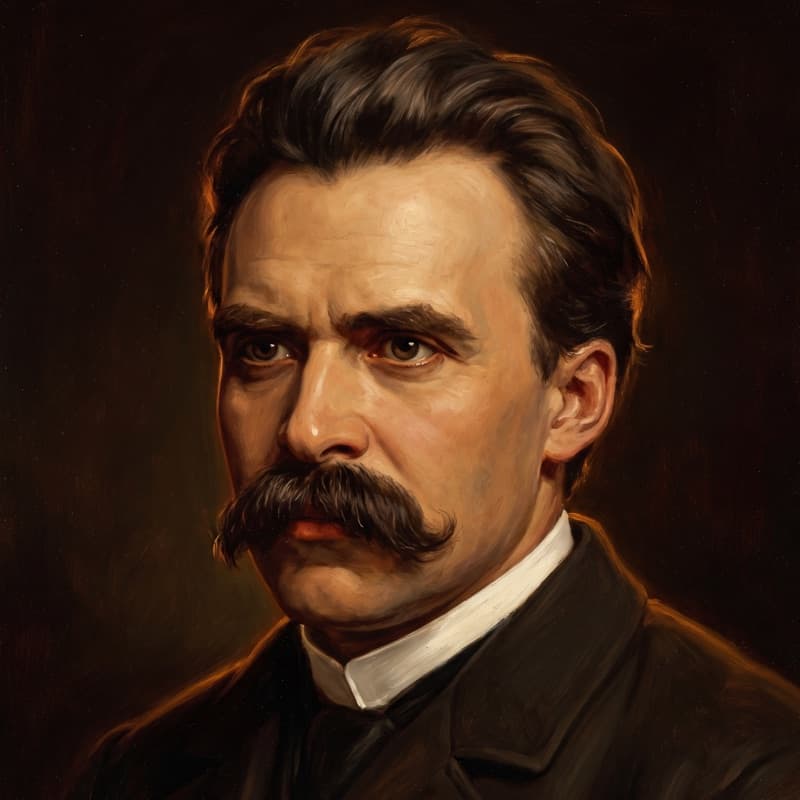
Friedrich Nietzsche was a German philosopher and former classical philologist, born October 15, 1844, in Röcken, near Leipzig, the son of a Lutheran minister who died when Nietzsche was four. He became, at 24, the youngest person appointed to the chair of classical philology at the University of Basel — and then, over the following decade, one of the most unclassifiable minds in modern philosophy: a critic of inherited morality and religion, the philosopher who diagnosed "the death of God," and the writer behind Thus Spake Zarathustra, Beyond Good and Evil, and the idea of the Übermensch. Chronic illness forced him out of his professorship in 1879. He spent the following decade as a wandering, half-blind independent writer, collapsed in Turin in January 1889, and died on August 25, 1900, having never learned that the twentieth century would claim him.
That is the summary. The man is stranger, funnier, and sicker than the summary.
The philologist who became dynamite
Nietzsche did not start as a philosopher. He was a prodigy of classical philology, studying at Bonn and then Leipzig under Friedrich Wilhelm Ritschl, and his 1869 appointment to Basel came before he had even finished his doctorate — a career fast-tracked on raw talent. His first book, The Birth of Tragedy (1872), was less an academic monograph than a bomb thrown into classical scholarship: a meditation on Greek tragedy and Wagnerian music-drama that scandalized his own field. He had, by then, already befriended Richard and Cosima Wagner, meeting them as a student in Leipzig; the friendship deepened at the Wagners' home at Tribschen and lasted into the mid-1870s, effectively ending by 1878 as Nietzsche soured on Wagner's turn toward German nationalism and Christian spectacle.
Breaking down, writing at altitude
By 1879, chronic migraines, nausea, and failing eyesight had made the professorship impossible, and Nietzsche resigned to live as an independent writer on a small pension — modern scholarship points to a possible retro-orbital meningioma as a contributing cause of his lifelong suffering. What followed was a disciplined itinerancy: summers in Sils-Maria in the Swiss Engadin, winters chasing a survivable climate through Genoa, Nice, and Turin. Whole books were composed on six-hour mountain walks before ever reaching paper — sickness turned into method, producing a style built for a mind that could not always tolerate sustained reading or writing. "A living thing seeks above all to DISCHARGE its strength—life itself is WILL TO POWER," he wrote in Beyond Good and Evil (§13); "self-preservation is only one of the indirect and most frequent RESULTS thereof." It is a claim about the character of life in general, not a slogan about domination — a distinction worth holding onto, since the phrase gets flattened constantly.
The death of God, and what he actually meant
Nietzsche's most famous idea is also his most misread. The line comes from a parable in The Joyful Wisdom (1882), where a madman runs into a marketplace announcing that God is dead and that "we" have killed him. Read straight, it can sound like a triumphant declaration of atheism. Scholarly context reads it differently: as a diagnosis of the collapsing cultural authority of Christian belief and values in nineteenth-century Europe, and the vertigo — not triumph — that follows when a civilization's foundation gives way. Nietzsche called nihilism "the uncanniest of all guests," a threat standing at Europe's door, not a victory to celebrate.
From a conversation with our Nietzsche
What follows is an excerpt from a conversation with our AI Nietzsche persona — a stylized recreation for readers, not a historical quotation.
Caller: Didn't you just want to tear everything down?
Nietzsche: Tear down, yes — but a demolition crew that never builds is just vandalism with better vocabulary. I sound out idols with a hammer the way a physician taps a chest: to hear what rings hollow, and to make room for something that can actually bear weight. Ask yourself what you would build if the wall came down. If you have no answer, keep the wall a while longer. It is doing more for you than you think.
The Übermensch, eternal recurrence, and amor fati
Thus Spake Zarathustra (1883–1885) is where Nietzsche's constructive ideas live. "I teach you the Superman," Zarathustra announces. "Man is something that is to be surpassed" — not a biological ideal but a bridge, a rope stretched between beast and something higher, meant to provoke self-overcoming rather than describe a master race. The same book carries his most demanding thought experiment, eternal recurrence — could you will your exact life again, unchanged, forever? — alongside lines built for lightness as much as gravity: "I tell you: one must still have chaos in one, to give birth to a dancing star." Elsewhere his aphorisms turn plainer and sharper still. "That which does not kill me, makes me stronger," he wrote in Twilight of the Idols — a line born in a specific "military school of life" framing, not a general-purpose gym slogan, though it has become one. In the same book: "Without music life would be a mistake," and a warning worth taking personally — "He who fights with monsters should be careful lest he thereby become a monster. And if thou gaze long into an abyss, the abyss will also gaze into thee."
Wagner, and the fight worth having
The Wagner rupture is one of the great breakups in intellectual history, and Nietzsche never fully let it go — he was still writing The Case of Wagner against him in 1888, his most productive year, alongside Twilight of the Idols, The Antichrist, and his autobiography Ecce Homo. That same year, further back, he had broken with his sister Elisabeth over her marriage to the antisemitic agitator Bernhard Förster and their colonial venture in Paraguay — a fact worth holding against every later attempt to conscript Nietzsche into nationalist or racial ideology he explicitly despised.
The collapse, and the silence after
In January 1889, Nietzsche collapsed in Turin and was found, mentally incapacitated, by his friend Franz Overbeck. He was cared for by his mother and then his sister for the rest of his life, dying on August 25, 1900, of a stroke complicated by pneumonia. The popular story of him weeping over a flogged horse in the street is, by Wikipedia's own framing, "an often-repeated tale from shortly after his death" — a legend, not documented fact. He never knew his eventual fame, never saw his sister's editorial hand shape his unpublished notebooks into the posthumous The Will to Power — not a book he planned or finished — and never lived to see his name misused by movements he would have mocked without mercy.
Keep reading — or call him yourself
Our Nietzsche — an AI recreation, honestly labeled — argues the way the record suggests he argued: aphoristic, warm in person even when merciless on the page, quick to turn your certainties back on you as a question. Ask him what building might rise once an idol falls, why he broke with Wagner, or what he actually meant by loving your fate. He has time, and questions of his own for you.