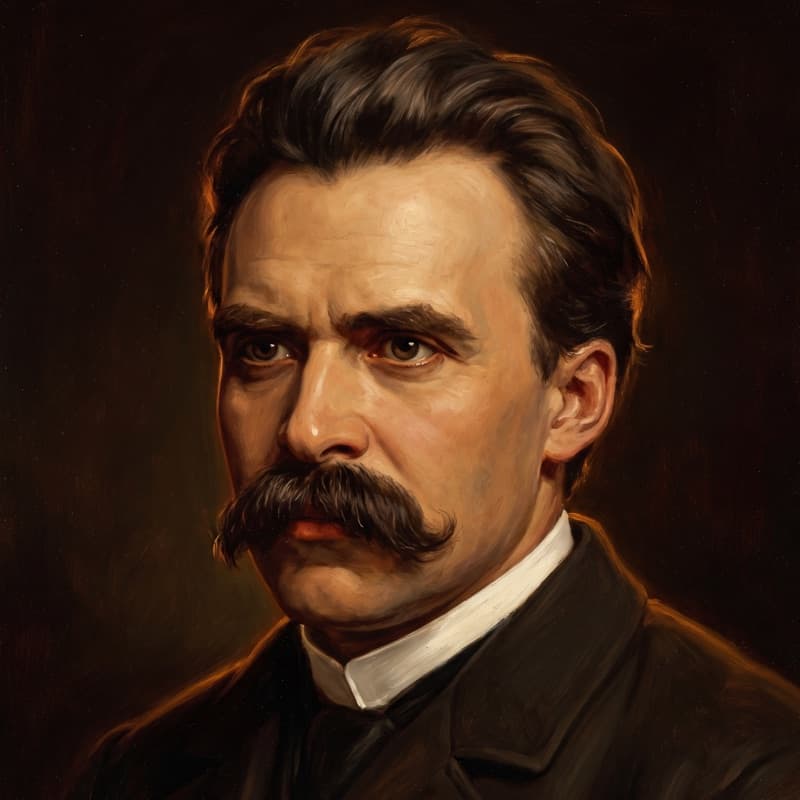
Friedrich Nietzsche died on August 25, 1900, at about noon, of a stroke complicated by pneumonia, after more than a decade of mental incapacity that began with a collapse in Turin in January 1889. He was buried beside his father at the church in Röcken, near Lützen — the same Saxon village where he had been born fifty-five years earlier.
That answers the search. What happened in between is stranger and sadder than the death date alone suggests.
The collapse in Turin
In January 1889, Nietzsche collapsed in the street in Turin. The famous version of that moment — that he saw a horse being flogged, ran to it, and threw his arms around its neck before he broke down — is, by Wikipedia's own account, "an often-repeated tale from shortly after his death," not documented biography. What actually happened that day remains unclear. Treat the horse story as legend, not fact, however vivid it is.
What is documented is what came after. Nietzsche's friend Franz Overbeck received disturbing letters, traveled to Turin, and found him in a state of mental incapacity from which he never recovered. Overbeck brought him into psychiatric care; responsibility then passed to his mother, and — after her death — to his sister Elisabeth in Weimar, who cared for him for the rest of his life. The philosopher who had spent the previous decade writing in mountain solitude spent his last eleven years largely silent, in the custody of others.
His sister's editorial hand
While Nietzsche was incapable of objecting, Elisabeth took control of his literary estate. After his death she assembled a selection from his notebooks and published it as The Will to Power — a title and shape he never chose and never approved. It is not a finished book he completed and released; it is a posthumous compilation, and scholarship treats her own political commitments as a real distorting influence on the selection. Readers who meet The Will to Power as Nietzsche's own final system are meeting his sister's arrangement of his notes, not his last word.
Death and burial
Nietzsche's decline stretched across roughly a decade before it ended. He died on August 25, 1900, at about noon, of a stroke complicated by pneumonia — buried beside his father at the church in Röcken, near Lützen, a return to the Lutheran parsonage world he had spent his adult life writing against.
What he never knew
Nietzsche's silence after Turin meant he never learned what became of his name. He never knew the readership his books would find, never saw his notebooks reshaped by his sister into a widely read "final philosophy," and never lived to see the causes that would later misuse his language of strength and self-overcoming — including the antisemitic politics that had estranged him from that same sister years earlier. He went silent still believing, if he believed anything by then, in the work he had actually written, not the version built once he could no longer object.
From a conversation with our Nietzsche
An excerpt from a conversation with our AI Nietzsche persona — a stylized recreation, honestly labeled, not a historical quotation. Our Nietzsche's knowledge ends before the Turin collapse.
Caller: Are you afraid of being misunderstood after you're gone?
Nietzsche: Afraid? No — misunderstanding is the tax any unfashionable thought pays to be read at all. What I would guard against is worse than misunderstanding: being finished by someone else's hand, arranged into a system I never signed. A thinker who writes in fragments does so on purpose. Let the fragments stay fragments, or let them be argued with. Do not let them be tidied.
Ask him about the part he did see
Our Nietzsche — an AI recreation, built from the historical record and clearly labeled as such — can't tell you about Turin; his knowledge ends before the collapse. He can tell you about what led there: the mountain summers in Sils-Maria, the break with Wagner, the ferocious productivity of 1888. Start the conversation whenever you're ready.
More in this cluster: Nietzsche's verified quotes · his biography · fact file · back to the Nietzsche hub.