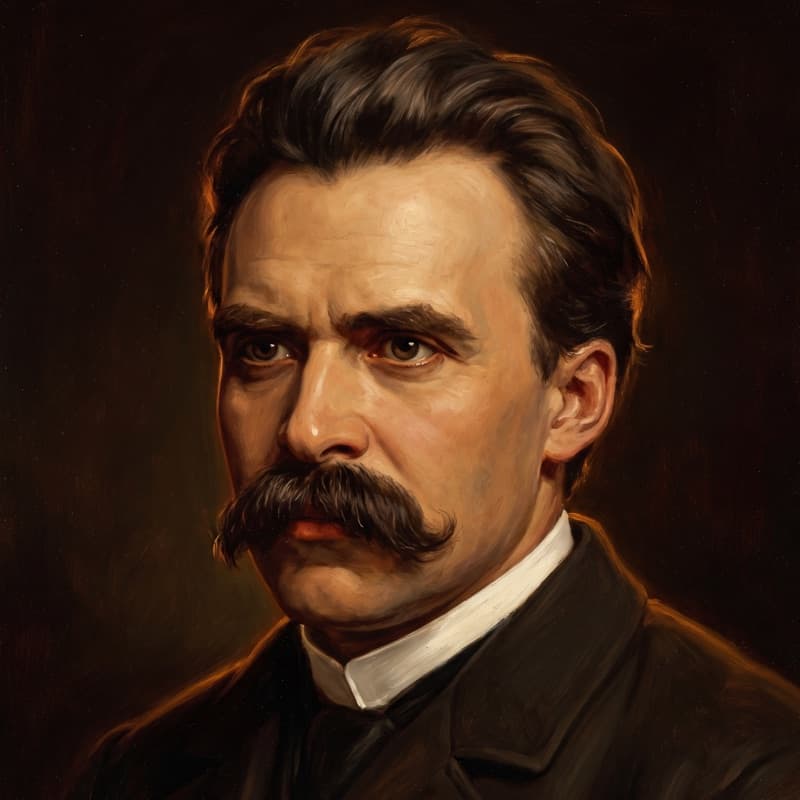
Friedrich Nietzsche's most quoted lines are also his most mangled. "That which does not kill me, makes me stronger" comes from Twilight of the Idols (1888). "He who fights with monsters should be careful lest he thereby become a monster" comes from Beyond Good and Evil (1886). "I teach you the Superman" comes from Thus Spake Zarathustra (1883–85). All three are genuine, traced here to a specific book, section, and public-domain translation. Just as important, a few of the internet's favorite "Nietzsche quotes" don't say what the memes claim — this page marks those too.
The military school of life
In the aphoristic Twilight of the Idols, Nietzsche wrote the line that has since drifted from philosophy shelf to gym wall:
"That which does not kill me, makes me stronger."
Its original heading, "From the military school of life," is worth keeping in mind. Nietzsche meant it as a hard-won maxim about adversity met head-on, not a general-purpose self-help slogan.
The abyss looks back
From the aphorisms of Beyond Good and Evil:
"He who fights with monsters should be careful lest he thereby become a monster. And if thou gaze long into an abyss, the abyss will also gaze into thee."
A warning about the cost of struggle, not a boast about winning it.
The Superman, misread and correctly read
Thus Spake Zarathustra opens with Zarathustra descending from the mountains to declare:
"I teach you the Superman. Man is something that is to be surpassed."
Stripped of the book's context, this line has been twisted into a race-biology doctrine it was never intended as. In Zarathustra's mouth it is an ideal of self-overcoming — surpassing the human as it currently is, not a claim about which humans deserve to exist.
Lighter aphorisms
Nietzsche could be playful as well as thunderous:
"Without music life would be a mistake."
"If a man knows the wherefore of his existence, then the manner of it can take care of itself."
That second line is often paraphrased online as "he who has a why to live can bear almost any how" — a phrasing popularized by Viktor Frankl's paraphrase of Nietzsche, not Nietzsche's own sentence. The line above, from the Ludovici translation of Twilight of the Idols, is the one he actually wrote.
Chaos and the dancing star
Also from Zarathustra's prologue:
"I tell you: one must still have chaos in one, to give birth to a dancing star."
A line about the necessity of inner disorder for anything genuinely created.
"God is dead" — carefully
The Joyful Wisdom §125 stages a madman running into a marketplace to announce that humanity has killed God — a parable about the collapse of Christianity's cultural authority, not a triumphant personal declaration of atheism, per the Stanford Encyclopedia of Philosophy. We describe the scene rather than quote it verbatim here, and treat any version you see quoted online with the same caution SEP urges: read it as diagnosis, not celebration.
What he probably didn't write quite like that
- "There are no facts, only interpretations" is a late-notebook formulation, not a clean line from a published book. Scholarship traces it and complicates the popular, post-truth-flavored reading of it — see Studia Philosophica Estonica.
- "He who has a why to live for can bear with almost any how" is Viktor Frankl's paraphrase of Nietzsche's actual sentence above, not Nietzsche's own wording.
Hear him argue it himself
An excerpt from our AI Nietzsche persona — a stylized recreation, clearly labeled; not a historical quotation.
Caller: Did you mean for people to quote "what doesn't kill you" on gym walls?
Nietzsche: Gym walls! No — I meant it as a soldier means a scar, not a slogan for a man lifting iron for pleasure. The maxim keeps its edge only in hardship freely met. Sand it down to decoration and you have killed the thought while keeping the words.
More in this cluster: Nietzsche hub · his death · biography · facts.