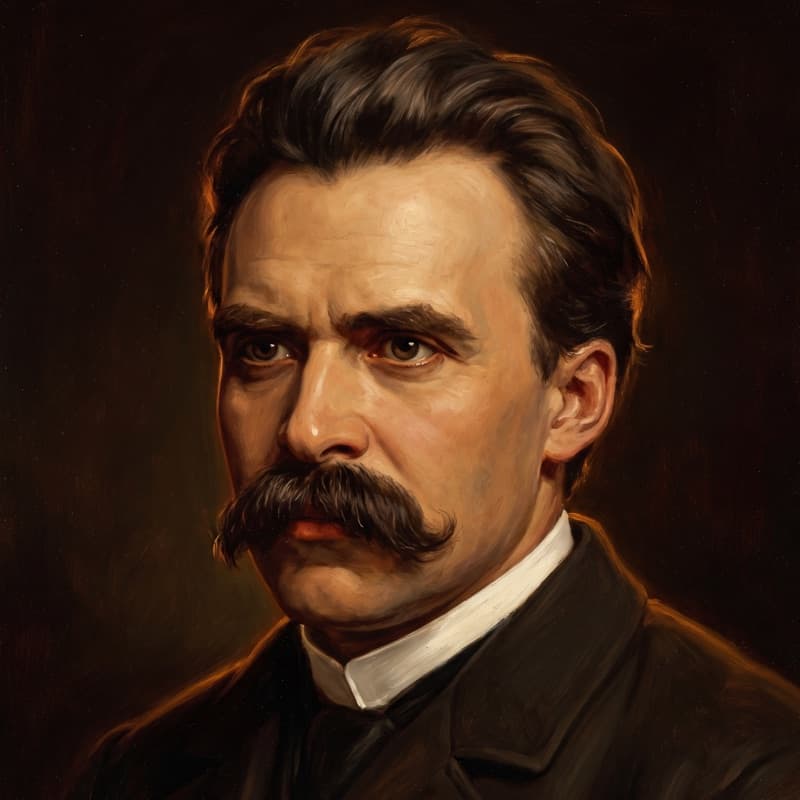
Friedrich Nietzsche was born on October 15, 1844, in Röcken, near Leipzig, the son of a Lutheran minister who died in 1849, when Friedrich was still a small child. He died on August 25, 1900, in Weimar, of a stroke complicated by pneumonia, after more than a decade of incapacity that began with a collapse in a Turin street in January 1889. Between those two points runs one of philosophy's strangest careers: a prodigy of classical philology who abandoned the academy for a nomadic, largely unread independence, writing his way toward fame in years he was no longer well enough to know it was arriving.
A parsonage childhood, then Bonn and Leipzig
Nietzsche's early years were shadowed by loss before they were shadowed by philosophy — his father's 1849 death fell inside a household already built around Lutheran gravity. He studied theology and classical philology first at Bonn, then Leipzig, training under the philologist Friedrich Wilhelm Ritschl and forming a lasting friendship with fellow student Erwin Rohde.
A chair at twenty-four, and the Wagner circle
Ritschl's backing helped put Nietzsche, at just 24, into the chair of classical philology at the University of Basel in May 1869 — the youngest person appointed to such a post there. Basel also placed him near Richard and Cosima Wagner, and the friendship formed at their home at Tribschen shaped his first book, The Birth of Tragedy (1872), a meditation on tragedy and Wagnerian music-drama that scandalized his own field. The friendship did not survive the decade; by 1878 it had effectively ended.
Illness, resignation, and the wandering decade
Service as a medical orderly in the Franco-Prussian War of 1870–71 left Nietzsche with diphtheria and dysentery, an early marker of the chronic headaches, nausea, and failing eyesight that would define his adult life. Ill health forced his 1879 resignation from Basel; he spent the rest of his working life as an independent writer, wintering in Genoa, Nice, and Turin and summering, from 1881 to 1888, in Sils-Maria in the Swiss Engadine. There, near Surlei, he arrived at the idea of eternal recurrence in August 1881. In 1882 he proposed marriage to Lou Salomé through his friend Paul Rée, then directly; she refused him.
These wandering years produced the books he is remembered for: Thus Spake Zarathustra (1883–85), Beyond Good and Evil (1886) — carrying a warning already in print: "He who fights with monsters should be careful lest he thereby become a monster. And if thou gaze long into an abyss, the abyss will also gaze into thee." — and On the Genealogy of Morality (1887). In 1888, his final lucid year, he worked at startling speed, finishing Twilight of the Idols, The Case of Wagner, The Antichrist, and his autobiography Ecce Homo — four books from a man who, months later, would write no more.
From a conversation with our Nietzsche
An excerpt from a conversation with our AI Nietzsche persona — a stylized recreation, honestly labeled; not a historical quotation.
Caller: Did the isolation ever feel like failure?
Nietzsche: Only to those who mistake a crowded room for proof of anything. I left the lecture hall because it had nothing left to teach me, and found instead mountains, and the discipline of my own bad health.
What came after him
Nietzsche collapsed in Turin in January 1889, found by his friend Franz Overbeck in a state of mental incapacity from which he never recovered; his last eleven years were spent in the care first of his mother, then of his sister Elisabeth — the same sister he had broken with over her 1886 marriage to an antisemitic agitator. He never learned what the century after would make of his name.
Continue the conversation — literally
You have just read the recorded life. Our Nietzsche — an AI recreation, built on the sourced record and labeled as what it is — speaks from inside it. Ask him why he broke with Wagner, or what Sils-Maria meant to a man who could no longer trust a lecture hall.
More in this cluster: Nietzsche hub · his death · verified quotes · facts.