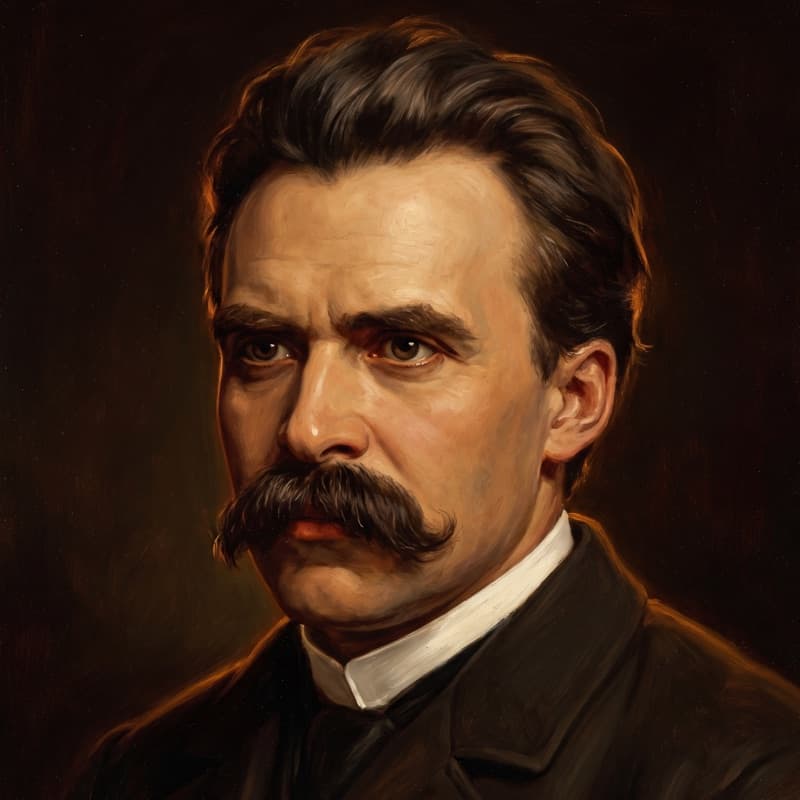
Every Friedrich Nietzsche fact on this page is checked against the Stanford Encyclopedia of Philosophy, Wikipedia, or a primary institutional source, with the citation shown inline. The short version: born October 15, 1844, in Röcken, near Leipzig, the son of a Lutheran minister who died when Nietzsche was four; appointed to the Basel chair in classical philology at 24, the youngest ever; resigned in 1879 amid chronic illness and became a wandering independent writer; collapsed in Turin in January 1889 and never recovered; died August 25, 1900. Details and sources below, followed by corrections to three claims that circulate as his but distort what he actually argued.
Ten verified facts
- Born October 15, 1844, in Röcken, near Leipzig; his father, a Lutheran minister, died in 1849, when Nietzsche was not yet five (Stanford Encyclopedia of Philosophy).
- Appointed to the chair of classical philology at the University of Basel in May 1869, at age 24 — the youngest person ever appointed to that chair (Stanford Encyclopedia of Philosophy).
- His first book, The Birth of Tragedy, appeared in 1872, a controversial intervention in classical scholarship and a meditation on tragedy and Wagnerian music drama (Stanford Encyclopedia of Philosophy).
- He served in the Prussian forces during the Franco-Prussian War (1870–71) as a medical orderly and contracted diphtheria and dysentery during his service (Wikipedia).
- His close friendship with Richard and Cosima Wagner, formed as a student in Leipzig, had effectively ended by 1878 (Stanford Encyclopedia of Philosophy).
- Ill health forced him to resign the Basel professorship in 1879, after which he lived as an independent writer, moving seasonally between Sils-Maria in summer and Genoa, Nice, or Turin in winter (Stanford Encyclopedia of Philosophy).
- He returned to Sils-Maria in the Upper Engadine every summer from 1881 through 1888, calling it, in his own words, "my proper refuge and home" (Nietzsche-Haus museum).
- In 1882 he proposed marriage to Lou Salomé — first through his friend Paul Rée, then again directly in Lucerne — and was rejected both times (Wikipedia).
- In 1886 his sister Elisabeth married the antisemitic agitator Bernhard Förster, and the couple later travelled to Paraguay to found the "Germanic" colony Nueva Germania (Wikipedia).
- 1888 was his most productive year as an independent writer — he completed Twilight of the Idols, The Case of Wagner, The Antichrist, and his autobiography Ecce Homo — before collapsing in Turin in January 1889 and dying on August 25, 1900, of a stroke complicated by pneumonia (Stanford Encyclopedia of Philosophy).
Three circulating claims, corrected
"God is dead" as Nietzsche's personal, triumphant atheism. The line is genuine, but in The Joyful Wisdom it is spoken by a madman, and scholarship treats it as a diagnosis of the collapsing cultural authority of Christian belief and the resulting problem of value — not a cheerful personal announcement (Stanford Encyclopedia of Philosophy).
"The Will to Power is Nietzsche's completed final system." It isn't. After his 1889 collapse, his sister assembled a notebook selection under that title; the editorial construction does not represent a book Nietzsche finished or approved in that form (Stanford Encyclopedia of Philosophy).
"There are no facts, only interpretations" as a license for post-truth relativism. The popular slogan flattens a late-notebook formulation into something Nietzsche never quite argued; a close scholarly reading finds him building varied interpretational and argumentative standards, not declaring that any interpretation is as good as any other (Studia Philosophica Estonica).
Frequently asked, quickly answered
Was Nietzsche a Nazi, or did he influence Nazism? He didn't live to see it, and the record points the other way at home: his own sister married an antisemitic agitator in 1886 and left for Paraguay to found a "Germanic" colony, a union that strained his relationship with her (Wikipedia). It was that same sister who later controlled his papers and assembled The Will to Power after his collapse — the editorial hand behind much of his posthumous reputation (Stanford Encyclopedia of Philosophy).
Why did he leave his professorship? Chronic ill health — he suffered severe headaches, nausea, and failing eyesight for most of his adult life, which modern scholarship suggests may have been aggravated by a slow-growing tumor behind his right eye — made the 1879 resignation from Basel unavoidable (Stanford Encyclopedia of Philosophy).
Where did he actually write his books? Mostly on the move: Sils-Maria in summer, the Mediterranean coast in winter, with no fixed academic post after 1879 — an independent, itinerant existence for the rest of his working life (Stanford Encyclopedia of Philosophy).
Related pages
Nietzsche hub · his death · verified quotes · biography.
For what a fact list can't settle — how a pastor's son from Röcken became the philologist who dismantled inherited morality, what the fracture with Wagner actually felt like, why a chronically ill wanderer wrote his most explosive books in his final lucid year — this site hosts a conversational AI recreation of Nietzsche, grounded in the sources cited above and labeled plainly as an AI persona. The facts are here; the voice is a conversation away.