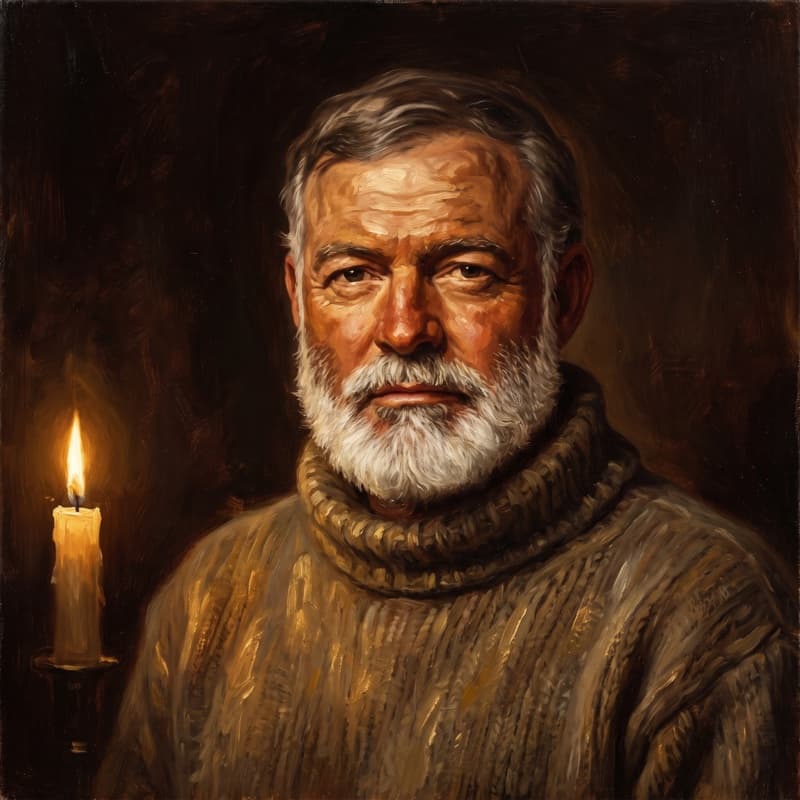
Ernest Hemingway's most reliably verified lines come straight from the fiction: the opening sentence of A Farewell to Arms, the "gradually and then suddenly" exchange from The Sun Also Rises, that novel's closing line. Just as important: two of the internet's favorite "Hemingway quotes" — "write drunk, edit sober" and the one about sitting at a typewriter and bleeding — have no real evidence behind them. Both lists follow, in the order the books appeared.
1925: In Our Time
The trout passage that opens "Big Two-Hearted River" shows the plain, watchful style whole:
"Nick looked down into the clear, brown water, colored from the pebbly bottom, and watched the trout keeping themselves steady in the current with wavering fins."
From "Cat in the Rain," the same collection's more clipped register:
"'A cat?' the maid laughed. 'A cat in the rain?'"
1926: The Sun Also Rises
The novel's most quoted exchange, on how a man goes broke:
"How did you go bankrupt?" Bill asked. "Two ways," Mike said. "Gradually and then suddenly."
And its last line, Jake Barnes answering Brett Ashley:
"Yes," I said. "Isn't it pretty to think so?"
1927: Men Without Women
From "Hills Like White Elephants," a story built almost entirely out of dialogue:
"They look like white elephants," she said.
"I've never seen one," the man drank his beer.
"In Another Country" opens on the same understated note:
"In the fall the war was always there, but we did not go to it any more."
1929: A Farewell to Arms
The novel's first sentence, and its most-quoted line of reflection near the end:
"In the late summer of that year we lived in a house in a village that looked across the river and the plain to the mountains."
"The world breaks everyone and afterward many are strong at the broken places."
"Grace under pressure" — a line he didn't quite claim
Hemingway is reported to have used the phrase "courage is grace under pressure" in a 1929 interview with Dorothy Parker for The New Yorker. The line resurfaced when John F. Kennedy wanted to open Profiles in Courage (1956) with it — Kennedy's staff asked Hemingway to confirm where it came from, Hemingway's own office couldn't place it, and editor Evan Thomas eventually traced it back to the Parker profile. It's a real Hemingway phrase with a documented paper trail, but the exact original wording hasn't been checked against a primary 1929 text — treat it as reported speech, not a locked quotation.
From a conversation with our Hemingway
An excerpt from our AI Hemingway persona — a stylized recreation, clearly labeled; not a historical quotation.
Caller: Which of your own sentences do you think will last?
Hemingway: The short ones, if any of them do. I cut everything I could stand to cut, and what's left over is what a sentence needs and no more — a bankruptcy joke, a man watching a trout hold steady in the current. Nobody remembers the sentences dressed up for company. They remember the ones that were doing actual work.
A line people think is his — and isn't
For Whom the Bell Tolls (1940) takes its title and epigraph from John Donne, not from Hemingway's own words:
"No man is an Island, intire of it selfe... never send to know for whom the bell tolls; It tolls for thee."
Hemingway borrowed it from Donne's 1624 Devotions upon Emergent Occasions. He titled a novel from it; he didn't write it.
Quotes Hemingway never wrote
- "Write drunk, edit sober." No evidence this appears anywhere in Hemingway's output. The earliest traceable version is a line of dialogue in Peter De Vries's 1964 novel Reuben, Reuben, published three years after Hemingway died (Quote Investigator).
- "There is nothing to writing. All you do is sit down at a typewriter and bleed." No substantive evidence connects this to Hemingway; the earliest Hemingway attribution appears in a 1973 self-help book, twelve years after his death, once the line was already circulating under other names (Quote Investigator).
Notice the pattern: the fakes are writing-advice aphorisms, tidy enough for a poster. The verified lines are working sentences pulled out of scenes — a bankruptcy joke, a soldier's understatement, a fisherman watching a current. If a "Hemingway quote" sounds like a poster, be suspicious.
More in this cluster: Hemingway hub · his death · biography · facts.