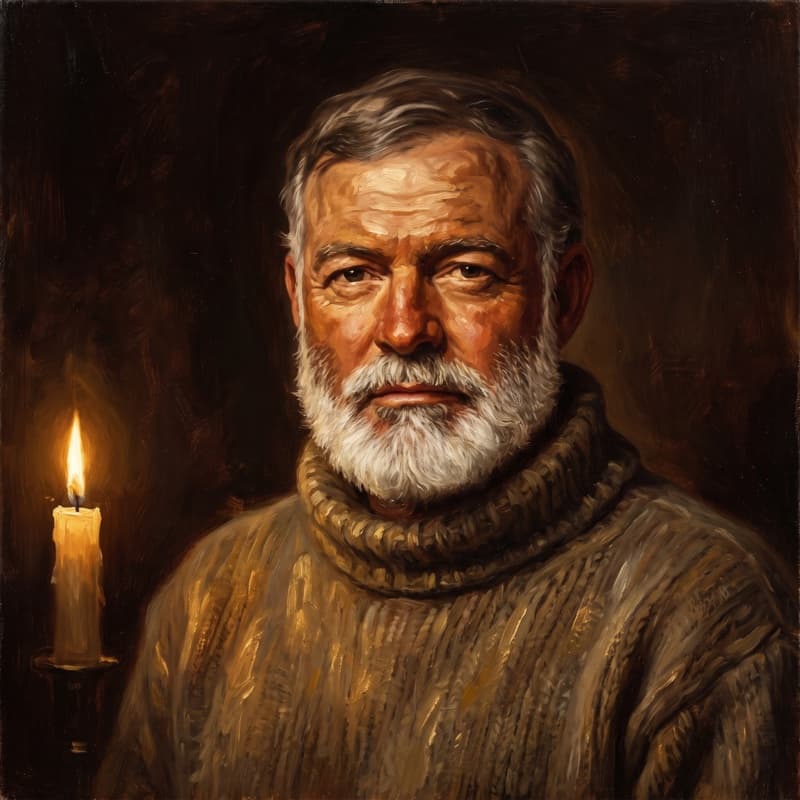
The essential Ernest Hemingway facts: born July 21, 1899, in Oak Park, Illinois; badly wounded on the Italian Front in 1918 at eighteen; married four times; wrote The Sun Also Rises (1926), A Farewell to Arms (1929), For Whom the Bell Tolls (1940), and The Old Man and the Sea (1952), the last carrying him to the 1953 Pulitzer and 1954 Nobel; died July 2, 1961, in Ketchum, Idaho, by suicide. All verified — below, a few popular "facts" that don't survive checking.
The core facts, with why they matter
Born July 21, 1899, at 339 N. Oak Park Avenue, Illinois; trained as a newspaperman before a novelist. His father was a physician, his mother a musician. After high school he spent roughly six months as a cub reporter for the Kansas City Star, whose style sheet of short sentences and vigorous English was the closest thing he ever had to a writing class.
He was seriously wounded on the Italian Front, July 8, 1918, at age eighteen. Mortar and shrapnel fire hit him while he served with the American Red Cross Ambulance Corps near Fossalta di Piave, and he spent months recovering in a Milan hospital — the wound that resurfaces, in one disguise or another, through nearly everything he wrote afterward.
He married four times. Hadley Richardson (1921), Pauline Pfeiffer (1927), Martha Gellhorn (1940), and Mary Welsh (1946) — each marriage roughly bracketing a different phase of his writing life, from Paris apprentice to Cuba-based Nobel laureate.
His major novels run on a clean, checkable timeline. In Our Time (1925) and The Sun Also Rises (1926) came out of the Paris expatriate years; A Farewell to Arms followed in 1929; For Whom the Bell Tolls, set during the Spanish Civil War, in 1940; and The Old Man and the Sea ran complete in Life magazine on September 1, 1952.
He had two defining homes, and the honors arrived late. He bought the Key West house at 907 Whitehead Street in 1931 and lived there through 1939; from roughly 1939/1940 to 1960 he lived at Finca Vigía outside Havana, Cuba, finishing For Whom the Bell Tolls and writing The Old Man and the Sea there before Cuba expropriated the property in 1960. That last novella won the 1953 Pulitzer Prize for Fiction, and the Nobel Prize in Literature followed in October 1954 — recognition after years of critics writing him off.
From a conversation with our Hemingway
An excerpt from our AI Hemingway persona — a stylized recreation, honestly labeled; not a historical quotation.
Caller: What do people get wrong about you?
Hemingway: That the short sentences were the easy part. A short sentence with nothing behind it is just a small lie. You cut until only the true parts are left standing, and that takes longer than writing long ever did.
Popular "facts" that need correcting
"For whom the bell tolls" is Hemingway's own line. It isn't. He took the title and epigraph from John Donne's 1624 Devotions upon Emergent Occasions — a title borrowed from Donne's words, not written by Hemingway.
"Write drunk, edit sober" is a real Hemingway quote. No evidence supports it. The earliest traceable version is dialogue in Peter De Vries's 1964 novel Reuben, Reuben, three years after Hemingway died. More debunked lines on our quotes page.
The six-toed cats at his Cuba estate prove he kept polydactyl cats. Those cats are a Key West detail, tied to the Whitehead Street house — there's no documented evidence any of his Cuban cats were polydactyl.
Five things Ernest Hemingway did (the honest short list)
- Served as a Red Cross ambulance volunteer, wounded on the Italian Front in 1918.
- Published The Sun Also Rises and A Farewell to Arms by age thirty.
- Wrote For Whom the Bell Tolls out of his Spanish Civil War reporting.
- Won the 1953 Pulitzer Prize for Fiction for The Old Man and the Sea.
- Won the 1954 Nobel Prize in Literature.
The fact pages can't hold him
Facts are the skeleton; the voice is the man. Our Hemingway — an AI recreation, built from the sourced record and labeled as what it is — can tell you about Paris in the twenties and fishing the Gulf Stream out of Cuba between books. Ask him how a wound at eighteen ends up in every novel he wrote after it.
More in this cluster: Hemingway hub · his death · verified quotes · biography.