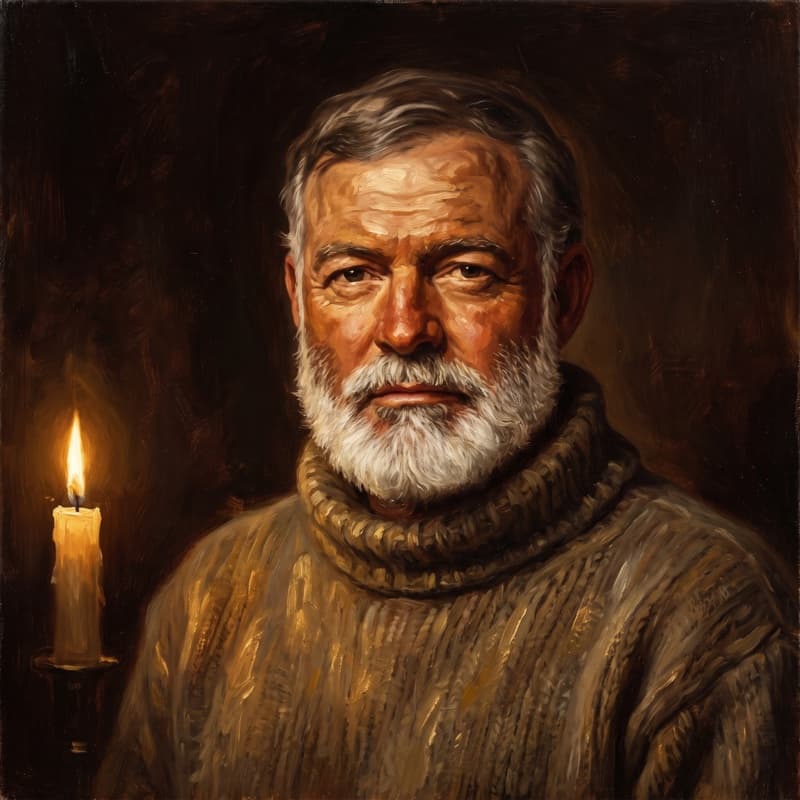
Ernest Hemingway died on July 2, 1961, at his home in Ketchum, Idaho, by suicide. He was 61, about three weeks short of his 62nd birthday. The death closed out a life that had carried him from a doctor's household in Oak Park, Illinois, through two world wars, four marriages, and a body of fiction that changed how English prose could sound.
That answers the immediate question. What came just before it, and what the record does and doesn't actually support about it, is worth a few more minutes.
From a bad review to the Nobel Prize
The years just before his death traced an unusually steep arc. His 1950 novel, Across the River and Into the Trees, met, by most accounts, the coldest reviews of his career — a hard landing for a writer who had spent three decades as the standard other novelists were measured against. Two years later came The Old Man and the Sea, serialized complete in Life magazine on September 1, 1952, and published in book form by Scribner's a week after that. It won him his first Pulitzer Prize for Fiction on May 4, 1953, and helped carry him to the Nobel Prize in Literature the following October. Harsh failure and the two largest honors in American letters, arriving within four years of each other — public triumph running on one clock, whatever was happening privately running on another.
What were his last words?
There is no reliable, verifiable account of what Hemingway said in his final moments, despite lines that circulate online as his "last words." The honest answer is the one the record actually supports: the date, July 2, 1961, and the place, his home in Ketchum, Idaho. Anything more specific than that is invention dressed up as biography.
The manuscript he left unfinished
In his last working years, Hemingway had been shaping a memoir out of notebooks from his 1920s Paris years — the Hadley years, the poverty, Gertrude Stein and Ezra Pound reading over his shoulder. He did not live to see it published. It reached readers posthumously, in 1964, as A Moveable Feast: not the last thing he ever wrote, but the last one that mattered enough to him that other hands finished bringing it into the world.
From a conversation with our Hemingway
An excerpt from a conversation with our AI Hemingway persona — a stylized recreation built from the historical record, honestly labeled, not a historical quotation.
Caller: How do you want people to think about the end of the story?
Hemingway: Not as the whole story, if you can help it. A man writes for forty years, and one bad winter doesn't erase the sentences that came before it. I'd rather you thought about the trout in the river, the wound outside Fossalta, the boat going out past the reef. The last chapter happened. It isn't the book.
Ask him about the years before
Our Hemingway — an AI recreation, built from the historical record and labeled as what it is — can't tell you about that last winter in Ketchum; his knowledge is built from the work and the life that came before it. But he can talk about the Kansas City newsroom that taught him short sentences, the mortar wound outside Fossalta di Piave at eighteen, the Paris years with Hadley, and the fishing off Cuba that fed The Old Man and the Sea. Start the conversation whenever you're ready.
More in this cluster: Hemingway's verified quotes · his biography · fact file · back to the Hemingway hub.