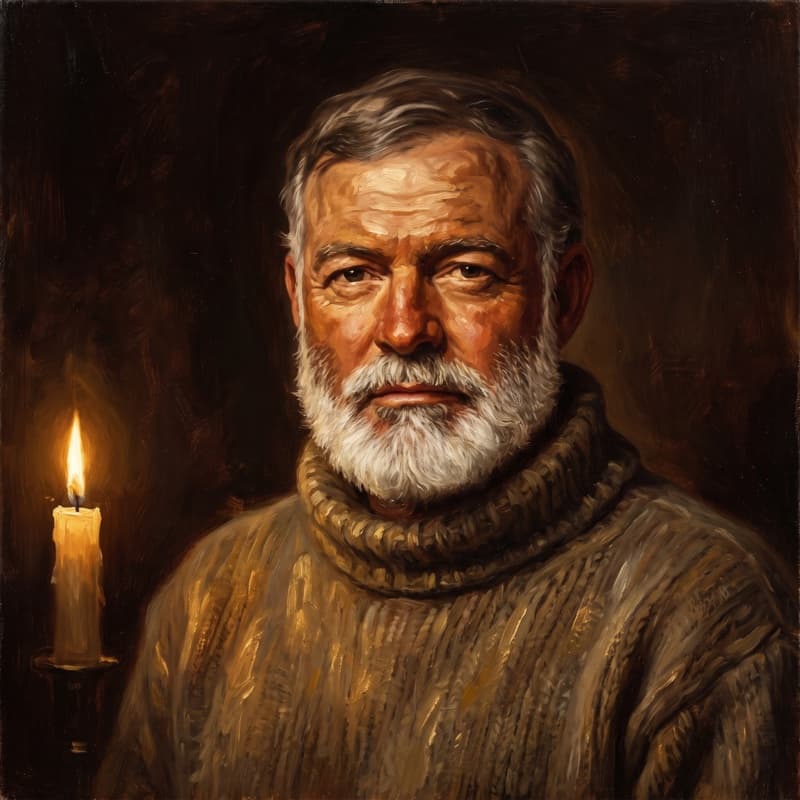
Ernest Hemingway was born on July 21, 1899, in Oak Park, Illinois — the second of six children, son of a physician and a musician. He died on July 2, 1961, in Ketchum, Idaho, by suicide. Between those two facts sits one of the most imitated prose styles in the language and a Nobel Prize that arrived only after the critics had written him off.
A reporter, then a wound
Hemingway left high school in 1917 and spent roughly six months as a cub reporter for the Kansas City Star, whose style sheet — short sentences, vigorous English, no unnecessary words — marked his prose for decades. That December he volunteered for the Red Cross Ambulance Corps, reached Paris by May 1918, and was deployed to the Italian Front the next month. On July 8, 1918, at Fossalta di Piave, mortar and shrapnel fire wounded him seriously; he was eighteen. Italy decorated him with the War Merit Cross and the Silver Medal of Military Valor; he recovered roughly six months in a Milan hospital.
From a conversation with our Hemingway
An excerpt from a conversation with our AI Hemingway persona — a stylized recreation, honestly labeled; not a historical quotation.
Caller: Did the war change what you wanted to write about?
Hemingway: It changed what I'd trust on a page. Before Fossalta a man can write a fine sentence about courage without knowing what it costs. After it, you want the true one instead — nothing dressed up to look brave. The dressed-up sentence is usually the one that's lying to you.
Paris, and the breakthrough
He married Hadley Richardson on September 3, 1921, and settled into threadbare expatriate Paris — Gertrude Stein and Ezra Pound reading his drafts, F. Scott Fitzgerald a friend alongside them. In Our Time appeared in 1925 and The Sun Also Rises followed from Scribner's in October 1926 — the novel whose Chapter XIII gives Mike's answer to how a man goes bankrupt: "Gradually and then suddenly." A Farewell to Arms came three years later, on September 27, 1929, opening with as spare a sentence as he ever wrote: "In the late summer of that year we lived in a house in a village that looked across the river and the plain to the mountains." Its closing pages hold what may be his most quoted line: "The world breaks everyone and afterward many are strong at the broken places."
Key West, Spain, and a second marriage
Hemingway divorced Hadley in January 1927 and married Pauline Pfeiffer that May. In 1931 the couple bought the house at 907 Whitehead Street in Key West and lived there through 1939, years that also carried him to Spain as a war correspondent — work that fed For Whom the Bell Tolls, published October 1940. Its title and epigraph belong to John Donne's 1624 Devotions upon Emergent Occasions; Hemingway borrowed the line, not the words.
Finca Vigía and the late prize
By 1939 Hemingway had moved to Cuba, first renting and then, in December 1940, buying the Finca Vigía outside Havana, near the fishing village of Cojímar. He married Martha Gellhorn on November 20, 1940, then Mary Welsh in 1946. At the Finca he finished For Whom the Bell Tolls and wrote The Old Man and the Sea, which ran complete in Life on September 1, 1952, reportedly selling 5.3 million copies in two days. It won the Pulitzer Prize on May 4, 1953, and carried him, in October 1954, to a Nobel Prize that had looked unlikely years earlier. Cuba's government expropriated the Finca in fall 1960.
Ketchum
His final months were spent in Ketchum, Idaho, where he died on July 2, 1961 — a harder story told separately rather than tacked onto the end of this one.
Continue the conversation — literally
You have just read the recorded life. Our Hemingway — an AI recreation, built on the sourced record and labeled as what it is — speaks from inside it. Ask about the Star's style sheet, Paris, or the Finca's fishing boat.