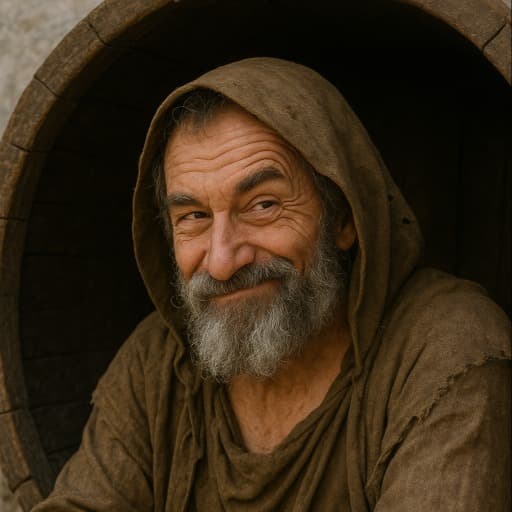
Diogenes of Sinope died at Corinth around 323 BCE — and the honest answer to how is that no single account can be trusted over the others. The one substantial ancient source, Diogenes Laertius's Lives of Eminent Philosophers, was written roughly 500 years after the fact, and even it preserves at least four incompatible traditions about the death rather than settling on one. A hub that picked its favorite version and presented it as fact would be doing exactly what centuries of retelling already did to this man's biography. Here is what the record actually holds.
Four stories the source itself couldn't reconcile
Diogenes Laertius's own account, in Book VI, doesn't choose a cause — it lists several, apparently because no version had won out by the time he was compiling reports centuries later:
- Illness from raw octopus. One tradition says he was "seized with colic after eating an octopus raw."
- Voluntary death by holding his breath. A more dramatic version has him choosing the moment, consistent with the self-sufficiency he preached in life.
- An infected bite. A third account has him bitten on the foot while dividing a raw octopus among a pack of dogs — a detail that reads almost like a parody of his reputation as "the Dog."
- Simply found dead. The plainest version: friends found him wrapped in his cloak at the Craneum, a gymnasium at Corinth, and concluded he had deliberately stopped breathing, though nothing about the scene proves that.
Four versions, one source, no tiebreaker — the real state of the evidence, worth saying plainly rather than smoothed over for a tidier page.
The Alexander coincidence
Ancient and modern tradition both note that Diogenes's conventional death date, c. 323 BCE, is the same year usually given for Alexander the Great's death — the emperor who wanted the world and the philosopher who wanted nothing, gone the same year. But it rests on two separately uncertain conventional dates lining up, not on any source that directly connects the two deaths. Treat it as a noted coincidence, not a confirmed synchronism.
Caller: If the stories about your death can't even agree, does it matter which one is true?
Diogenes: You want it to matter more than I did. I spent a life telling men that what they fear most is mostly noise they've agreed to be frightened by together. Death was no exception. Whether it was a bad shellfish or my own held breath or simply an old dog lying down and not getting up, the lesson is the same: worry less about how the story ends and more about whether you told it honestly while you were awake for it.
— From a conversation with our Diogenes persona. This is an AI recreation speaking in character, not a historical record of his actual death.
What Corinth did with the body
Whichever account is true, the tradition agrees on what came after: admirers raised a bronze statue of a dog at his grave, and Corinth later added a marble pillar with its own dog carving and a verse epitaph — "Time makes even bronze grow old: but thy glory, Diogenes, all eternity will never destroy. Since thou alone didst point out to mortals the lesson of self-sufficingness and the easiest path of life." A strikingly warm honor for a man who spent his life mocking civic pretension.
The same source reports Diogenes's own instructions were sharper than any monument: some say he asked to be thrown out unburied, "that every wild beast might feed on him," or dropped in a ditch with a little dust over him — refusing even a grave as one more piece of vanity. Others record a rival instruction to be thrown into a river instead, so his body could still be useful to someone. Either way, it's the same argument he made all his life, delivered one last time: don't dress up the plain facts of a body, or an ending, more than they deserve.
More in this cluster: Diogenes's verified quotes · his biography · fact file · back to the Diogenes hub.