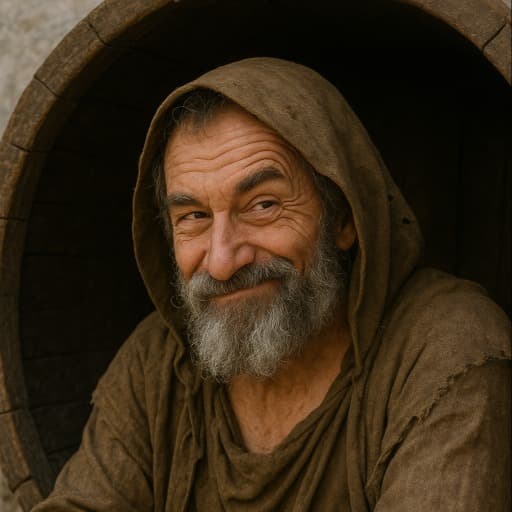
The core Diogenes of Sinope facts, stated plainly: a 4th-century BCE Cynic philosopher from Sinope on the Black Sea; exiled after his father Hicesias's coinage scandal; a resident of a pithos — a jar, not a barrel; sold into slavery in Crete to Xeniades of Corinth; the self-described "citizen of the world"; the man who reportedly told Alexander the Great to stop blocking his sun; and the subject of at least four conflicting ancient death accounts. None of it comes from a contemporary witness — Diogenes Laertius wrote roughly 500 years later, working from anecdote and hearsay. This page treats the facts as reported tradition, not settled biography, and flags what shouldn't be presented as certain.
The core facts, with why they matter
A Cynic philosopher, active in the 4th century BCE, traditionally dated to roughly 412–400 BCE. Even the birth year is uncertain — sources give a range, not a single date, which is the pattern for nearly everything about his life.
His father Hicesias was a banker at Sinope, and Diogenes went into exile after the city's coinage was debased. The source tradition isn't even internally consistent: one account has him exiled over the scandal, another has him privately admitting he adulterated the coins himself.
He reportedly lived in a pithos, not a barrel. A pithos was a large ceramic storage jar, the kind used for grain or wine, set near the Metroön in Athens — the barrel image is a later modernization of the same reported detail.
Pirates reportedly captured him at sea and sold him as a slave in Crete; Xeniades of Corinth bought him. The story inverts itself — Diogenes is said to have told the auctioneer to sell him to a man who needed a master, then ran Xeniades's household and tutored his sons, effectively in charge despite being technically owned.
Asked what country he came from, he reportedly answered that he was "a citizen of the world." Modern scholarship treats this as one of the earliest attestations of cosmopolitan self-identification in the Greek tradition.
He is said to have told Alexander the Great to stop blocking his sunlight. The wording varies by translation and by ancient source — this is one story told at least three different ways in the surviving record.
Diogenes Laertius records at least four incompatible accounts of his death at Corinth — illness from raw octopus, voluntary breath-holding, an infected dog bite, and simply being found dead wrapped in his cloak — with no agreement on which, if any, is accurate.
From a conversation with our Diogenes
An excerpt from a conversation with our AI Diogenes persona — a stylized recreation, honestly labeled; not a historical quotation.
Caller: People love the barrel story. Does it bother you that it's wrong?
Diogenes: A jar, not a barrel — the Athenians would have laughed at your carpentry. But it does not trouble me. Men remember the container and forget the point of it: that a man needs less than he thinks. Fix the noun if it pleases you. Fix the thinking that made a jar seem strange in the first place, and you'll have done something worth my time.
Popular "facts" that need correcting
"Diogenes definitely carried a lantern in daylight to search for an honest man." The report gives him the line "I am looking for a man" — the one quotation where the two major English translations agree word for word — but it is still Diogenes Laertius reporting centuries after the fact, not a witnessed event.
"Diogenes told Alexander, word for word, 'Stand out of my sunlight.'" Diogenes Laertius reports the exchange, but the wording differs across translations and even across separate ancient authors retelling the same story — treat the encounter as reported, not transcribed.
The fact pages can't hold him
These are the load-bearing facts, hedged the way an honest Diogenes page has to be — nothing here is a contemporary record. Our Diogenes, an AI recreation built from that same reported tradition and labeled as what it is, goes further: the jar, the slave block, why Alexander left that conversation the loser.
More in this cluster: Diogenes hub · his death · verified quotes · biography.